UN says aid halted to Tigray after renewed clashes

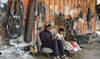
A truck, carrying grains to Tigray and belonging to the World Food Programme (WFP), burns out on a route 80 kilometers from the Semera, Ethiopia, on June 10, 2022. (AFP)
Short Url
Updated 09 September 2022
Follow

UN says aid halted to Tigray after renewed clashes

  • The resumption of fighting late last month shattered a tenuous truce agreed in March that had allowed aid convoys to travel to the stricken region’s capital Mekele for the first time since mid-December

ADDIS ABABA: Renewed clashes in northern Ethiopia have forced desperately needed aid deliveries to a halt in Tigray, the UN said, exacerbating a humanitarian crisis triggered by the nearly two-year war between pro-government forces and Tigrayan rebels.

The resumption of fighting late last month shattered a tenuous truce agreed in March that had allowed aid convoys to travel to the stricken region’s capital Mekele for the first time since mid-December.

In its first situation report since fresh clashes broke out on Aug. 24, the UN’s humanitarian agency OCHA said that the violence was “already impacting the lives and livelihood of vulnerable people, including the delivery of lifesaving humanitarian assistance.”

“The last humanitarian convoy to enter Tigray before the interruption was the humanitarian convoy on 23 August consisting of 158 trucks with humanitarian and operational supplies,” the UN’s Office for the Coordination of Humanitarian Affairs said.

“The United Nations Humanitarian Air Service flights, which had been flying between Addis Ababa and Mekele twice per week ... have also come to a halt since Aug. 26.”

Fighting erupted around Tigray’s southeastern border, but has since spread along the region’s southern border to areas west and north of the initial clashes.

The uptick in violence has sparked international concern, with the US envoy to the Horn of Africa, Mike Hammer, currently in Ethiopia to kick-start diplomatic efforts to resolve the crisis.

The two sides have traded blame for starting the latest round of hostilities, with the Tigray People’s Liberation Front accusing the government and Eritrea — which backed Ethiopian forces during the war’s early phase — of launching a joint offensive against Tigray.

Ethiopia’s northernmost region has been suffering from severe food shortages and limited access to basic services such as electricity, communications and banking.

The fighting has also hit access to aid in neighboring regions, with the OCHA report saying that “humanitarian operations in hard-to-reach areas in Amhara region, such as in parts of Wag Hemra, were put on hold due to security concerns.”

Even before the latest clashes, Tigray was in the grip of a hunger crisis, with the UN’s World Food Programme warning last month that nearly half of the region’s six million people were “severely food insecure.”

“Hunger has deepened, rates of malnutrition have skyrocketed, and the situation is set to worsen as people enter peak hunger season until this years’ harvest in October,” WFP said in its latest assessment covering November 2021 to June 2022.

The war erupted in November 2020 when Prime Minister Abiy Ahmed sent troops to topple the TPLF, the region’s former ruling party, saying the move came in response to attacks by the group on army camps.


Militants kill 6 officers and a civilian in ambushes on police vehicles in northwest Pakistan

Updated 2 sec ago
Follow

Militants kill 6 officers and a civilian in ambushes on police vehicles in northwest Pakistan

  • Assailants ambushed a police vehicle and killed one officer in Kohat — When police reinforcements arrived minutes later, they launched another attack and killed five more officers and a civilian
  • No group claimed responsibility for this week’s attacks, but suspicion may fall on the Pakistani Taliban, also known as Tehrik-e-Taliban Pakistan, or the TTP
PESHAWAR, Pakistan: A pair of attacks on police vehicles by suspected militants killed at least six police officers and a civilian in northwest Pakistan on Tuesday, authorities said.
The assailants ambushed a police vehicle and killed one officer in Kohat, a district in Khyber Pakhtunkhwa province. When police reinforcements arrived minutes later, they launched another attack and killed five more officers and a civilian, police official Kamran Khan said.
Separately on Tuesday, a suicide bomber detonated explosives at a police post in Bukkur, a district in eastern Punjab province, killing two officers and wounding four others, police official Shahzad Rafiq said.
He provided no further details and only said officers were still investigating.
No group immediately claimed responsibility for the attacks, which have increased across the country in recent months.
President Asif Ali Zardari condemned the attacks in Kohat and Bukkur and offered condolences to the victims’ families.
The latest violence followed an attack on a paramilitary post in Karak on Monday, when a drone loaded with explosives wounded several officers. The attackers later ambushed two ambulances transporting the wounded, killing three officers and burning their bodies before fleeing. The driver of the second ambulance transported several wounded officers despite suffering burn injuries and authorities recovered the remains of the three officers.
No group claimed responsibility for this week’s attacks, but suspicion may fall on the Pakistani Taliban, also known as Tehrik-e-Taliban Pakistan, or the TTP. The TTP is separate from, but closely allied with, Afghanistan’s Taliban. Islamabad has accused the group of operating from inside Afghanistan, a claim the TTP and Kabul deny.
Pakistan’s military said it killed at least 70 militants on Sunday in strikes along the Afghan border, targeting hideouts of Pakistani militants blamed for recent attacks inside the country.