Queen Elizabeth II under medical care amid health fears

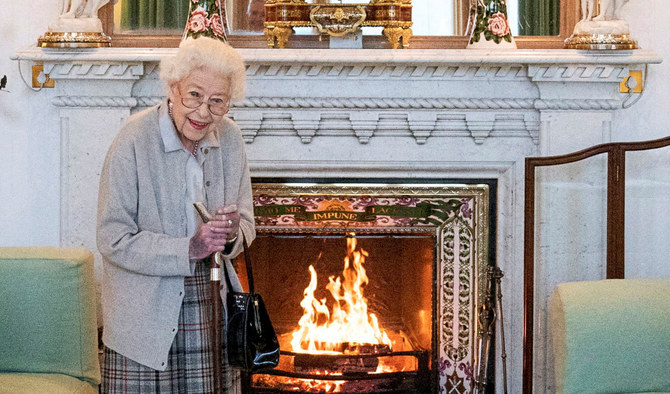
Britain's Queen Elizabeth waits in the Drawing Room before receiving Prime Minister Liz Truss at Balmoral Castle, Scotland, on September 6, 2022. (Pool via REUTERS)
Short Url
Updated 08 September 2022
Follow

Queen Elizabeth II under medical care amid health fears

  • Prince Charles, heir to the throne, and his wife, Camilla, are with the queen after traveling to Balmoral Castle, queen’s summer home
  • Elizabeth marked seven decades on throne this year, has increasingly handed duties to Charles and other members of royal family in recent months

LONDON: Queen Elizabeth II has been placed under medical supervision because doctors are “concerned for Her Majesty’s health,” Buckingham Palace said Thursday, as members of the royal family traveled to Scotland to be with the 96-year-old monarch.
The announcement comes a day after the queen canceled a virtual meeting of her Privy Council when doctors advised her to rest following a full day of events on Tuesday, when she formally asked Liz Truss to become prime minister.
“Following further evaluation this morning, the Queen’s doctors are concerned for Her Majesty’s health and have recommended she remain under medical supervision,” a palace spokesperson said, speaking on condition of anonymity in line with customary policy. “The Queen remains comfortable and at Balmoral.”
Prince Charles, the heir to the throne, and his wife, Camilla, are with the queen after traveling to Balmoral Castle, the queen’s summer vacation home, to be with her. Prince William, Charles’ eldest son, is en route.
Elizabeth marked seven decades on the throne this year. She has increasingly handed over duties to Charles and other members of the royal family in recent months as she struggled to get around.
“The whole country will be deeply concerned by the news from Buckingham Palace this lunchtime,” Truss said on Twitter.
“My thoughts — and the thoughts of people across our United Kingdom — are with Her Majesty The Queen and her family at this time.”
The Privy Council, a group of the monarch’s senior advisers, was due to formally swear in Truss and her new Cabinet members at Wednesday’s meeting. The session will be held at a later date.


US allies, foes alarmed by capture of Venezuela’s Maduro

Updated 55 min 26 sec ago
Follow

US allies, foes alarmed by capture of Venezuela’s Maduro

  • Countries such as Russia and China, which had ties with Maduro’s government, were quick to condemn the operation but alarm also shared by France and EU
  • UN Secretary-General Antonio Guterres was “deeply alarmed” by the US strikes

PARIS: The US military operation that led to the seizure of Venezuelan President Nicolas Maduro on Saturday sparked alarm across the international community, with allies and foes of Washington and Caracas expressing disquiet.
US President Donald Trump said Maduro and his wife would be taken to New York to face federal charges after military strikes and an operation which he described as looking like a “television show.”
The Venezuelan government decried what it termed a “extremely serious military aggression” by Washington and declared a state of emergency.
Countries such as Russia and Iran, which had longstanding ties with Maduro’s government, were quick to condemn the operation but their alarm was also shared by Washington’s allies including France and the EU.
Here is a rundown of the main reaction.

Russia

Russia demanded the US leadership “reconsider its position and release the legally elected president of the sovereign country and his wife.”

China

Beijing said “China is deeply shocked and strongly condemns the US’s blatant use of force against a sovereign state and its action against its president.”

Iran

Iran, which Trump bombed last year, said it “strongly condemns the US military attack on Venezuela and a flagrant violation of the country’s national sovereignty and territorial integrity.”

Mexico

Mexico, which Trump has also threatened with military force over drug trafficking, strongly condemned the US military action in Venezuela, saying it “seriously jeopardizes regional stability.”

Colombia

Colombian President Gustavo Petro — whose country neighbors Venezuela — called the US action an “assault on the sovereignty” of Latin America which would lead to a humanitarian crisis.

Brazil

Brazilian President Luiz Inacio Lula da Silva slammed the US attacks as a “serious affront” to Venezuela’s sovereignty.

Cuba

Cuba, a strong ally of Venezuela, denounced “state terrorism against the brave Venezuelan people.”

Spain

Spain offered to mediate in the crisis to find a way to a peaceful solution, while calling for “de-escalation and restraint.”

France

France condemned the US operation, saying it undermined international law and no solution to Venezuela’s crisis can be imposed from the outside.

EU

The EU more generally expressed concern at the developments and urged respect for international law, even as it noted that Maduro “lacks legitimacy.”
EU candidate country North Macedonia, along with fellow Balkan nations Albania and Kosovo, backed Washington, however.
“We stand with the United States and the Venezuelan people for freedom and democracy,” North Macedonia FM Timco Mucunski said on X.

Britain

British Prime Minister Keir Starmer said all countries should “uphold international law” and added that “the UK was not involved in any way in this operation” as he urged patience in order to “establish the facts.”

Italy

In a rare expression of support for the US operation by a major European country, far-right Italian Prime Minister Giorgia Meloni — a Trump ally — argued the US military action in Venezuela was “legitimate” and “defensive.”

Israel

Israel also hailed the operation, saying Washington acted as the “leader of the free world.”

Ukraine

Ukraine — dependent on US support in its war against invading Russia — did not address the legality of a big country like America using military force against a much smaller one like Venezuela.
Foreign minister Andriy Sybiga instead focused on Maduro’s lack of legitimacy and the Venezuelan government’s repression, while backing “democracy, human rights, and the interests of Venezuelans.”

South Africa

South Africa, which Trump accuses of alleged discrimination — and even “genocide” — of minority white Afrikaners, said: “Unlawful, unilateral force of this nature undermines the stability of the international order and the principle of equality among nations.”

UN

UN Secretary-General Antonio Guterres was “deeply alarmed” by the US strikes, with his spokesman quoting him as saying it could “constitute a dangerous precedent.”