

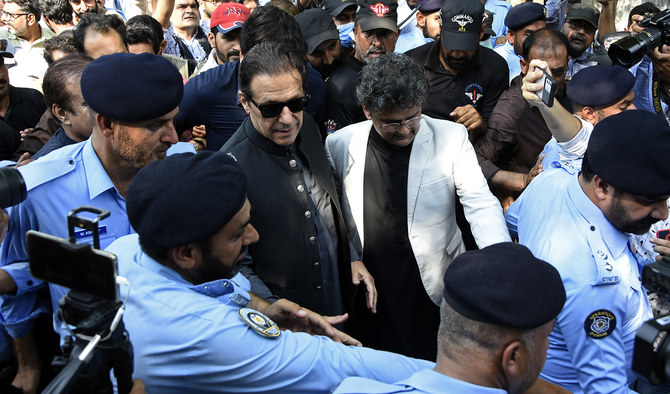

ISLAMABAD: A Pakistani court said on Thursday it was not satisfied with former prime minister Imran Khan’s response in a contempt case which he faced after making controversial remarks against a female judge last month, adding it would frame charges against him in the next hearing on September 22.
The former prime minister arrived at the Islamabad High Court (IHC) earlier in the day after his lawyers submitted a written response in the court on Wednesday wherein he expressed “deep regrets” over his criticism of the judge, Zeba Chaudhry, in an impassioned speech on August 20.
Khan had denied threatening the judge in his previous response before the first hearing of the case while offering to take back his words if they were deemed “inappropriate” by the court.
A police report on the ex-premier’s speech at a public rally in the federal capital quoted him as saying that he “would not spare” Islamabad’s police chief and the female judge since he alleged that his chief of staff, Dr. Shahbaz Gill, had been tortured after his arrest on charges of sedition. Police and prison authorities deny his allegation.
“We have unanimously found the response of the respondent [Imran Khan] in the case unsatisfactory and charges will be framed [against him] after two weeks,” Chief Justice Athar Minallah announced after holding three hours of hearing.
Pakistan’s information minister Marriyum Aurangzeb did not respond to phone calls and text messages seeking her comment on the development.
The mood at the courtroom remained tense during the proceedings as the judges raised several questions over Khan’s written response to the court.
The ex-premier kept shifting posture in his chair while rolling the rosary beads in his hand. He also consumed two half-liter bottles of water as his lawyer Hamid Khan failed to convince the judges to end the contempt proceedings against his client.
Unlike his previous appearance in the case, when he was accompanied by senior party leaders like Shah Mahmood Qureshi and Asad Umar, Khan entered the courtroom alone since security personnel did not allow any of his aides to escort him.
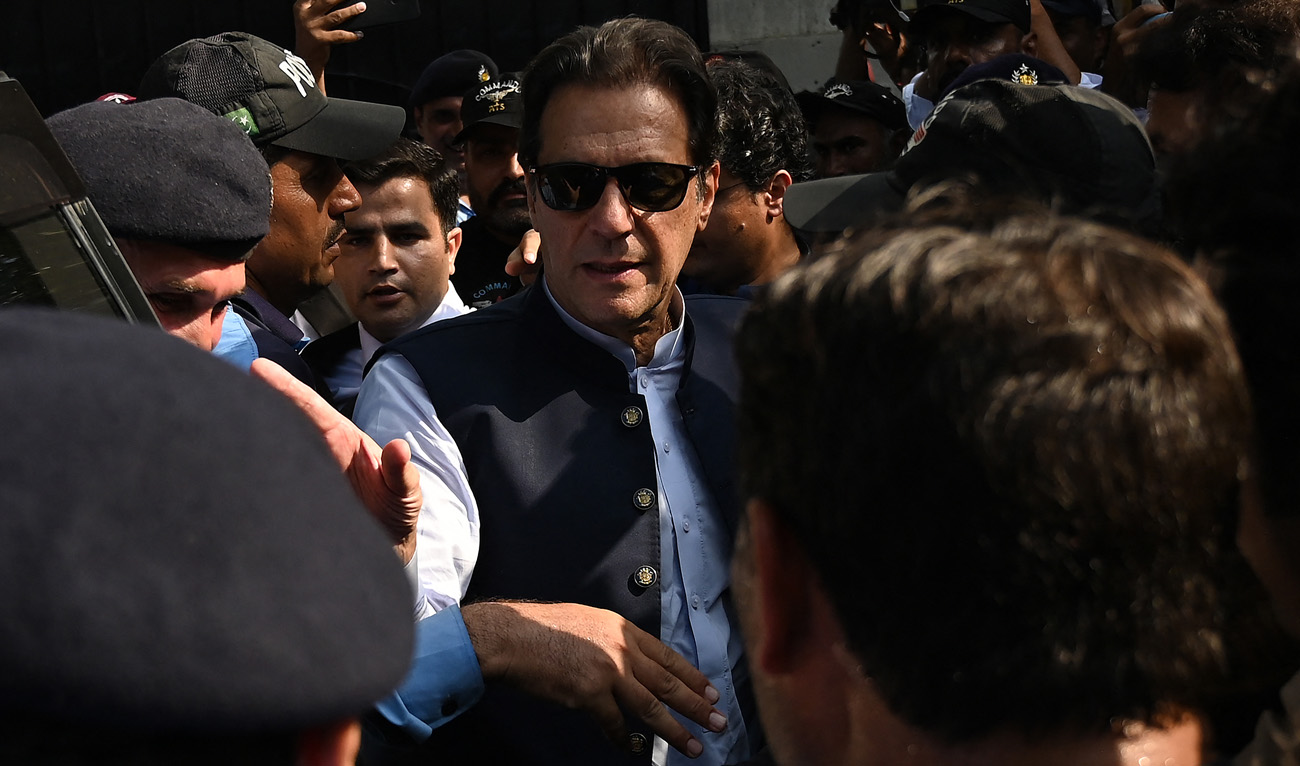
Members of security personnel escort Pakistan's former Prime Minister Imran Khan (C) as he leaves after appearing before the High Court in Islamabad on August 31, 2022. (AFP/File)
The ex-premier also expressed annoyance over heightened security in and around the court as a nearby market was closed ahead of the hearing.
“We are seeking closure of the matter,” Khan’s lawyer said at the outset of the hearing. “We seek magnanimity of the court and request forgiveness.”
The chief justice remarked it was a criminal contempt that was serious in nature as the public was incited against the judge through Khan’s speech.
“The district judiciary is a red line for the court,” he said. “The offense is extremely grave, but you don’t have realization of it.”
Khan’s lawyer tried to assure the court that the female judge would not be harmed by anybody based on his client’s statement. “We want to ensure and assure you that no harm will happen to the female judge,” he said.
Attorney General Ashtar Ausaf said the accused should have filed his written response in the court through an affidavit and sought an unconditional apology to close the case.
Two of the three amici curiae, Munir A. Malik and Makhdoom Ali Khan, urged the court to drop the contempt proceedings against the former prime minister.
“This power of contempt of court should be used sparingly and with restraint,” Malik argued. “This should be used only to strengthen the judiciary.”
Malik said the ex-premier’s words were distasteful, but courts should not get influenced by statements of politicians. “This is a messy, unpleasant, and uneasy task to haul a person for contempt of court,” he said.
Advocate Khan said public interest was involved in the dispensation of justice and free speech which had not been compromised in any way by the former prime minister’s speech.
“It is inconceivable that a statement by a politician may influence the proceedings or judgment of a court,” he said while urging the bench to discharge the show-cause notice issued to the ex-premier.
The third amicus curiae, Akhtar Hussain, said the respondent should have tendered an unconditional apology as the court had rightly issued the contempt notice.
The former PM wanted to speak in his defense during the proceedings, but he was not allowed by the court. He stood up from his chair again when the judges announced to have a five-minute break during the proceedings and told the chief justice that he wanted to explain his position, but he was refused the opportunity.
“I wanted to clarify the context of my remarks, but wasn’t allowed,” Khan told reporters in the courtroom.
Khan, who came into power in 2018 and was ousted in April in a no-confidence vote in parliament, can be disqualified for life from politics if convicted of insulting the judge.
Khan’s aide Ali Awan told the media outside the high court ahead of the hearing that the former premier would be cleared of all the “hilarious cases” against him.
“If anyone thinks they can threaten or intimidate Mr. Khan, then this will never happen,” he said. “Neither has Khan been afraid of anyone since the past 26 years nor has he bowed before anyone.”
Khan said in his latest written response to the court that he never meant to hurt the feelings of the female judge, adding he “deeply regretted” if his statement had done that.
He requested the court to end the case against him, citing the Islamic principles of forgiveness and restraint. Besides, he maintained he did not know he was commenting on a subjudice matter.
The former prime minister said he believed in the rule of law and supremacy of the constitution.


