GENEVA: The number of new coronavirus cases fell everywhere in the world last week by about 12 percent, according to the World Health Organization’s (WHO) latest weekly review of the pandemic issued Wednesday.
The UN health agency reported that there were just under 4.2 million new infections last week and about 13,700 deaths — a 5 percent drop.
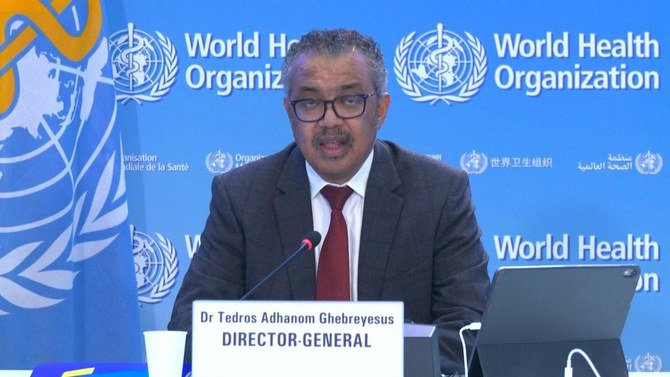
“This is very encouraging, but there is no guarantee these trends will persist,” said WHO Director-General Tedros Adhanom Ghebreyesus at a press briefing. “The most dangerous thing is to assume (that) they will,” he said. He added that even though the number of weekly reported deaths have plummeted more than 80 percent since February, one person still dies with COVID-19 every 44 seconds and that most of those deaths are avoidable.
In its pandemic report, WHO said COVID-19 deaths dropped in Southeast Asia, Europe and the Middle East, but increased in Africa, the Americas and the Western Pacific.
Maria Van Kerkhove, WHO’s technical lead on COVID-19, noted that the virus has not yet settled into a seasonal pattern and that its continued evolution will require constant surveillance and possible tweaks to diagnostics, treatments and vaccines.
Scientists warn the coronavirus will linger far into the future, partly because it is getting better and better at getting around immunity from vaccination and past infection. Experts point to emerging research that suggests the latest omicron variant gaining ground in the US — BA.4.6, which was responsible for around 8 percent of new US infections last week — appears to be even better at evading the immune system than the dominant BA.5.
In China, authorities this week locked down 65 million of its citizens under tough COVID-19 restrictions and is discouraging domestic travel during upcoming national holidays.
Across the country, 33 cities including seven provincial capitals are under full or partial lockdown covering more than 65 million people, according to a tally published late Sunday by the Chinese business magazine Caixin.
It said that outbreaks have been reported in 103 cities, the highest since the early days of the pandemic in early 2020.


WHO: COVID-19 cases drop everywhere, but pandemic not over
https://arab.news/4dfpf
WHO: COVID-19 cases drop everywhere, but pandemic not over

- The UN health agency reported that there were just under 4.2 million new infections last week and about 13,700 deaths - a 5% drop
- “This is very encouraging, but there is no guarantee these trends will persist,” said WHO’s Director-General


Isolated Kremlin critics lament lost future at Nemtsov memorial
- Hundreds used to flock to the makeshift memorial on the anniversary of his death
- Since Russia ordered troops into Ukraine it has intensified a crackdown on dissent, with almost no opposition to the Kremlin visible on the street
MOSCOW: On a bridge next to the Kremlin on a drizzly Friday morning, a lone Russian police officer stood looking at the half-dozen bunches of flowers laying in memory of slain opposition figure Boris Nemtsov.
The symbolism was almost too much.
Four years into Moscow’s full-scale offensive on Ukraine, which has seen President Vladimir Putin eradicate all forms of dissent and usher in strict military censorship laws that have silenced his critics, few Russians dared, or wanted, to pay tribute.
Nemtsov, a longtime Putin opponent, was shot and killed on February 27 2015, meters from the Kremlin’s red walls. He was 55.
Hundreds used to flock to the makeshift memorial on the anniversary of his death, which came on Friday.
This year, there was barely a trickle. Those who turned up were visibly nervous.
“So few people, they’ve all forgotten,” lamented one elderly man, who refused to give his name.
“Everybody is afraid,” a woman standing nearby added.
Since Russia ordered troops into Ukraine it has intensified a crackdown on dissent, with almost no opposition to the Kremlin visible on the street.
AFP reporters on Friday morning saw only around a dozen mourners alongside Western ambassadors laying red carnations.
“Keep moving, don’t gather in a crowd, don’t block the way for other citizens,” a police officer said through a megaphone.
Three days after Russia launched its offensive on Ukraine in 2022, protesters had staged an impromptu rally against the war at the memorial on the anniversary of Nemtsov’s death.
Nemtsov’s supporters have always accused Chechen leader and key Putin ally Ramzan Kadyrov of ordering his killing.
Kadyrov has rejected the claims.
Five Chechens were convicted of a contract killing but investigators never said who it was ordered by.
- ‘Everything is persecuted’ -
For his followers, Nemtsov is a totemic figure in Russian political life — seen as a once-future leader who might have taken the country on a different path.
“I come here every year,” said 79-year-old scientist Sergei at the bridge on Friday.
“Russia should have had — though unfortunately it didn’t work out — a leader exactly like Nemtsov,” he told AFP, declining to give his surname.
“Right now everything here is suppressed, everything is persecuted, people are sitting in prisons.”
A physicist by education, Nemtsov rose to fame in the 1990s as a young, liberal provincial governor, and was widely tipped to take over from Boris Yeltsin.
He gave his hesitant backing to Putin when the ex-KGB spy was tapped to enter the Kremlin instead, but became an early — and fierce — opponent of what he cast as the Russian leader’s creeping authoritarianism.
He had largely lost popularity and was only a marginal figure in Russian politics when he was killed in 2015. Still, his murder shocked the country and the world.
“The hopes of the whole country were pinned on him — of all the people who wanted it to be free here,” said Olga Vinogradova, a 66-year-old volunteer who tends to the pop-up memorial to Nemtsov on the bridge.
“When this man was killed, naturally, all of us were, we were all just executed at that moment. Because our hopes were destroyed,” she said.
“With this memorial, we remind people that there was a different path for Russia. And that there was a real person who could have led us down this path.”
- ‘Forced out’ -
Nemtsov had strongly opposed Putin’s 2014 annexation of Crimea from Ukraine and Moscow’s military backing for pro-Russian separatists in eastern Ukraine.
He was also a close and early ally of Alexei Navalny, who died in 2024 in an Arctic prison in what his supports say was a poisoning.
Open opposition to the Kremlin is unheard of inside Russia since the first days of the Ukraine offensive — when riot police cracked down hard on the thousands that took to the streets to protest.
All major critics of the Kremlin are in exile, prison or dead.
Those that remain have been silenced.
“Many have been forced out of the country, some have been killed,” said Gleb, a 23-year-old photographer.
A movement or person like Nemtsov was “impossible” to imagine right now, he said.
Still, he held on to a slither of hope.
“But everything can change at any moment.”