YouTube goes down in Pakistan ahead of ex-PM Khan’s Peshawar rally — monitor 

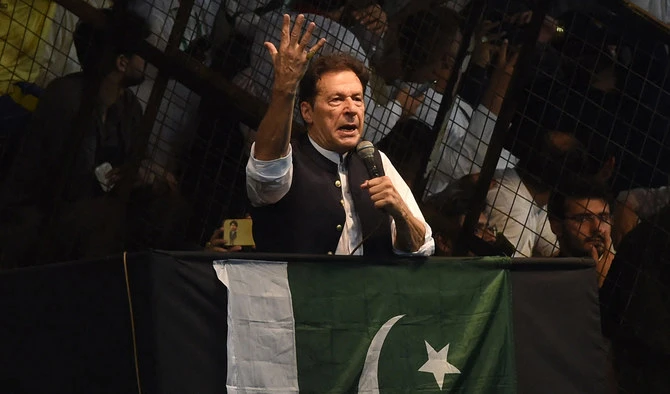
Pakistan's former Prime Minister Imran Khan delivers speech to his supporters during a rally in Lahore on August 13, 2022. (AFP/FILE)
Short Url
Updated 06 September 2022
Follow

YouTube goes down in Pakistan ahead of ex-PM Khan’s Peshawar rally — monitor 

  • Internet users in Pakistan complained of disruptions in YouTube service on Monday 
  • The disruptions came shortly after Khan arrived at the venue of his rally in Peshawar 

ISLAMABAD: YouTube, one of the world’s largest online video services, encountered disruptions in Pakistan, an Internet outage tracker said on Monday, ahead of former prime minister Imran Khan’s speech at a rally in the country’s northwest. 

Internet users complained of experiencing disruptions in YouTube service across the country Monday evening as they were unable to log on to the video database. 

NetBlocks, a monitor that tracks network shutdowns worldwide, confirmed reports of YouTube disruptions in Pakistan. 

“Confirmed: Metrics corroborate reports of a new disruption to YouTube in #Pakistan; the incident comes as former PM Imran Khan appears on screen to live stream a speech on the platform, following a pattern observed in August #PeshawarJalsa,” the monitor said on Twitter. 


The disruptions in YouTube service came minutes before ex-PM Khan, who has been increasingly critical of the country’s government and the powerful military establishment, arrived at the venue of his public meeting in the northwestern city of Peshawar. 

Khan, who was ousted from power in a no-trust vote in April, recently said the government of PM Shehbaz Sharif was delaying fresh polls in the country as it was hoping to appoint an army chief of its own choice to save its leaders from graft cases. 

Any “strong and patriotic” officer on that position would ask members of the ruling coalition about the ill-gotten wealth, the former premier argued at a rally in Faisalabad on September 4. 

Khan’s statement wasn’t well-received by the country’s military, which said it was “aghast” at the “defamatory and uncalled for” remarks by the former prime minister. 

Since his ouster in April, Khan and his supporters have openly expressed resentment that the army and its chief, General Qamar Javed Bajwa, did not block the opposition’s bid to topple his government, and are not supporting his moves, including regular public rallies across the country, to get snap elections announced. 

Civilian-military-discord has been the source of tension throughout 75-year history of Pakistan, where army’s mediation has in the past offered a face-saving way to governments and opposition parties. 

Pakistan says IMF has not imposed new conditions under $7 billion bailout

Updated 4 sec ago
Follow

Pakistan says IMF has not imposed new conditions under $7 billion bailout

  • Finance ministry says measures cited as ‘new conditions’ are phased extensions of reforms already agreed
  • Media described steps like civil servants’ asset disclosures and sugar industry deregulation as new demands

ISLAMABAD: Pakistan said on Sunday some of the reform measures mentioned in the media and linked to the International Monetary Fund (IMF) bailout program are not “new conditions” imposed by the lender but extensions of commitments already agreed under the arrangement.

Local media and social platforms have described a series of IMF-linked structural benchmarks as fresh conditions under the $7 billion loan for Pakistan in recent weeks. News reports published and broadcast in India also mentioned 11 measures under the loan, describing them as new IMF demands imposed on the country.

“The Ministry of Finance has clarified the intent, context, and continuity of reform measures under Pakistan’s IMF Extended Fund Facility (EFF) program, particularly in response to recent commentary regarding so-called ‘new conditions,’” said an official statement circulated in Islamabad.

“The purpose is to reaffirm that the measures referenced are part of a phased, medium-term reform agenda agreed with the IMF, many of which are extensions or logical progressions of reforms already initiated by the Government of Pakistan,” it added.

The ministry said the EFF is designed to support medium-term structural reforms implemented in a sequenced manner, with each program review building on prior actions to meet policy objectives agreed at the outset.

It provided detailed clarification on 11 measures that had been characterized as new conditions, including public disclosure of asset declarations of civil servants, strengthening the operational effectiveness of the National Accountability Bureau, empowering provincial anti-corruption bodies through access to financial intelligence and facilitating foreign remittances.

Other measures cited included the development of the local currency bond market, deregulation of the sugar industry, a comprehensive reform roadmap for the Federal Board of Revenue, a medium-term tax reform strategy, phased privatization of power distribution companies, regulatory reforms to strengthen corporate compliance and contingency measures to address potential revenue shortfalls.

The ministry said several of these reforms had been embedded in the Memorandum of Economic and Financial Policies (MEFP), a document detailing mutually agreed commitments, dating back to May 2024 and March 2025, including pledges related to tax policy, governance, energy sector restructuring and revenue mobilization.

“During discussions and negotiations with the IMF, the Government of Pakistan presents its planned policy reform initiatives,” the statement added. “Where the IMF assesses that these initiatives contribute to the agreed program objectives, they are incorporated into the MEFP.”

“As a result,” it continued, “many of the structural benchmarks and actions included in the latest MEFP are derived from reforms already undertaken or initiated by the Government of Pakistan, rather than being externally imposed or newly introduced conditions.”

The statement noted the measures outlined in the latest MEFP represent “continuity, sequencing and deepening of Pakistan’s agreed reform agenda” under the IMF loan, rather than the “imposition of abrupt or unprecedented conditions.”