

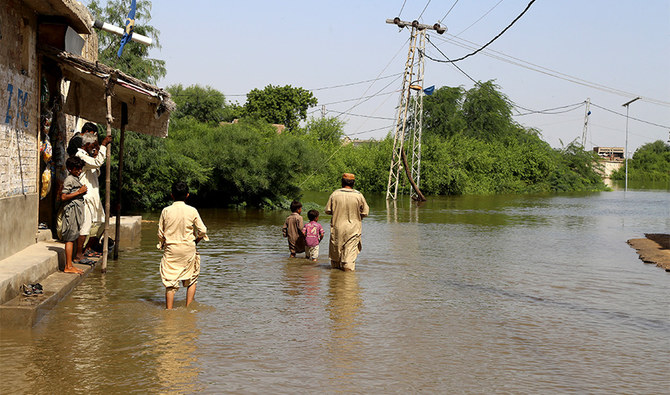

JAMSHORO: As the United Nations warned of more misery to come, Pakistan scrambled on Tuesday to widen a breach in its biggest lake in a bid to prevent it from overflowing amid unprecedented floods that have inundated a third of the South Asian nation.
Flooding, brought by record monsoon rainfall and glacier melt in the north, has impacted 33 million people and killed at least 1,325, including 466 children, the national disaster agency said.
About 636,940 displaced people have been housed in tent villages, it said, adding the raging waters had swept away 1.6 million houses, roads, rail and telecommunication systems, and inundated over two million acre of farmland, destroying both standing and stored crops.
Reuters’ drone footage over Sindh province showed agricultural and residential areas completely submerged in water, with just the tops of trees and buildings visible.
Rice fields resembled massive lakes of several miles in diameter, according to aerial video footage by the Pakistani military.
Officials have estimated economic cost of the losses minimum at $10 billion.
With more rain expected in the coming month, the situation could worsen, a top official of the United Nations’ refugee agency (UNHCR) warned.
“We fear the situation could deteriorate,” said Indrika Ratwatte, the agency’s director for Asia and the Pacific.
“This will increase challenges for flood survivors, and likely worsen conditions for nearly half a million displaced people, forcing more to abandon their homes.”
A key concern was country’s largest Manchar freshwater lake, in Sindh province, which was close to bursting its banks.
“We have widened the earlier breach at Manchar to reduce the rising water level,” provincial irrigation minister Jam Khan Shoro told Reuters on Monday.
Already, 100,000 people have been displaced in efforts to keep the lake from overflowing, and if it breaches its banks, it could affect hundreds of thousands more, authorities said.
The region already faces the dangers of water-borne and skin diseases, dengue fever, snake bites and breathing issues, Azra Fazal Pechuho, health minister for the southern province, told a news briefing.
She said 856,000 patients had been treated since flooding began in July, mostly from field and mobile hospitals.
“Over 1200 of our health facilities are under water,” she said, adding the field hospitals were receiving nearly 20,000 diarrhea and 16,000 malaria cases daily.
The World Health Organization has said over 6.4 million people need humanitarian support in the flooded areas.
To help the medicine stocks, Pechuho said, the UNHCR’s aid has arrived.
The UNHCR is working with Pakistani authorities to step up humanitarian supplies, Ratwatte added. Three more UN relief flights arrived on Tuesday, foreign ministry said.
“Till yesterday there was enormous pressure on the dikes of Johi and Mehar towns, but people are fighting it out by strengthening the dikes,” district official Murtaza Shah said on Tuesday, adding that 80 percent to 90 percent population of the towns had already fled.
Those who remain are attempting to strengthen existing dikes with machinery provided by district officials.
The waters have turned the nearby town of Johi into a virtual island, as a dike built by locals holds back the water.
“After the breach at Manchar, the water has started to flow, earlier it was sort of stagnant,” one resident, Akbar Lashari, said by telephone, following Sunday’s initial breach of the lake.
The rising waters have also inundated the nearby Sehwan airport, civil aviation authorities said.
The floods have followed record-breaking summer heat. Pakistan and the United Nations both have blamed climate change for the extreme weather and resulting devastation.
Pakistan has received nearly 190 percent more rain than the 30-year average in July-August, totalling 390.7mm (15.38 inches), with the southern Sindh province getting 466 percent more rain than the average.


