

Myanmar junta chief on another Russia trip seeking ‘special relations’

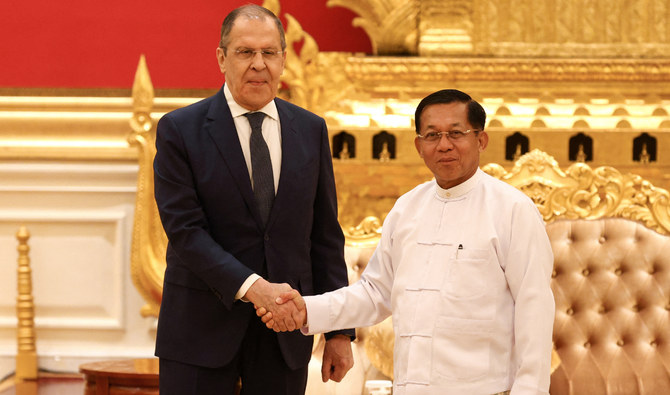
Russian Foreign Minister Sergei Lavrov (R) shaking hands with Myanmar junta chief Min Aung Hlaing on August 3, 2022. (AFP/File)
Short Url
Updated 05 September 2022
Follow

Myanmar junta chief on another Russia trip seeking ‘special relations’

  • Min Aung Hlaing first visited Moscow as leader last June
  • Talks likely to focus on military aid, say ex-officials

YANGON: Myanmar’s junta chief arrived in Vladivostok on Monday to attend the Eastern Economic Forum, his second trip to Russia in less than two months, in what former officials said is part of the ruling military’s attempt to establish “special relations” with Moscow.

The southeast Asian country has maintained friendly ties with Russia since the junta seized power from the elected government of Aung San Suu Kyi in February 2021. The coup saw Myanmar slapped with sanctions from Western countries and faced with a downgrade in relations, with Moscow under the same scrutiny over its invasion of Ukraine, which it calls a “special military operation.”

In July, Myanmar and Russia agreed to deepen their defense cooperation when Snr. Gen. Min Aung Hlaing visited the latter on what was reported as a private visit. The junta announced last month that Yangon planned on importing Russian oil, after Min Aung Hlaing met Russia’s Foreign Minister Sergei Lavrov in Naypyidaw.

Min Aung Hlaing, who first visited Moscow as leader last June, is set to meet with Russian officials and visit landmarks, universities, and factories during this week’s visit, according to a report from Myanmar state media. This is “to further cement cooperation in friendly relations, economic and other sectors between governments and peoples of both countries.”

Though it is “more risky,” the junta chief is likely trying to get closer to Russia for military aid, a former army official who had also served as a lawmaker in Myanmar’s parliament, told Arab News.

“General Min Aung Hlaing seems to be trying to establish special relations with a powerful country like Russia which is supporting him in the United Nations,” the official, who requested anonymity out of safety concerns, said.

“As Myanmar didn’t get much military help from China as expected, Russia became the only nation to rely on in getting military aid at the moment,” he said. “It’s not yet certain if Myanmar will get any other help apart from military aid from Russia.”

Russia is a main source of military hardware for Myanmar and was one of the first countries to voice their support for the junta after last year’s coup. Moscow has also been providing Yangon with COVID-19 vaccines.

U Ye Htun, a former lawmaker with the Shan Nationalities Democratic Party, is also expecting a similar discussion.

“Myanmar and Russia will mainly discuss arms trading besides economic matters,” Htun told Arab News.

Min Aung Hlaing appears to continue the “close relationship” with Russia, “hoping to get military aid,” a retired major from the Myanmar military, who also requested anonymity out of safety concerns, told Arab News.

Though the visit might risk Myanmar’s place in the international community, the former official doubted that Min Aung Hlaing would care.

“He has nothing to lose after all. He’s already had a bad name in the international community,” the major said.

“The first priority for him is to be able to seize power, control the whole country and restore … law and order as soon as he can.”

Min Aung Hlaing, who is chair of the junta-backed State Administration Council that has been running Myanmar since the military takeover, said the November 2020 general election, that saw Suu Kyi’s National League for Democracy party winning by a landslide, was marred with fraud.

The UN and activists have accused the junta of atrocities and crimes against humanity, as they urged the international community, particularly China and Russia, to stop supplying it with weapons.


Hungary says it will block a key EU loan to Ukraine until Russian oil shipments resume

Updated 9 sec ago
Follow

Hungary says it will block a key EU loan to Ukraine until Russian oil shipments resume

  • Szijjártó said: “As long as Ukraine blocks the resumption of oil supplies to Hungary, Hungary will block European Union decisions that are important and favorable for Ukraine”
  • Hungary’s decision to block the key funding came two days after it suspended diesel shipments

BUDAPEST: Hungary will block a planned 90-billion-euro ($106-billion) European Union loan to Ukraine until the flow of Russian oil through the Druzhba pipeline resumes, Hungary’s foreign minister said.
Russian oil shipments to Hungary and Slovakia have been interrupted since Jan. 27 after what Ukrainian officials said was a Russian drone attack damaged the Druzhba pipeline, which carries Russian crude across Ukrainian territory and into Central Europe.
Hungary and Slovakia, which have both received a temporary exemption from an EU policy prohibiting imports of Russian oil, have accused Ukraine — without providing evidence — of deliberately holding up supplies. Both countries ceased shipping diesel to Ukraine this week over the interruption in oil flows .
In a video posted on social media Friday evening, Foreign Minister Péter Szijjártó accused Ukraine of “blackmailing” Hungary by failing to restart shipments. He said his government would block a massive interest-free loan the EU approved in December to help Kyiv to meet its military and economic needs for the next two years.
“We will not give in to this blackmail. We do not support Ukraine’s war, we will not pay for it,” Szijjártó said. “As long as Ukraine blocks the resumption of oil supplies to Hungary, Hungary will block European Union decisions that are important and favorable for Ukraine.”
Hungary’s decision to block the key funding came two days after it suspended diesel shipments to its embattled neighbor and only days before the fourth anniversary of Russia’s full-scale invasion.
Nearly every country in Europe has significantly reduced or entirely ceased Russian energy imports since Moscow launched its war in Ukraine on Feb. 24, 2022. Yet Hungary and Slovakia — both EU and NATO members — have maintained and even increased supplies of Russian oil and gas.
Hungary’s nationalist Prime Minister Viktor Orbán has long argued Russian fossil fuels are indispensable for its economy and that switching to energy sourced from elsewhere would cause an immediate economic collapse — an argument some experts dispute.
Widely seen as the Kremlin’s biggest advocate in the EU, Orbán has vigorously opposed the bloc’s efforts to sanction Moscow over its invasion, and blasted attempts to hit Russia’s energy revenues that help finance the war. His government has frequently threatened to veto EU efforts to assist Ukraine.
On Saturday, Slovakia’s populist Prime minister Robert Fico said his country will stop providing emergency electricity supplies to Ukraine if oil is not flowing through the Druzhba by Monday. Orbán’s chief of staff, Gergely Gulyás, said earlier this week that Hungary, too, was exploring the possibility of cutting off its electricity supplies to Ukraine.
Not all of the EU’s 27 countries agreed to take part in the 90-billion-euro loan package for Kyiv. Hungary, Slovakia and the Czech Republic opposed the plan, but a deal was reached in which they did not block the loan and were promised protection from any financial fallout.