

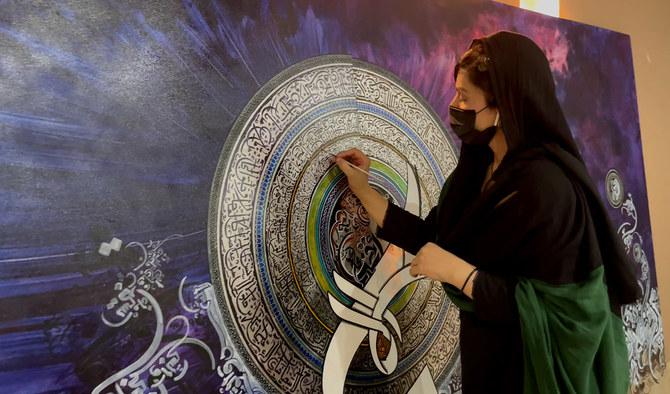

LAHORE: Ayesha Kamal, a contemporary Islamic calligrapher from the eastern Pakistani city of Lahore, dominates the canvas with measured brushstrokes as she begins to work on Arabic inscriptions which take different shapes in her artwork.
Kamal, who has had her works widely represented in galleries around the world, pays great attention to the concept of a religious text in Islam, with stunning hues, strokes and geometry. Her work manifests mixed techniques and materials, including oil, acrylic and ink, besides the use of pure silver leaves to ingrain her thoughts on the canvas.
Her use of multiple fonts, including one of the oldest fonts Thuluth as well as the colorful, traditional fonts of Moalla and Shikasta, makes her works different from other Islamic calligraphy paintings. Kamal recently introduced the Kufi font to her paintings, highlighting the angular and linear shapes of the letters.
Kamal says she prefers acrylic and oil paints, and was inspired to pick up the brush after watching a painting by a Pakistani maestro, Sadequain, at the Lahore Museum while she was a child.
“While I was in his pupilage, he would often allow me to fill sketches made by him with colors which helped me a lot,” she told Arab News. “He is a master calligrapher who uses miniature style that requires a lot of attention to detail. It’s really all about precision, detail, quality of brushwork, and smoothness. And that’s exactly what I do now.”

Pakistani contemporary Islamic calligrapher Ayesha Kamal's work is photographed in Lahore, Pakistan on August 24, 2022. (AN photo)
Kamal, whose larger paintings of Surah Ar-Rahman from the Holy Quran have been winning the internet nowadays, took about ten years to learn the craft from her teacher, Amir Kamal, who introduced her to different artistic techniques and geometric styles.
The artist aspires to carry forward the legacy of Sadequain.
She paints the Quranic verses in a style which is mainly inspired by Sadequain, though she infuses her artwork with miniature style painting. Sometimes she uses her unique style to paint lengthy chapters of the Muslim scripture on small canvases without ever making the text obscure.
“Miniatures are done on smooth surfaces,” she said. “So, we have to prepare the surface first and then paint with a very fine brush. A great amount of time and attention is needed to be paid to every little detail.”
Kamal also paints on bigger canvases with similar precision.

Pakistani contemporary Islamic calligrapher Ayesha Kamal (not visible) works on a piece of calligraphy at her studio in Lahore, Pakistan on August 24, 2022. (AN photo)
She uses multiple fonts in her calligraphic works, but the one which set her apart from most other calligraphers is the Kufic script.
“It highlights the angular shapes of letters which make each alphabet come to life in my imagination,” she said.
“Since the time I have started painting, my selection of verses or surahs [Quranic chapters] was solely based on what I would be feeling and thinking,” she continued. “For example, since childhood, I remember Surah Ar-Rahman by heart, and so I would often recite it or some other verses that I remembered while painting them on the canvas.”
Kamal’s work has been widely exhibited, and she has also been part of various government projects in Pakistan.
Recently, her work was displayed at an event, “Contemporary Art of Pakistan,” in Belarus which was also the first time she participated in an exhibition abroad.
Her calligraphies were displayed with nearly eighty other art pieces by prominent painters like Sadequain and Noreen Sajid.
“After the Belarus exhibition,” she said, “I was not only invited by many galleries across the globe to showcase my paintings but several of my artworks sold within days as well.”


