Saudi Arabia working to localize 18 professions over the next year: Minister

Saudi Minister of Industry and Mineral Resources Bandar Ibrahim Alkhorayef said the goals outlined under Saudi Vision 2030 require a unique business model.
Short Url
Updated 05 September 2022
Follow

Saudi Arabia working to localize 18 professions over the next year: Minister

RIYADH: Saudi Arabia is working to localize 18 professions over the next year, as the Kingdom steadily progresses in its efforts to create more jobs in line with Vision 2030, according to Saudi Transport Minister Saleh bin Nasser Al-Jasser.

While speaking at the Local Content Forum in Riyadh on Monday, Al-Jasser revealed that the transportation sector of the Kingdom is working to increase the proportion of Saudi nationals in all its services.

“The transportation system is working to increase the proportion of localization in all its services. We are close to the percentage of full localization for the profession of co-pilot, and soon the full localization of pilots will be achieved,” said Al-Jasser.

While speaking at the event, Saudi Minister of Investment Khalid Al-Falih said that the Kingdom has a broader and more comprehensive strategy, which will help differentiate between localization and local content.

“Local content is one of the regulatory and legislative tools that different countries use within certain limits to achieve broader strategies and policies for settlement,” said Al-Falih.

According to Al-Falih, the Kingdom could achieve localization and increase the local content with the help of foreign investors.

He, however, added that focusing on and exaggerating local content may harm the efficiency of the country to attract foreign investments.

According to the Local Content and Government Procurement Authority website, the aim of promoting local content “is to preserve the largest possible amount of money spent on purchases inside the Kingdom by the target groups, whether governmental or private agencies or even members of the community.”

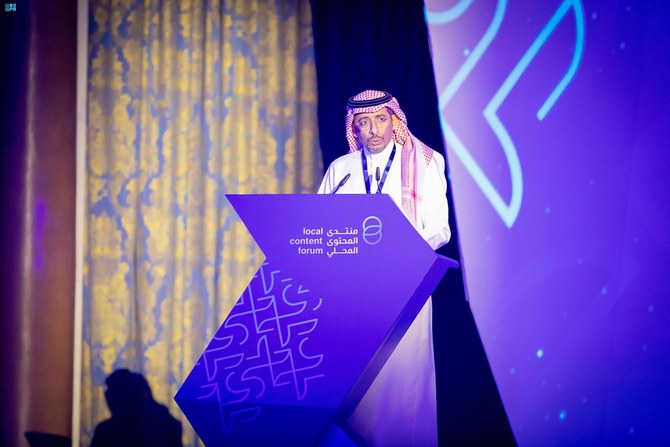
During the event, Saudi Minister of Industry and Mineral Resources Bandar Ibrahim Alkhorayef said the goals outlined under Saudi Vision 2030 require a unique business model.

“The goals outlined in the Vision 2030 cannot be achieved using traditional methods, and the vitality of local content comes into the picture at this juncture,” Alkhorayef noted.

“This concept represents a comprehensive umbrella under which several elements fall, starting from the product to services, personnel, training and technology,” added the minister.

Alkhorayef further noted that local content could help maximize the economic impact of the Kingdom’s industries, services, and natural resources.

He pointed out that the Saudi government’s Local Content Coordination Council is working to elevate the private sector’s contribution to the local content.

The minister said steps are being taken to strengthen strategic partnerships with the private sector to enhance its “participation in the development of local content.” 


European gas prices soar almost 50% as Iran conflict halts Qatar LNG output

Updated 02 March 2026
Follow

European gas prices soar almost 50% as Iran conflict halts Qatar LNG output

  • Analysts warn prolonged disruption could push prices higher
  • Some shipments of oil, LNG through Strait of Hormuz suspended
  • Benchmark Asian LNG price up almost 39 percent

LONDON: ​Benchmark Dutch and British wholesale gas prices soared by almost 50 percent on Monday, after major liquefied natural gas exporter Qatar Energy said it had halted production due to attacks in the Middle East.

Qatar, soon to cement its role as the world’s second largest LNG exporter after the US, plays a major role in balancing both Asian and European markets’ demand of LNG.

Most tanker owners, oil majors and ‌trading houses ‌have suspended crude oil, fuel and liquefied natural ​gas shipments ‌via ⁠the ​Strait of ⁠Hormuz, trade sources said, after Tehran warned ships against moving through the waterway.

Europe has increased imports of LNG over the past few years as it seeks to phase out Russian gas following Russia’s invasion of Ukraine.

Around 20 percent of the world’s LNG transits through the Strait of Hormuz and a prolonged suspension or full closure would increase global competition for other ⁠sources of the gas, driving up prices internationally.

“Disruptions to ‌LNG flows would reignite competition between ‌Asia and Europe for available cargoes,” said ​Massimo Di Odoardo, vice president, gas ‌and LNG research at Wood Mackenzie.

The Dutch front-month contract at the ‌TTF hub, seen as a benchmark price for Europe, was up €14.56 at €46.52 per megawatt hour, or around $15.92/mmBtu, by 12:55 p.m. GMT, ICE data showed.

Prices were already some 25 percent higher earlier in the day but extended gains ‌after QatarEnergy’s production halt.

Benchmark Asian LNG prices jumped almost 39 percent on Monday morning with the S&P Global ⁠Energy Japan-Korea-Marker, widely used ⁠as an Asian LNG benchmark, at $15.068 per million British thermal units, Platts data showed.

“If LNG/gas markets start to price in an extended period of losses to Qatari LNG supply, TTF could potentially spike to 80-100 euros/MWh ($28-35/mmBtu),” Warren Patterson, head of commodities strategy at ING, said. The British April contract was up 40.83 pence at 119.40 pence per therm, ICE data showed.

Europe is also relying on LNG imports to help fill its gas storage sites which have been depleted over the winter and are currently around 30 percent full, the latest data from Gas Infrastructure ​Europe showed. In the European carbon ​market, the benchmark contract was down €1.10 at €69.17 a tonne