

Pakistan’s finance chief expects economic growth of over 3.5 percent despite unprecedented floods

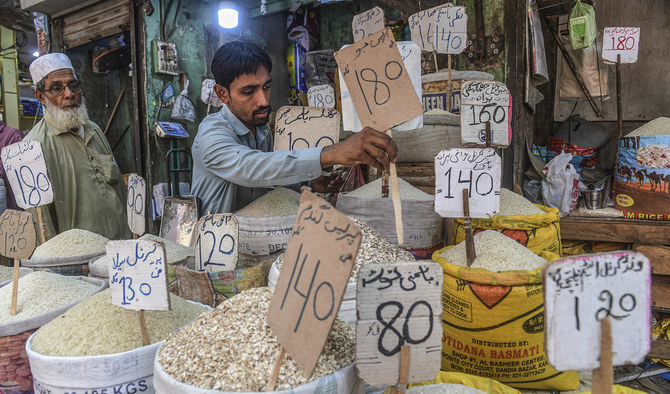
A shopkeeper place a price tag on rice at a shop in Karachi, Pakistan, on June 10, 2022. (AFP/FILE)
Short Url
Updated 04 September 2022
Follow

Pakistan’s finance chief expects economic growth of over 3.5 percent despite unprecedented floods

  • Miftah Ismail says inflation in Pakistan is close to its peak and will average about 15 percent for the year
  • Pakistan is likely to allow cotton import in the wake of the floods since textiles dominate its export revenue

ISLAMABAD: Pakistan’s finance minister Miftah Ismail told an international publication on Saturday he expected the economy to grow more than 3.5 percent in the current fiscal year while urging the nation to “live within its means.”
The country recently managed to secure $1.16 billion from the International Monetary Fund (IMF) amid tough economic challenges that led to speculations of an imminent default.
Pakistan has also received investment and loan pledges of $9 billion from friendly nations like Saudi Arabia, United Arab Emirates and Qatar.
Speaking to Bloomberg News, the finance minister said he hoped that about $1 billion of investment would flow into listed state-owned companies within the next one month.
“Ismail expects economic growth of more than 3.5 percent for the fiscal year that started in July, down from an initial target of 5 percent,” reported the international publication. “He predicts that inflation, running at the highest in 47 years and the second highest in Asia, is close to its peak and will average 15 percent for the year.”
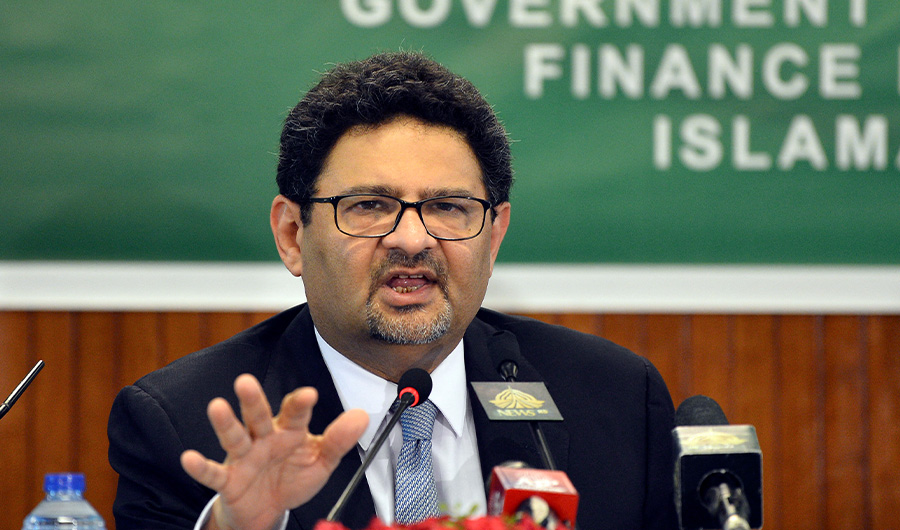


Pakistan's Finance Minister Miftah Ismail speaks during the launch ceremony of 'Economy Survey 2021-22' in Islamabad on June 9, 2022. (AFP/FILE)

Pakistan’s economic situation has become even more difficult in the wake of the recent floods that have affected the lives of 33 million people – or about 15 percent of the country’s total population – while depriving hundreds of thousands of their livelihood after they lost crops and livestock.
For now, the Pakistani finance minister has tried to reduce the country’s trade gap and current account deficit since taking over the office earlier this year.
“I want to see a Pakistan that lives within its means. That’s it,” he said. “Nothing can happen in one year, but we can start.”
Ismail restricted imports of luxury goods, including automobiles and automotive parts, in recent months. While the measure was only supposed to last for a brief period, said Bloomberg, the impact of the floods could lead to its extension.
“If I have limited dollars, I will absolutely make sure that I use them to buy wheat, I use them to buy edible things for our people,” the finance minister added. “Maybe we can delay buying Audis and Mercedes.”
Pakistan has already decided to import necessary food items like tomatoes and onions from Afghanistan, Iran and Turkey to deal with the market shortage of these vegetables.
Bloomberg said the government would also allow substantial cotton import since the country’s export revenue is dominated by textiles and much of Pakistan’s cotton crop was washed away by floods.



Pakistan’s first female central bank governor dies at 71

Updated 19 sec ago
Follow

Pakistan’s first female central bank governor dies at 71

  • Shamshad Akhtar led the State Bank of Pakistan from 2006 to 2009 and later served twice as caretaker finance minister
  • Finance Minister Muhammad Aurangzeb describes Akhtar as an accomplished economist and an outstanding human being

KARACHI: Shamshad Akhtar, Pakistan’s first woman to serve as governor of the central bank and one of the country’s most internationally experienced economic policymakers, died at the age of 71, officials said on Saturday.

Akhtar led the State Bank of Pakistan from 2006 to 2009, becoming the first and only woman to lead the institution since its establishment in 1948. She later served twice as caretaker finance minister, overseeing fiscal management during transitional governments ahead of the 2018 and 2024 general elections.

According to local media reports, Akhtar died of cardiac arrest.

President Asif Ali Zardari expressed sorrow over her passing in a statement.

“The president paid tribute to her services in the field of economics and financial management, noting her contribution to strengthening economic governance in the country,” the presidency said, adding that he extended condolences to the bereaved family and prayed for the departed soul.

Finance Minister Muhammad Aurangzeb described Akhtar as a highly accomplished economist and an outstanding human being.

“Dr. Shamshad Akhtar was a dignified, principled and wise voice in Pakistan’s economic history,” he said.

He said she served Pakistan with integrity and dedication across several senior economic roles, adding that her national service would always be remembered with respect.

At the time of her death, Akhtar was serving as chairperson of the Pakistan Stock Exchange, a role that placed her at the intersection of Pakistan’s monetary policy, fiscal management and capital markets.

Beyond Pakistan, she held senior positions at major international institutions, including the World Bank, the Asian Development Bank and the United Nations Economic and Social Commission for Asia and the Pacific.

Born in Hyderabad, she was educated in Karachi and Islamabad and held advanced degrees in economics from institutions in Pakistan and the United Kingdom.

Akhtar was widely regarded as a technocrat known for institutional discipline, policy continuity and a strong commitment to economic reform.

With input from Reuters