

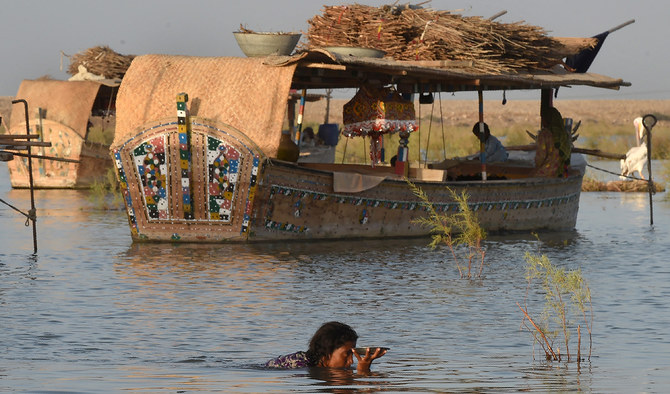

KARACHI: Authorities in Pakistan’s southern Sindh province on Sunday breached the dyke of the country’s largest natural freshwater lake after reports that water overflow from the swelling reservoir could sink two major towns.
Torrential rains and floods have killed at least 1,290 people, including more than 490 in Sindh, since the onset of monsoon season in Pakistan in mid-June, according to the National Disaster Management Authority (NDMA).
A large number of people living in Pakistan’s southern regions have lost their homes, livestock and crops in the last two and a half months ago. The government has urged the international community for humanitarian assistance since it lacks necessary resources to deal with the magnitude of the situation.
Meteorologists have predicted more rains in the coming days and authorities have urged villagers in the Jamshoro and Dadu districts of Sindh province near Lake Manchar to evacuate.
“The Sindh government on the recommendation of irrigation expert decided to make a controlled breach in Manchar Lake to save Sehwan and Bhan Syedabad towns,” Sharjeel Memon, the provincial information minister and in-charge of relief activities, told reporters in Hyderabad, adding the population of Sehwan alone was over 300,000.
Manchar Lake, located west of the Indus River in Sindh’s Jamshoro district, is the largest natural freshwater lake in Pakistan. It’s located some 18 kilometers from Sehwan, a city where the 13th-century Sufi saint and poet of the present-day Pakistan and Afghanistan, Sayyid Usman Marwandi, popularly known as Lal Shahbaz Qalandar, is resting. The lake had also overflowed during the 2010 floods in Pakistan.
Memon said the breach in the swelling lake would submerge five union councils, including the home of the Sindh chief minister.
“The lake has been filled beyond capacity and has started overflowing,” he said, adding over 100,000 residents of the affected union councils were being moved to safer locations.
Fariduddin Mustafa, a senior government official, on Saturday directed people living around the Manchar Lake to evacuate, saying water in the lake was continuously rising. The lake's ridge could cave in at any time, he added.
According to official statistics, heavy monsoon rains in Pakistan have affected the lives of 33 million people – or about 15 percent of the country’s total population.
The Met Office has predicted more rains in upper parts of the country until Tuesday.
“Rain-wind/thundershower (with isolated heavy falls) is expected in Kashmir, Gilgit-Baltistan, Islamabad, Rawalpindi, Murree, Attock, Chakwal, Jhelum, Sialkot, Narowal, Lahore, Gujranwala, Gujrat, Sheikhupura, Mianwali, Khushab, Sargodha, Hafizabad, Mandi Bahauddin, Jhang and Faisalabad from Saturday (night) to Tuesday,” the Pakistan Meteorological Department (PMD) said in a statement.
It issued a similar forecast for places like Dir, Swat, Kohistan, Mansehra, Abbottabad, Peshawar, Mardan, Charsadda, Swabi and Nowshera in the northwestern Khyber Pakhtunkhwa province.
The Met Office predicted hot and humid weather in Sindh, Balochistan and southern Punjab during the next three to four days.
Pakistani officials have already said that the rehabilitation activities in the wake of the recent floods are likely to take years and may cost the country over $10 billion.
The government and the United Nations recently issued a joint appeal for $160 million of emergency funding to assist millions of those affected by floods.


