

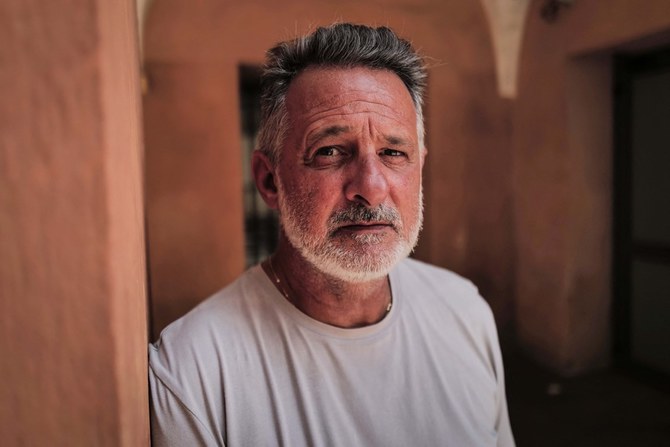

NICE: The Frenchman who tried single-handedly to stop a truck that mowed down dozens of people six years ago in the port city of Nice says he felt no fear at the time, but can’t help wondering whether a quicker reaction could have saved lives.
Franck Terrier, an airport worker and father of two, took his wife out to the Promenade des Anglais on his scooter to get ice cream on the night of July 14, 2016, joining thousands of others enjoying the Bastille Day fireworks.
“Suddenly a truck overtook me on the right,” Terrier said in an interview in the run-up to the trial on Monday of suspects linked to the attack by Mohamed Lahouaiej-Bouhlel, a Tunisian, who drove a truck into the crowd, killing 86 people and injuring hundreds more. “I dropped my wife off, and decided to go after him,” Terrier said. “It was a reflex,” said Terrier, who flung his scooter at the truck’s wheels in an unsuccessful attempt to force the powerful vehicle to stop.
“I felt no fear,” he said. “I wanted to get into the cabin, I fought (with the attacker), I held on to the cabin. He tried to shoot me, a round went off but missed. In the struggle I took a blow to the head and I fell, but got back up.”
President Emmanuel Macron decorated Terrier with France’s highest honor, the Legion of Honour, a year later, an expression of the nation’s gratitude for his daring action.
Yet Terrier, now 55, can’t shake the feeling that perhaps he could have done more.
“The worst thing is to face the victims’ families, because I keep having this feeling that I didn’t do enough,” he said. “Maybe
I could have acted faster.”
BACKGROUND
President Emmanuel Macron has decorated Franck Terrier with France’s highest honor, the Legion of Honour — an expression of the nation’s gratitude for his daring action.
Terrier said he is aware that such thoughts are irrational and he understands that “with hindsight, I couldn’t have done more.”
But, he said, “there’s always a feeling of guilt because 86 people died.”
The attacker died in a shootout with police while Terrier, exhausted, leaned against the truck’s front wheel.
Police, assuming that Terrier had been in on the attack, roughed him up at first, but “when I managed to talk to them, they understood what had happened.”
Terrier, who had been chief runway manager at Nice’s airport for 30 years, never returned to that post and is now employed by city hall.
He has low expectations for the trial that is to examine the possible role of people close to Lahouaiej-Bouhlel in the attack, including those who sold him weapons.
“I don’t think there will be enough evidence against the people who were arrested. But still, it will be a chance to tell the story,” he said.
Terrier said he will not attend any screening of CCTV footage retracing the truck’s murderous itinerary at the trial. “I don’t have the strength,” he said.
He never refers to the attacker by name. “For me, people who commit such acts are not human, so I feel no hatred or anything else, just incomprehension,” he said.
His life “has returned to a semblance of normality”, Terrier said, “but I will never be able to turn the page, I will remember this all my life. I just hope that, over time, I will feel better.”


