

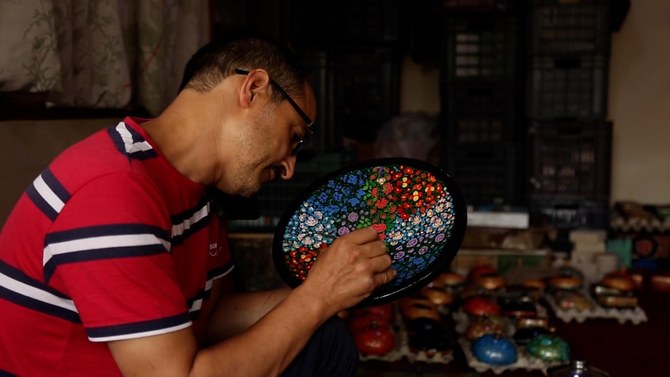
Artisans struggle to keep centuries-old Kashmiri papier-mache craft alive

A papier-mâché artist is giving final touches to a decorative plate in Srinagar, India. (AN Photo)
Short Url
Updated 03 September 2022
Follow

Artisans struggle to keep centuries-old Kashmiri papier-mache craft alive

SRINAGAR: Famous throughout the world, Kashmir’s centuries-old papier-mache craft has been ruptured by conflict and the coronavirus pandemic.

Now on the verge of extinction, some artists are trying to introduce innovation to keep it alive.

The emergence of the art of papier-mache accompanied the advent of Islam in the region. It was introduced to Kashmir by Sufi scholar Mir Sayyid Ali Hamadani, who arrived from Persia with skilled craftsmen in the 14th century.

Deeply interwoven with tradition, the art has been passed down from generation to generation. In 2019, the local government patented papier-mache as a regional art form, but the unrest that followed the abrogation of Kashmir’s semi-autonomy in August that year, and the pandemic soon after, dealt a major blow to the industry, making the younger generation less willing to practice it.

Papier-mache vases, cups, boxes, trays, and other decorative items are made of repulped paper that has been mixed with glue or paste so that it can be molded. They are beautifully decorated in Oriental motifs and handsomely lacquered with colorful paint.

They are usually produced at small workshops at homes in the old part of Srinagar, the region’s main city.

“I think 5 percent of Kashmir’s population is involved in this profession, but the trend is such that many of them are leaving the traditional art, and very few youngsters are preferring to come to this profession,” Syed Javed Iqbal, a third-generation papier-mache artist in Srinagar, told Arab News.

“There is less money in this that’s why the new generation does not want to come to this traditional art.”

From Kashmir, most of the items are exported to other parts of India and abroad. Besides decorative items, papier-mache handicrafts include reading desks for reciting the Qur’an, and even small furniture items depicting life and historical scenes from Mughal courts.

“Some niche products go to the US and European markets,” Iqbal said. “Products like camels, elephants, gift boxes, and all also go to the Middle East.”

HIGHLIGHT

Arrival of the art form in the 14th century accompanied the advent of Islam in the region.

While Iqbal hopes his son will inherit the profession and family legacy, other artisans are less hopeful about its future. They say that with the craft’s decreasing popularity, the amount of time and effort it requires does not make it sustainable.

Shabeer Husain Dar has been decorating papier-mache items for the past 17 years. He earns $60 a month, which is hardly enough to maintain his family of four.

“The young generation does not want to learn papier-mache technique and if the trend continues like that this art will disappear,” he said. “I wouldn’t like my sons to join this profession, because there is no money and the wage that you get is too little to run a family.”

Exports have lately plunged, with the Kashmir Chamber of Commerce estimating that few artists are now able to earn more than $4 a day.

“The traditional art which is linked to Kashmir’s identity is facing an existential crisis,” the chamber’s president, Sheikh Ashiq Ahmad, told Arab News. “Export has declined by 40 to 50 percent in the last few years.”

He said that either government intervention to save the “dying industry” or innovation were needed to keep it afloat.

While the former is not yet in sight some people, such as 26-year-old Shafiya Shafi, are trying to mix papier-mache with other techniques.

The self-taught artisan from Srinagar started to apply traditional ornaments to objects made of clay.

“I tried to create a fusion,” she said. “I customized the papier-mache design into wedding gifts and decorations. It enhanced the value of the product and people started demanding it.”

While her attempts are welcomed by customers, not all of those whose families have been practicing the craft for centuries are supportive of them, seeing the fusion of techniques as distorting the traditional art.

But unlike them, the young artist’s workshop is continuously receiving commissions from Kashmir and beyond.

Shafi told Arab News she has been trying to convince other artisans to be innovative as well. “I tell them that for any art to survive you need the modern touch,” she added.


’Content to die’: Afghanistan’s hunger crisis worsened by winter, aid cuts

Updated 5 sec ago
Follow

’Content to die’: Afghanistan’s hunger crisis worsened by winter, aid cuts

  • As winter spreads across Afghanistan’s arid landscape, work opportunities have dried up, while the wave of returning Afghans has swelled the population by a tenth, said Aylieff of WFP
  • “Last year was the biggest malnutrition surge ever recorded in Afghanistan and sadly the prediction is that it’s going to get worse“

KABUL: In the dull glow of a single bulb lighting their tent on the outskirts of Kabul, Samiullah and his wife Bibi Rehana sit down to dry bread and tea, their only meal of the day, accompanied by their five children and three-month-old grandchild.
“We have reached a point where we are content with death,” said 55-year-old Samiullah, whose family, including two older sons aged 18 and 20 and their wives, is among the millions deported by neighboring Iran and Pakistan in the past year.
“Day by day, things are getting worse,” he added, after their return to a war-torn nation where the United Nations’ World Food Programme estimates 17 million battle acute hunger after massive cuts in international aid.
“Whatever happens to us has happened, but at least our children’s lives should be better.”
He was one of the returned Afghans speaking before protests in Iran sparked a massive crackdown by the clerical establishment, killing more than 2,000 in ensuing violence.
Samiullah said his family went virtually overnight from its modest home in Iran to their makeshift tent, partially propped up by rocks and rubble, after a raid by Iranian authorities led to their arrests and then deportation.
They salvaged a few belongings but were not able to carry out all their savings, which would have carried them through the winter, Samiullah added.
Reuters was unable to reach authorities in Iran for ⁠comment.
“Migrants who are newly returning to the country receive assistance as much as possible,” said Afghan administration spokesman Zabiullah Mujahid, in areas from transport to housing, health care and food.
It was impossible to eradicate poverty quickly in a country that suffered 40 years of conflict and the loss of all its revenue and resources, he added in a statement, despite an extensive rebuilding effort.
“Economic programs take time and do not have an immediate impact on people’s lives.”
The WFP says Iran and Pakistan have expelled more than 2.5 million Afghans in massive repatriation programs.
Tehran ramped up deportations last year amid a flurry of accusations that they were spying for Israel. Authorities blamed the expulsions on concerns about security and resources.
Islamabad accelerated deportations amid accusations that the Taliban was harboring militants responsible for cross-border attacks ⁠on Pakistani soil, allegations Afghanistan has denied.

NO INCOME, NO AID
As winter spreads across Afghanistan’s arid landscape, work opportunities have dried up, while the wave of returning Afghans has swelled the population by a tenth, said John Aylieff, the WFP’s country director.
“Many of these Afghans were working in Iran and Pakistan and they were sending back remittances,” he told Reuters, adding that 3 million more people now face acute hunger. “Those remittances were a lifeline for Afghanistan.”
Cuts to global programs since US President Donald Trump returned to the White House have sapped the resources of organizations such as the WFP, while other donor countries have also scaled back, putting millions at risk worldwide.
“Last year was the biggest malnutrition surge ever recorded in Afghanistan and sadly the prediction is that it’s going to get worse,” added Aylieff, estimating that 200,000 more children would suffer acute malnourishment in 2026.
At the WFP’s aid distribution site in Bamiyan, about 180 km (111 miles) from Kabul, the capital, are stacks of rice bags and jugs of palm oil, while wheelbarrows trundle in more food, but it is still too little for the long queues of people.
“I am forced to manage the winter with these ⁠supplies; sometimes we eat, sometimes we don’t,” said Zahra Ahmadi, 50, a widowed mother of eight daughters, as she received aid for the first time.

’LIFE NEVER REMAINS THE SAME’
At the Qasaba Clinic in the capital, mothers soothed their children during the wait for medicine and supplements.
“Compared to the time when there were no migrants, the number of our patients has now doubled,” said Dr. Rabia Rahimi Yadgari.
The clinic treats about 30 cases of malnutrition each day but the supplements are not sufficient to sustain the families, who previously relied on WFP aid and hospital support, she said.
Laila, 30, said her son, Abdul Rahman, showed signs of recovery after taking the supplements.
“But after some time, he loses the weight again,” she said.
After the Taliban takeover, she said, “My husband lost his (government) job, and gradually our economic situation collapsed. Life never remains the same.”
The United States led a hasty withdrawal of international forces from Afghanistan in July 2021, after 20 years of war against the Taliban, opening the doors for the Islamists to take control of Kabul.
As dusk gathers and the temperature falls, Samiullah brings in firewood and Bibi Rehama lights a stove for warmth.
“At night, when it gets very cold, my children say, ‘Father, I’m cold, I’m freezing.’ I hold them in my arms and say, ‘It’s OK.’ What choice do we have?” Samiullah said.
“(When) I worked in Iran, at least I could provide a full meal. Here, there is neither work nor livelihood.”
