

Dubai ruler sanctions AED50 million in aid to Pakistan as flood death toll tops 1,200

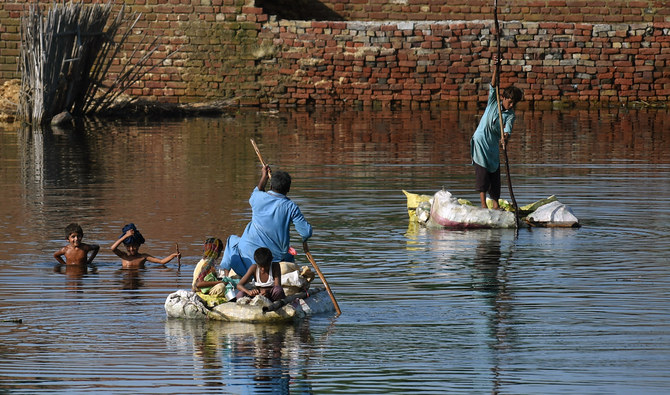
People use rafts to cross a flooded area after monsoon rains on the outskirts of Sukkur, Sindh province, on September 1, 2022. (AFP)
Short Url
Updated 02 September 2022
Follow

Dubai ruler sanctions AED50 million in aid to Pakistan as flood death toll tops 1,200

  • Deadly floods have left over 6.4 million people in dire need of humanitarian aid in Pakistan
  • The UN this week issued flash appeal for $160 million to help Pakistan deal with the disaster

ISLAMABAD: Dubai ruler Sheikh Mohammed Bin Rashid Al-Maktoum has sanctioned 50 million dirhams in emergency aid to Pakistan, the UAE embassy said Thursday night, as the death toll from monsoon downpours and floods surged past 1,200 in the South Asian nation.

Torrential rains and subsequent floods have killed at least 1,208 people, including 416 children, in Pakistan since the onset of monsoon season in mid-June, according to the National Disaster Management Authority (NDMA).

The World Health Organization has estimated that more than 6.4 million people are in dire need of humanitarian aid after rains destroyed hundreds of thousands of homes and water torrents washed away large swathes of prime farmland and road infrastructure in the South Asian country.

“H.H. Sheikh Mohammed Bin Rashid Al-Maktoum, Vice President, Prime Minister of UAE and Ruler of Dubai, directs [to] provide emergency aid worth AED 50 million to the flood affectees of Pakistan in cooperation with WFP (World Food Programme) & Mohammed bin Rashid Al-Maktoum Humanitarian and Charity Est,” the UAE embassy said late Thursday.

Pakistan’s planning Minister Ahsan Iqbal this week said early estimates put the damage from deadly floods at more than $10 billion.

On Tuesday, UN Secretary-General Antonio Guterres and Pakistani Foreign Minister Bilawal Bhutto-Zardari simultaneously launched a flash appeal for $160 million for Pakistan to cope with flood devastation.

The United Kingdom on Thursday announced £15 million in humanitarian aid to Pakistan, while flood relief aid has been arriving on planes from the United Arab Emirates (UAE), Saudi Arabia, China and Turkey.

Iqbal also said the world owed Pakistan, which was a victim of climate change caused by “irresponsible development of the developed world.”

Pakistan contributes less than 1 percent of global greenhouse emissions, but it is among the 10 most vulnerable countries to climate change.


Pakistan invites Uzbek firms to run off-dock terminals at Karachi Port

Updated 10 sec ago
Follow

Pakistan invites Uzbek firms to run off-dock terminals at Karachi Port

  • Pakistan has offered landlocked Central Asian nations access to global sea lanes via its ports
  • Officials in Islamabad seek greater regional cargo flows by modernizing port infrastructure

KARACHI: Pakistan on Thursday invited Uzbek industry and trade stakeholders to consider operating dedicated off-dock terminals at Karachi Port, according to an official statement, as the country looks to expand the use of its maritime infrastructure for regional trade.

The offer was made during a visit by a 13-member delegation from Uzbekistan to the Karachi Port Trust (KPT), where officials briefed them on port infrastructure, terminal operations and logistics-related investment opportunities.

Rear Admiral Shahid Ahmed, the KPT chairman, highlighted ongoing development initiatives, rail and road connectivity and terminal operations.

“In this context, the Chairman invited Uzbek industry and trade stakeholders to consider operating dedicated off dock terminals at Karachi Port to facilitate their import and export operations,” the statement said.

Off-dock terminals are cargo handling and storage facilities located outside a port’s boundaries but connected to it by road or rail to ease congestion and support import and export operations.

The visiting delegation, led by Deputy Minister for Investment, Industry and Trade Gulamov Shokhrukh Khasanovich, also toured private terminals at Karachi Port and was briefed on the use of modern technologies at the facilities.

Pakistan has been offering landlocked Central Asian economies access to global sea lanes through its ports on the Arabian Sea and hopes to position itself as a transshipment hub by strengthening port infrastructure.

Officials say transshipment hubs enable the transfer of cargo from one vessel to another, facilitating regional and international trade and generating revenue.

As part of its port modernization drive, Pakistan has engaged Abu Dhabi Ports Group to upgrade its maritime infrastructure.