

Israeli restrictions compound suffering of Palestinian patients

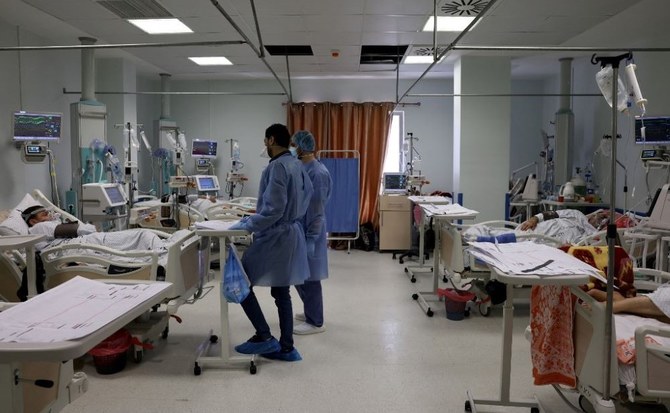
A ward in the Turkish-Palestinian Friendship Hospital in Gaza City, April 22, 2021. (AFP)
Short Url
Updated 31 August 2022
Follow

Israeli restrictions compound suffering of Palestinian patients

  • The Palestinian Ministry of Health in Gaza has accused Israel of preventing about 50 percent of patients in the Gaza Strip from receiving treatment
  • The ministry also accuses Israel of preventing the entry of 21 diagnostic X-ray machines into hospitals in the Gaza Strip

GAZA CITY: For years, patients in the Gaza Strip have complained about the lack of medical services and their inability to receive treatment because of Israeli restrictions and the bureaucracy involved in medical referrals.

Mahmoud and his wife Rahma seem tired as they wait in front of the window of the Palestinian Authority’s referral department to complete the procedure for Rahma’s treatment at Augusta Victoria Hospital in Jerusalem.

Rahma has been suffering from leukemia for three years and has been receiving chemotherapy in Jerusalem, but each time she goes to the hospital, she needs to prepare new papers and submit a travel permit to the Israeli side in order to be admitted to the hospital.

“For three years, I have been ill, and my husband and I have had to navigate bureaucratic procedures in order to receive treatment,” said Rahma Saeed, 43, a mother of three.

“Is it not enough that we suffer from a serious illness? Often there are no medicines in Gaza, and I have to go to the hospital in Jerusalem away from my husband and family,” she told Arab News.

She accompanied her mother to the hospital because her husband was refused an Israeli permit to pass from Gaza to Jerusalem, she said, adding that sometimes she went alone without any attendant.

The Palestinian Ministry of Health in Gaza has accused Israel of preventing about 50 percent of patients in the Gaza Strip from receiving treatment.

In a press conference held by the Ministry of Health in front of the Erez Crossing that separates Gaza and Israel, officials said that the continuation of the Israeli blockade has “deprived Gaza Strip patients of their treatment rights due to a 40 percent shortage of essential medicines, 32 percent of medical consumables and 60 percent of laboratory and blood bank equipment.”

They said that 1,922 patients could not reach the specialized hospitals in the West Bank, Jerusalem and Israel in time “due to the Israeli occupation’s procrastination and the failure to issue permits.”

The press conference heard that 371 patients left the Gaza Strip for treatment without anyone accompanying them and that this number was the highest since last April, including those who lost their lives alone in inhumane conditions.

Palestinian cancer patients must also endure months-long delays in receiving the necessary Israeli permits, delays that have led to the death of a number of them since the beginning of this year, said officials.

A Palestinian patient in the Gaza Strip must obtain a medical referral from the Palestinian Authority for treatment in hospitals in the West Bank, Israel and sometimes Egypt and Jordan. They also need an Israeli permit in order to pass through the Erez Crossing.

The Ministry of Health organized an ambulance march from the Indonesian Hospital in northern Gaza toward the Erez Crossing before holding the press conference to highlight the “Save Gaza Patients” campaign.

The ministry accuses Israel of preventing the entry of 21 diagnostic X-ray machines into hospitals in the Gaza Strip and the spare parts needed to repair 87 broken medical equipment, including 12 X-ray machines.

The press conference called for “international, humanitarian and human rights institutions today, more than ever, to put pressure on the Israeli occupation to end the siege on Gaza.”

Rahma hopes to obtain her permit to travel to Jerusalem as soon as possible in order to complete her treatment and return to her husband and children in Gaza.


Lebanon ex-central bank chief's corruption case being sent to top court, officials say

Updated 10 sec ago
Follow

Lebanon ex-central bank chief's corruption case being sent to top court, officials say

BEIRUT: The corruption case of Lebanon's former central bank governor, who is widely blamed for the country’s economic meltdown, has been transferred to the country's highest court, judicial officials told The Associated Press on Tuesday.
Riad Salameh was released on $14 million bail in September after a year in prison while awaiting trial in Lebanon on corruption charges, including embezzlement and illicit enrichment.
The trial of Salameh, 75, and his two legal associates, Marwan Khoury and Michel Toueini, will now be heard at the Court of Cassation, according to a copy of the notice obtained by the AP. Salameh and the others will be issued with arrest warrants if they don't show up for trial at the court.
No trial date has been set yet. Salameh denies the charges. The court’s final ruling can't be appealed, according to the four officials who spoke on condition of anonymity, because they weren't authorized to speak with the media.
In September 2024, he was charged with the embezzlement of $42 million, with the court later adding charges of illicit enrichment over an apartment rented in France, supposedly to be a substitute office for the central bank if needed. Officials have said that Salameh had rented from his former romantic partner for about $500,000 annually.
He was once celebrated for steering Lebanon’s economic recovery, after a 15-year civil war, upon starting his long tenure in 1993 and keeping the fragile economy afloat during long spells of political gridlock and turmoil.
But in 2023, he left his post after three decades with several European countries investigating allegations of financial crimes. Meanwhile, much of the Lebanese blame his policies for sparking a fiscal crisis in late 2019 where depositors lost their savings, and the value of the local currency collapsed.
On top of the inquiry in Lebanon, he is being investigated by a handful of European countries over various corruption charges. In August 2023, the United States, United Kingdom and Canada imposed sanctions on Salameh.
Salameh has repeatedly denied allegations of corruption, embezzlement and illicit enrichment. He insists that his wealth comes from inherited properties, investments and his previous job as an investment banker at Merrill Lynch.
Lebanon’s current central bank governor, Karim Souaid, announced last week that he's filing legal complaints against a former central bank governor and former banking official who diverted funds from the bank to what he said were four shell companies in the Cayman Islands. He didn't name either individual.
But Souaid said that Lebanon's central bank would become a plaintiff in the country's investigation into Forry Associates. The U.S. Treasury, upon sanctioning Salameh and his associates, described Forry Associates as “a shell company owned by Raja (Salameh’s brother) in the British Virgin Islands” used to divert about $330 million in transactions related to the central bank.
Several European countries, among them France, Germany, and Luxembourg, have been investigating the matter, freezing bank accounts and assets related to Salameh and his associates, with little to no cooperation from the central bank and Lebanese authorities.
Souaid said that he will travel later this month to Paris to exchange “highly sensitive” information as France continues its inquiries.