UNITED NATIONS: The UN political chief warned Tuesday that failure to resolve Libya’s political crisis and hold delayed elections poses a growing threat in the country, pointing to violent clashes a few days ago that killed at least 42 people and injured 159 others according to Libyan authorities.
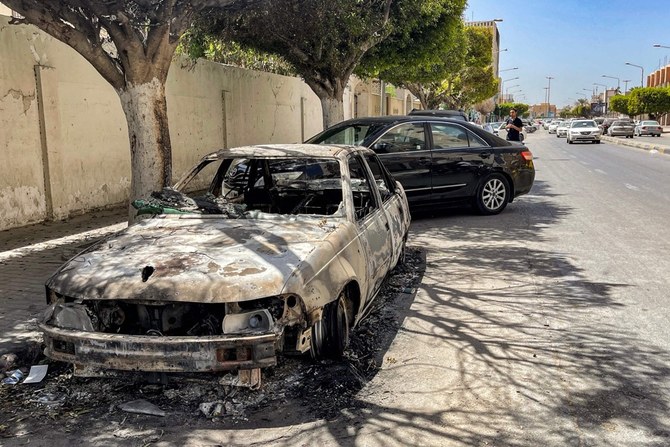
Rosemary DiCarlo told the UN Security Council that the clashes between armed groups supporting rival claimants to be prime minister involved the indiscriminate use of medium and heavy weapons and also displaced 50 families, significantly damaged five health facilities, and affected two detention centers for migrants and refugees, involving a total of 560 people.
Libya has plunged into chaos since a NATO-backed uprising toppled and killed longtime dictator Muammar Qaddafi in 2011. The oil-rich county has for years been split between rival administrations, each backed by rogue militias and foreign governments.
The current stalemate grew out of the failure to hold elections in December and the refusal of Prime Minister Abdul Hamid Dbeibah who led a transitional government to step down. In response, the country’s east-based parliament appointed a rival prime minister, Fathy Bashagha, who has for months sought to install his government in Tripoli.
The current stalemate grew out of the failure to hold elections in December and Prime Minister Abdul Hamid Dbeibah’s refusal to step down. In response, the country’s east-based parliament appointed a rival prime minister, Fathy Bashagha, who has for months sought to install his government in Tripoli.
DiCarlo said the fighting that broke out in the early hours of Aug. 27 appeared to be another attempt of pro-Bashagha forces to enter the capital.
“However, they were blocked by pro-Dbeibah forces at Zleiten — about 160 km east of Tripoli — and were forced to retreat, following clashes,” she said. “Attempts by other pro-Bashagha armed groups to advance on the capital from the west and southwest were similarly repelled.”
DiCarlo said fighting in Tripoli and its suburbs subsided on Aug. 28 but the situation remains “tense and fluid” and it’s unclear how long the current “fragile calm” will last.
“Retaliatory attacks by both sides and the announced intention by the (Tripoli-based) Government of National Unity to arrest pro-Bashagha elements involved in the fighting may trigger armed clashes that could again affect the civilian population,” DiCarlo warned.
She reiterated the UN’s belief that only elections can break the political impasse, and she urged rival leaders to reach agreement on a constitutional framework and timeline for elections that will enable Libyans to choose their leaders.
On a positive note, she said the 10-member Joint Military Commission, with five representatives from the rival sides, “finalized the modalities for the withdrawal of foreign forces, foreign fighters and mercenaries from Libya.”
Libya’s UN Ambassador Taher El Sonni demanded to know what the Security Council will do after the latest series of tragic events, and what they will say to the families of the victims, including a doctor who was one of his relatives and “died before the eyes of his children and wife inside his home.”
“Are you going to repeat your expressions of denunciation and condemnation? Or will the council act to shoulder its responsibilities in order to maintain international peace and security and to protect civilians?” he asked.
El Sonni asked the 15 council members and diplomats in the chamber to stand for a moment of silence “to mourn the lives of the victims that lost their lives from 2011 until today” in Libya, stressing that “they have done nothing wrong” and “this is a moral responsibility that we should bear.”
Everyone in the Security Council chamber stood silently.
The Libyan ambassador then said the victims and their families know that those responsible for recent events “are those who wish to impose authority by force,” and they want accountability.
“Will you contribute to investigate the events and hold those responsible accountable?” El Sonni asked.
The council took no immediate action.


![]()

UN: Failure to end Libya political crisis is growing threat
Short Url
https://arab.news/59v3h
UN: Failure to end Libya political crisis is growing threat


Latest updates





© 2026 SAUDI RESEARCH & PUBLISHING COMPANY, All Rights Reserved And subject to Terms of Use Agreement.