

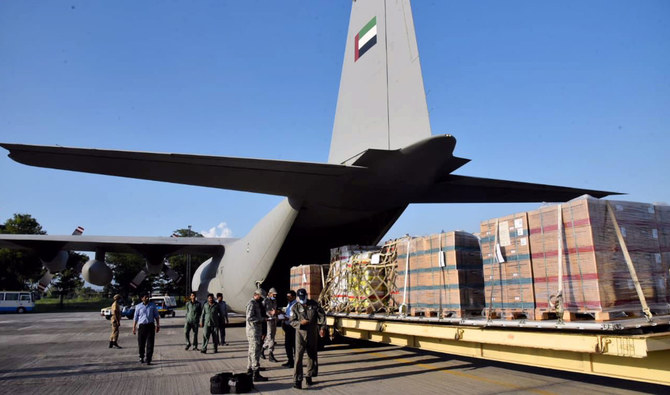

ISLAMABAD: Planes carrying relief goods for people stranded in Pakistan’s flood-hit areas are scheduled to arrive from the United Arab Emirates and China on Tuesday, the information ministry said.
Pakistani authorities have declared a national emergency and urged the international community for help after monsoon rains and floods left around 33 million people homeless, killing 1,136 since the beginning of the season in June.
Pakistan received the first aid flight from the UAE on Sunday. However, the country’s information minister Marriyum Aurangzeb said the Arab country would send 15 more planes carrying relief goods for flood-affected people in Pakistan.
In text messages sent to media on Tuesday, the EP wing of the foreign ministry said flights from China and the UAE would arrive on Tuesday afternoon.
“The relief aid includes shelter materials, humanitarian needs, food and medical parcels for those affected by torrential rains and floods, with the aim of contributing to supporting efforts to alleviate the suffering of the affected people,” UAE’s official news agency, WAM, had said on Monday.
Chinese Foreign Ministry Spokesperson Zhao Lijian announced on Monday China would provide additional humanitarian aid, including 25,000 tents, to flood-ravaged Pakistan.
Prime Minister Shehbaz Sharif thanked China’s President Xi Jinping and Premier Li Keqiang for providing financial assistance to the people of Pakistan.
“This flood is like no other in terms of its intensity & spread,” Sharif said in a Twitter post. “China has been there for us at the most difficult times & we greatly value its support.”
Pakistan and the United Nations will also launch a “flash appeal” simultaneously in Islamabad and Geneva on Tuesday to help the South Asian country deal with the devastating flood situation.
On Monday, PM Sharif said the government was forming a national flood response body to coordinate relief and rehabilitation efforts.
Pakistan’s planning minister Ahsan Iqbal also told Reuters in an interview on Monday that the recent floods in the country had caused significant damage to infrastructure which could cost the country over $10 billion.
“I think it is going to be huge,” he said. “So far, (a) very early, preliminary estimate is that it is big, it is higher than $10 billion.”
“People have actually lost their complete livelihood,” Iqbal added.
The country’s army chief General Qamar Javed Bajwa on Tuesday visited Swat, a scenic district of Khyber Pakhtunkhwa province, where the army has for days been evacuating tourists stranded in massive floods that washed away roads and key infrastructure in several areas.
The army chief “will meet stranded local residents and tourists who were struck in Kumrat / Kalam due to rains / flash floods,” the military’ media wing, ISPR, said in a statement released earlier today.
“Women, children, foreigners and other people are being evacuated through Pakistan Army aviation helicopters to Kanju Cantt Swat,” it added.
Pakistan’s permanent representative to the UN, Ambassador Munir Akram, briefed Secretary General António Guterres on the recent floods and told him about their devastating impact on the lives of people.
“Expressing his deep sympathy with the people & the Government of Pakistan in this hour of need, the UN Secretary General @antonioguterres assured full support & solidarity of the @UN system,” Akram said in a Twitter post.


