Scientists find clues to what makes ‘immortal jellyfish’ immortal

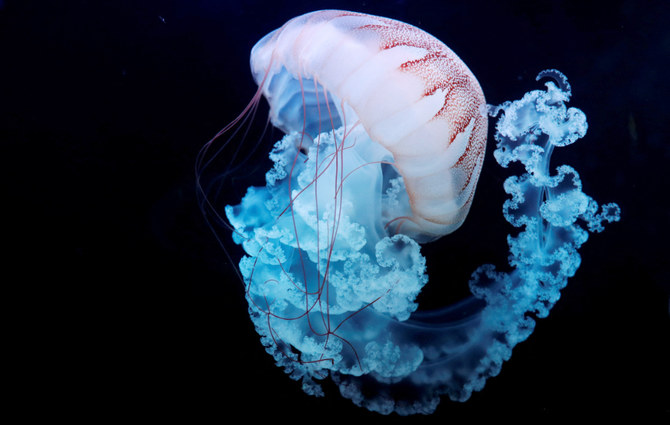
A jellyfish swims in a giant spherical tank at the World of Jellyfish aquarium in Prague, Czech Republic, February 3, 2020. (REUTERS)
Short Url
Updated 30 August 2022
Follow

Scientists find clues to what makes ‘immortal jellyfish’ immortal

  • Like other types of jellyfish, the T. dohrnii goes through a two-part life cycle, living on the sea floor during an asexual phase, where its chief role is to stay alive during times of food scarcity

CHICAGO: Scientists in Spain have unlocked the genetic code of the immortal jellyfish — a creature capable of repeatedly reverting into a juvenile state — in hopes of unearthing the secret to their unique longevity, and find new clues to human aging.
In their study, published on Monday in the Proceedings of the National Academy of Sciences, Maria Pascual-Torner, Victor Quesada and colleagues at the University of Oviedo mapped the genetic sequence of Turritopsis dohrnii, the only known species of jellyfish able to repeatedly revert back into a larval stage after sexual reproduction.
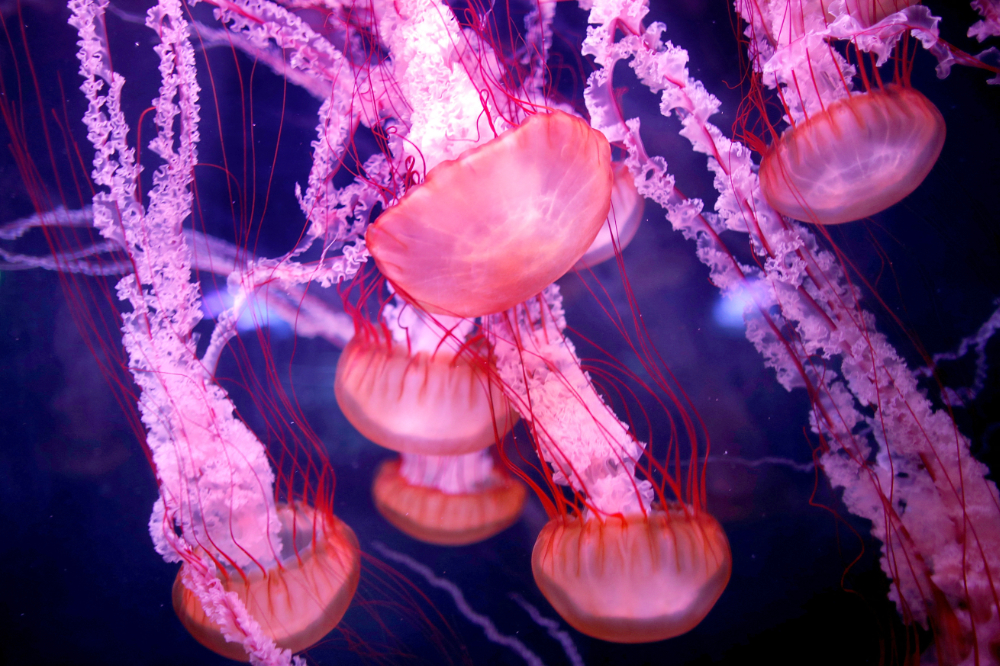


Jellyfish are seen in a new aquarium dedicated to 45 different delicate species at the Paris Aquarium, France, January 16, 2019. (REUTERS)

Like other types of jellyfish, the T. dohrnii goes through a two-part life cycle, living on the sea floor during an asexual phase, where its chief role is to stay alive during times of food scarcity. When conditions are right, jellyfish reproduce sexually.
Although many types of jellyfish have some capacity to reverse aging and revert to a larval stage, most lose this ability once they reach sexual maturity, the authors wrote. Not so for T. dohrnii.
“We’ve known about this species being able to do a little evolutionary trickery for maybe 15-20 years,” said Monty Graham, a jellyfish expert and director of the Florida Institute of Oceanography, who was not involved in the research.
This trick earned the species its nickname as the immortal jellyfish, a term Graham admits is a bit hyperbolic.
The study was aimed at understanding what made this jellyfish different by comparing the genetic sequence of T. dohrnii to that of Turritopsis rubra, a close genetic cousin that lacks the ability to rejuvenate after sexual reproduction.
What they found is that T. dohrnii has variations in its genome that may make it better at copying and repairing DNA. They also appear to be better at maintaining the ends of chromosomes called telomeres. In humans and other species, telomere length has been shown to shorten with age.
Graham said the research has no immediate commercial value.
“We can’t look at it as, hey, we are going to harvest these jellyfish and turn it into a skin cream,” he said.
It has more to do with understanding the processes and protein functionality that helps these jellyfish cheat death.
“It’s one of those papers that I do think will open up a door to a new line of study that’s worth pursuing.”


Cambodia takes back looted historic artifacts handled by British art dealer

Updated 28 February 2026
Follow

Cambodia takes back looted historic artifacts handled by British art dealer

  • The objects were returned under a 2020 agreement between the Ministry of Culture and Fine Arts and the family of the late Douglas Latchford, a British art collector and dealer who allegedly had the items smuggled out of Cambodia

PHNOM PENH, Cambodia: Cambodian officials on Friday received more than six dozen historic artifacts described as part of the country’s cultural heritage that had been looted during decades of war and instability.
At a ceremony attended by Deputy Prime Minister Hun Many, the 74 items were unveiled at the National Museum in Phnom Penh after their repatriation from the United Kingdom.
The objects were returned under a 2020 agreement between the Ministry of Culture and Fine Arts and the family of the late Douglas Latchford, a British art collector and dealer who allegedly had the items smuggled out of Cambodia.
“This substantial restitution represents one of the most important returns of Khmer cultural heritage in recent years, following major repatriations in 2021 and 2023 from the same collection,” the Culture Ministry said in a statement. “It marks a significant step forward in Cambodia’s continued efforts to recover, preserve, and restore its ancestral legacy for future generations.”
The artifacts were described as dating from the pre-Angkorian period through the height of the Angkor Empire, including “monumental sandstone sculptures, refined bronze works, and significant ritual objects.” The Angkor Empire, which extended from the ninth to the 15th century, is best known for the Angkor Wat archaeological site, the nation’s biggest tourist attraction.
Latchford was a prominent antiquities dealer who allegedly orchestrated an operation to sell looted Cambodian sculptures on the international market.
From 1970 to the 1980s, during Cambodia’s civil wars and the communist Khmer Rouge ‘s brutal reign, organized looting networks sent artifacts to Latchford, who then sold them to Western collectors, dealers, and institutions. These pieces were often physically damaged, having been pried off temple walls or other structures by the looters.
Latchford was indicted in a New York federal court in 2019 on charges including wire fraud and conspiracy. He died in 2020, aged 88, before he could be extradited to face charges.
Cambodia, like neighboring Thailand, has benefited from a trend in recent decades involving the repatriation of art and archaeological treasures. These include ancient Asian artworks as well as pieces lost or stolen during turmoil in places such as Syria, Iraq and Nazi-occupied Europe. New York’s Metropolitan Museum of Art is one of the prominent institutions that has been returning illegally smuggled art, including to Cambodia.
“The ancient artifacts created and preserved by our ancestors are now being returned to Cambodia, bringing warmth and joy, following the country’s return to peace,” said Hun Many, who is the younger brother of Prime Minister Hun Manet.