

Saudi calligraphers develop unique styles after learning rules of the art

1 / 2
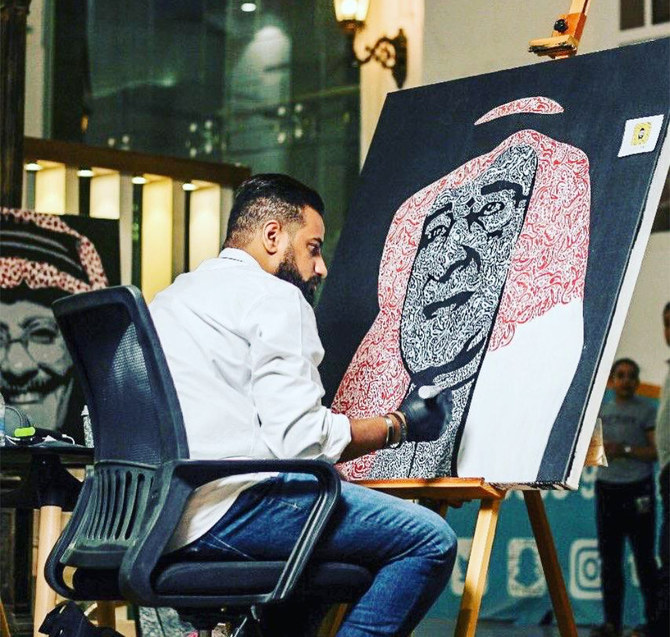
From a distance, Mohammed Bajubair’s artwork looks like accurate portraiture — most famously of members of Saudi Arabia’s royals — but upon closer inspection, the words become clearer. (Supplied)
2 / 2
Mazen Basaqer practicing his art form on different objects. (Supplied)
Short Url
Updated 29 August 2022
Follow

Saudi calligraphers develop unique styles after learning rules of the art

  • Calligraphers Mohammed Bajubair, Mazen Basaqer express creativity in different ways to distinguish artworks

JEDDAH: Calligraphy is an ancient art form practiced for thousands of years, and even today, people continue to employ the medium, which has evolved from merely an aesthetically-pleasing way to transmit the Arabic language, to express their own creativity.

Every artist who practices calligraphy adds something original. One of them is Saudi national Mohammed Bajubair, a 34-year-old calligrapher who has been taking Arabic poems and transcribing them in a way that creates portraits of people.

Typographic art, where words are written to create images, is well suited to the twisting, beautifying and bending of Arabic letters in a way that flows together.

Bajubair’s work is mind-bending, and breathtakingly beautiful. From a distance, it looks like accurate portraiture — most famously of members of the Kingdom’s royals — but upon closer inspection, the words become clearer.

FASTFACT

Mazen Basaqer has used all kinds of mediums for his calligraphy, from painting murals on big walls to tote bags to carving perfume bottles.

“The phrases, words, and poems I use are related to the person I am drawing. There is always a connection between the text I use and the person I have decided to portray,” said Bajubair, explaining how his work brings art and literature together.

He said he discovered this style of drawing “after learning calligraphy properly. I decided to apply the rules of typography to calligraphy and started arranging the calligraphy in a way that looked like realistic portraits. I developed it in my way so I can be distinguished among artists.”

Bajubair said standing out from a crowd of very creative people was his wish, to reach enough people with his artwork and leave a positive imprint for future generations.

The phrases, words, and poems I use are related to the person I am drawing. There is always a connection between the text I use and the person I have decided to portray.

Mohammed Bajubair

There are three great calligraphers who usually define the golden age of Arabic calligraphy: Ibn Muqla (886-940 AD), who is known as the inventor of the Thuluth style of calligraphy; Ibn Al-Buwwab (961-1022) who worked with the round script of the Arabic language, and Yakut Al-Musta’simi of Amasya (who died in 1298) who refined the six styles of Arabic calligraphy.

The six major Arabic calligraphy styles are Thuluth, Nesish, Muhakkak, Reyhami, Teuki, and Rika.

Mazen Basaqer, a calligrapher, defines the form as “like my sanctuary.”

He said that being such a big part of history makes calligraphy a sacred art. Still, to make it his own, he said he practiced the original rules first. “Once I had command over the calligraphy, and I was sure I understood the rules, I started to develop into my style.”

Basaqer has used all kinds of mediums for his calligraphy, from painting murals on big walls to tote bags to carving perfume bottles; he has managed to beautify everything, taking an object and making it a priceless piece of art.

He said that calligraphy has also gone from the physical world to social media, and this way, Arabs can reconnect with their ancient art, and people unacquainted with it can discover it.

“The art of Arabic calligraphy is not (just) an ancient art (but is) present in our current lives at all times. The period we live in can also be considered a golden time because I can reach my audience with just one touch,” said Basaqer.


Makkah’s urban shift enhances the city’s quality of life

Updated 08 February 2026
Follow

Makkah’s urban shift enhances the city’s quality of life

  • By harmonizing its religious heritage with modern urban development, Makkah is proving that a city can honor its past while vigorously embracing the future

MAKKAH: Islam’s holiest city is currently witnessing a qualitative urban shift, one that seamlessly blends its profound spiritual sanctity with a modern, vibrant lifestyle. By integrating cultural, educational, and entertainment initiatives, Makkah is redefining the visitor experience and significantly enhancing the quality of life for its residents, directly supporting the goals of Saudi Vision 2030.

The city’s transformation was recently highlighted by the success of the Makkah winter season. The event attracted approximately 400,000 visitors — over 60% of whom were locals — demonstrating a strong domestic demand for high-quality public spaces.

The season revitalized community interaction, driving a 35% increase in visits to recreational sites and creating more than 1,200 temporary jobs for the local workforce.

Central to this urban renaissance is the Hira Cultural District. Since opening its doors in January 2023 near the historic Mount Hira, the district has become a definitive landmark that bridges Islamic history with contemporary identity.

Makkah’s Hira Cultural District has become a definitive landmark that bridges Islamic history with contemporary identity. (SPA photo)

Far from being a static monument, the district has cultivated a thriving creative economy. Its craftsmanship program, which features over 100 artisans, has generated up to SAR 3 million in sales and attracted 130,000 visitors to live workshops. These interactive spaces allow visitors to engage directly with the region’s heritage, moving beyond passive observation to active participation.

A living legacy 

The shift extends to Makkah’s broader ecosystem of museums and cultural sites, which are now positioned as key pillars of cultural tourism. Facilities like the Revelation Exhibition use cutting-edge technology and multilingual content to narrate the story of the Holy Quran’s revelation, offering an immersive experience that complements the spiritual journey of pilgrims.

These efforts align with the “Makkah: A Living Legacy” campaign, which seeks to document the city’s historical narrative and preserve its collective memory. Recent months have seen a surge in educational workshops for university students and tour guides, ensuring that the human element of Makkah’s history is conveyed with accuracy and depth.

City’s transformation recently highlighted by the success of the Makkah winter season. (SPA photo)
 

Economic and social impact 

The results of this integrated approach are tangible. Specialized museums and restored historic sites now attract up to 1.6 million annual visitors. Crucially, this cultural enrichment is encouraging pilgrims to linger longer, increasing the average duration of stay by 18%.

By harmonizing its religious heritage with modern urban development, Makkah is proving that a city can honor its past while vigorously embracing the future, offering a holistic experience that nourishes both the soul and the community.