Ex-PM Khan’s political party accused of trying to scuttle IMF deal after leaked audio calls

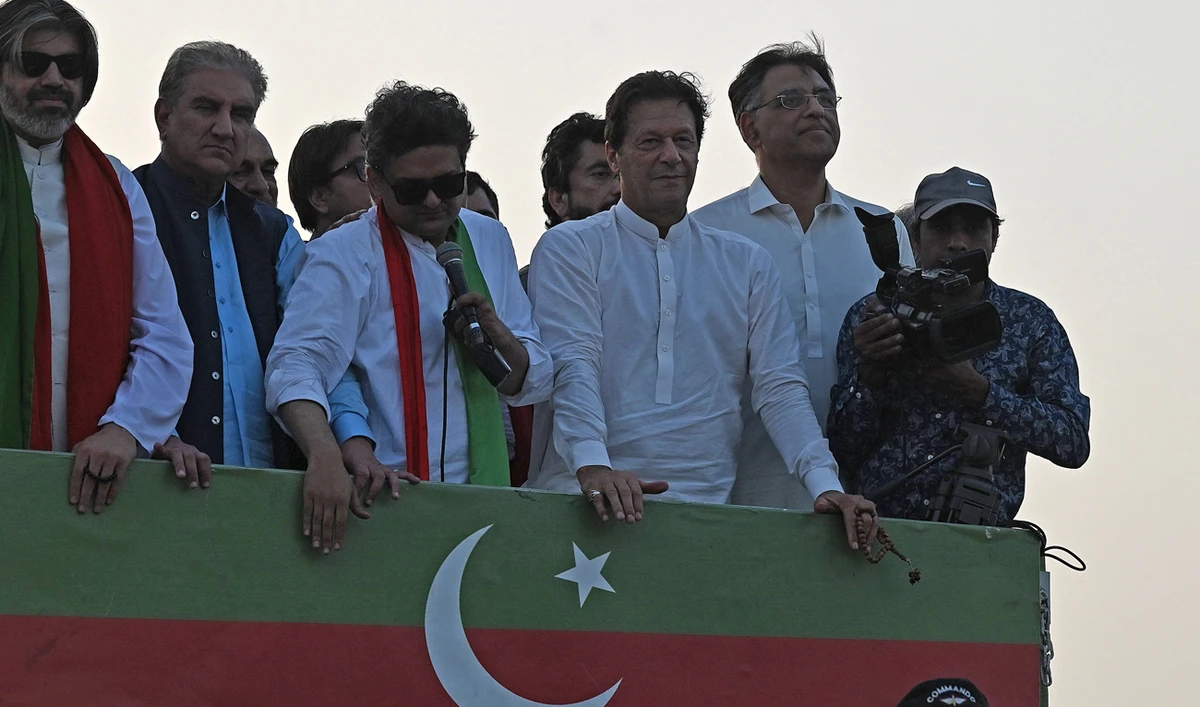
Pakistan's former prime minister Imran Khan (3R), takes part in a protest rally in Attock on May 25, 2022. (AFP/File)
Short Url
Updated 29 August 2022
Follow

Ex-PM Khan’s political party accused of trying to scuttle IMF deal after leaked audio calls

  • Khan’s close aide purportedly instructed Punjab and Khyber Pakhtunkhwa provinces to renege on IMF commitments
  • Asad Umar says Tarin wanted the provinces to seek fiscal concessions in the wake of the recent floods in the country

ISLAMABAD: The government on Monday accused former prime minister Imran Khan’s Pakistan Tehreek-e-Insaf (PTI) party of trying to scuttle a deal with the International Monetary Fund (IMF) after a local news channel played audio recordings of phone calls between a senior PTI leader and finance ministers of Punjab and Khyber Pakhtunkhwa provinces.

The leaked conversations were played by Geo News on the day when the IMF executive board is scheduled to review its staff-level agreement with Pakistan and decide if it wants to approve the resumption of a $6 billion loan program for the country.

Pakistani officials have said they are hopeful that the international lending agency will release $1.17 billion after the meeting since the country has met all its preconditions. However, the leaked phone calls suggest Khan’s close aide Shaukat Tarin instructed PTI administrations in Punjab and Khyber Pakhtunkhwa to renege on their commitments of provincial surplus ahead of the executive board meeting.

Discussing the audio leaks in a news conference, finance minister Miftah Ismail criticized the PTI leaders for jeopardizing the country’s economic interest for their own political gains.

“Are you bigger than this country,” he asked. “If there is no Pakistan, there will be no PTI.”

Ismail criticized Khan’s administration for mismanaging the national economy.

“First they made a promise to the IMF and then they broke it,” he said while referring to the PTI government’s decision to offer fuel and power subsidies earlier this year.

He added his own party was reluctant to assume the political power of the country at such a difficult economic juncture, though it ultimately decided to put its own “political capital at stake to save Pakistan.”

According to the audio recordings played by Geo News, PTI’s Tarin told Punjab finance minister Mohsin Leghari not to honor his province’s commitment to the IMF.

“You have signed a Rs750 billion commitment with the IMF,” he said. “You need to tell them now that the commitment was made before the floods.”

Khan’s aide also maintained the decision was taken to put the incumbent government under pressure.

A similar phone call between Tarin and Khyber Pakhtunkhwa’s finance minister Taimur Jhagra was also played by the news channel.

The audio recording was aired two days after the province backtracked from its IMF commitment.

Reacting to the development, Asad Umar, a senior PTI leader, held a news conference in which he defended Tarin’s conversation with the two provincial ministers.

“Shaukat Tarin only asked the finance ministers of the two provinces to tell the government that the country was facing floods and it was not a normal situation,” he said. “He asked them to seek concessions from the IMF vis-a-vis the provincial surplus condition under the circumstances.”

“Can any sane person say that it is not a good advice,” Umar asked.

He said that Khan also took a similar initiative during the COVID-19 pandemic to demand fiscal space for the country by calling the top IMF official on his own.

IMF board to approve Pakistan reviews today ‘if all goes well,’ say officials

Updated 08 December 2025
Follow

IMF board to approve Pakistan reviews today ‘if all goes well,’ say officials

  • IMF’s executive board is scheduled to meet today to discuss the disbursement of $1.2 billion
  • Economists say the money will boost Pakistan’s forex reserves, send positive signals to investors

KARACHI: The International Monetary Fund’s (IMF) executive board is scheduled to meet today, Monday, to approve the release of about $1.2 billion for Pakistan under the lender’s two loan facilities, said IMF officials who requested not to be named.

The IMF officials confirmed the executive board was going to decide on the Fund’s second review under the $7 billion Extended Fund Facility (EFF) and first review under the $1.4 billion Resilience and Sustainability Facility (RSF), a financing tool that provides long-term, low-cost loans to help countries address climate risks.

“The board meeting will be taking place as planned,” an IMF official told Arab News.

“The board is on today yes as per the calendar,” said another.

A well-placed official at Pakistan’s finance ministry also confirmed the board meeting was scheduled today to discuss the next tranche for Pakistan.

The IMF executive board’s meeting comes nearly two months after a staff-level agreement (SLA) was signed between the two sides in October.

Procedurally, the SLAs are subject to approval by the executive board, though it is largely viewed as a formality.

“If all goes well, the reviews should pass,” said the second IMF official.

On approval, Pakistan will have access to about $1 billion under the EFF and about $200 million under the RSF, the IMF said in a statement in October after the SLA.

The fresh transfer will bring total disbursements under the two arrangements to about $3.3 billion, it added.

Experts see smooth sailing for Pakistan in terms of the passing of the two reviews, saying the IMF disbursements will help the cash-strapped nation to strengthen its balance of payments position.

Samiullah Tariq, group head of research at Pakistan Kuwait Investment Company Limited, said the IMF board’s approval will show that Pakistan’s economy is on the right path.

“It obviously will help strengthen [the country’s] external sector, the balance of payments,” he told Arab News.

Until recently, Pakistan grappled with a macroeconomic crisis that drained its financial resources and triggered a balance of payments crisis.

Pakistan has reported financial gains since 2022, recording current account surpluses and taming inflation that touched unprecedented levels in mid-2023.

Economists also viewed the IMF’s bailout packages as crucial for cash-strapped Pakistan, which has relied heavily on financing from bilateral partners such as Saudi Arabia, China and the United Arab Emirates, as well as multilateral lenders.

Saudi Arabia, through the Saudi Fund for Development, last week extended the term of its $3 billion deposit for another year to help Pakistan boost its foreign exchange reserves, which stood at $14.5 billion as of November 28, according to State Bank of Pakistan statements.

“In our view this [IMF tranche] will be approved,” said Shankar Talreja, head of research at Karachi-based brokerage Topline Securities Limited.

“This will help strengthen reserves and will eventually help a rating upgrade going forward,” he said.

The IMF board’s nod, Talreja said, would also send a signal to the international and local investors regarding the continuation of the reform agenda by Pakistan’s government.