

Egyptian PM discusses bilateral relations with Japanese counterpart

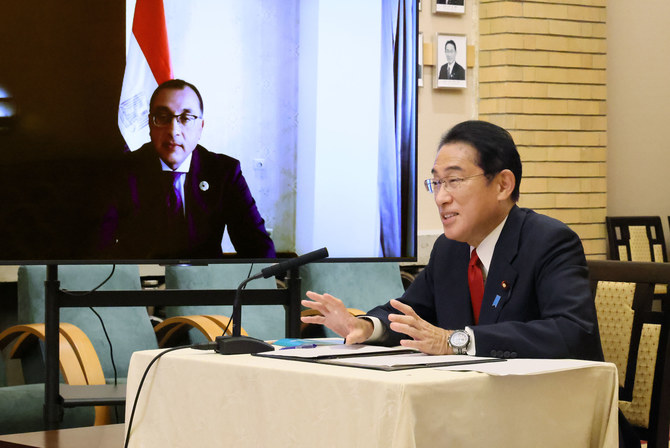
Egyptian Prime Minister Mostafa Madbouly meets with his Japanese counterpart Fumio Kishida via video link. (Twitter Photo)
Short Url
Updated 28 August 2022
Follow

Egyptian PM discusses bilateral relations with Japanese counterpart

  • PM Madbouly affirmed the Egyptian state’s appreciation for the support provided by the Japanese side in many important development projects, especially the Grand Egyptian Museum
  • Madbouly said that Egypt was looking forward to Japan taking executive steps to establish a Japanese industrial zone in the Suez Canal economic zone

CAIRO: On the sidelines of the eighth summit meeting in Tunisia of the Tokyo International Conference on African Development, Egyptian Prime Minister Mostafa Madbouly discussed with his Japanese counterpart, Fumio Kishida, bilateral relations and issues of common interest.

During the video conference meeting with Kishida, Madbouly offered his condolences on the death of Shinzo Abe, who was assassinated, stressing Egypt’s solidarity with Japan and praising the contributions made by Abe that had a great impact in deepening relations between the two countries.

Madbouly affirmed the Egyptian state’s appreciation for the support provided by the Japanese side in many important development projects, especially the Grand Egyptian Museum.

He said that Egypt was looking forward to Japan taking executive steps to establish a Japanese industrial zone in the Suez Canal economic zone in a way that achieved the common interests of both sides.

“The Japanese private sector can invest more in Egypt and benefit from legislative and structural reforms approved in the context of stimulating the business environment and improving the investment climate, particularly in the Suez Canal Economic Zone, which is an important logistical center that can serve as a portal for Japanese products to Africa,“ Madbouly said. 

Madbouly reviewed the investment opportunities available to Japanese companies in various sectors — including projects such as the new administrative capital, electricity and renewable energy projects, agricultural industrialization, water desalination and technology transfer — again referring to the incentives and guarantees guaranteed by Egyptian law to investors in these projects.

Madbouly stressed the Egyptian government’s interest in allowing more Egyptian agricultural products to enter Japan, which would contribute to boosting trade exchange between the two countries.

The Japanese prime minister thanked Madbouly for offering his condolences on the death of the Abe and expressed his happiness at the Egyptian participation in the conference summit.

Kishida said that there were many successful Japanese companies in Egypt, including Toyota Tsusho, which a few days ago signed two memoranda of understanding with the Suez Canal Authority and the Suez Canal Economic Zone.

He said that they would continue to encourage Japanese companies to come and invest in Egypt.

The Japanese prime minister praised the existing cooperation with Egypt in the field of schools as well as in higher education through the Egypt Japan University, which attracts not only Egyptian students but many African and foreign students.

Madbouly expressed the Egyptian government’s appreciation of the grants provided by its Japanese counterpart to Egyptian students.

Kishida concluded his speech by referring to aspects of development cooperation with Egypt in transportation and health, stressing his government’s interest in enhancing cooperation in various fields.


Virtual museum preserves Sudan’s plundered heritage

Updated 6 sec ago
Follow

Virtual museum preserves Sudan’s plundered heritage

CAIRO: Destroyed and looted in the early months of Sudan’s war, the national museum in Khartoum is now welcoming visitors virtually after months of painstaking effort to digitally recreate its collection.
At the museum itself, almost nothing remains of the 100,000 artefacts it had stored since its construction in the 1950s. Only the pieces too heavy for looters to haul off, like the massive granite statue of the Kush Pharaoh Taharqa and frescoes relocated from temples during the building of the Aswan Dam, are still present on site.
“The virtual museum is the only viable option to ensure continuity,” government antiquities official Ikhlass Abdel Latif said during a recent presentation of the project, carried out by the French Archaeological Unit for Sudanese Antiquities (SFDAS) with support from the Louvre and Britain’s Durham University.
When the museum was plundered following the outbreak of the war between the regular army and the paramilitary Rapid Support Forces (RSF) in April 2023, satellite images showed trucks loaded with relics heading toward Darfur, the western region now totally controlled by the RSF.
Since then, searches for the missing artefacts aided by Interpol have only yielded meagre results.
“The Khartoum museum was the cornerstone of Sudanese cultural preservation — the damage is astronomical,” said SFDAS researcher Faiza Drici, but “the virtual version lets us recreate the lost collections and keep a clear record.”
Drici worked for more than a year to reconstruct the lost holdings in a database, working from fragments of official lists, studies published by researchers and photos taken during excavation missions.
Then graphic designer Marcel Perrin created a computer model that mimicked the museum’s atmosphere — its architecture, its lighting and the arrangement of its displays.
Online since January 1, the virtual museum now gives visitors a facsimile of the experience of walking through the institution’s galleries — reconstructed from photographs and the original plans — and viewing more than 1,000 pieces inherited from the ancient Kingdom of Kush.
It will take until the end of 2026, however, for the project to upload its recreation of the museum’s famed “Gold Room,” which had housed solid-gold royal jewelry, figurines and ceremonial objects stolen by looters.
In addition to the virtual museum’s documentary value, the catalogue reconstructed by SFDAS is expected to bolster Interpol’s efforts to thwart the trafficking of Sudan’s stolen heritage.