

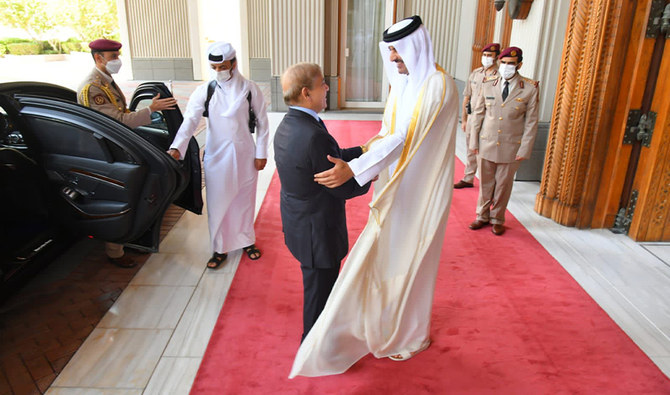
PM Sharif praises Qatar for its readiness to invest $3 billion in Pakistan

Pakistani Prime Minister Shehbaz Sharif received by Qatar’s Emir Sheikh Tamim bin Hamad Al-Thani at Dewan-e-Ameeri in Doha, Qatar on Aug 24, 2022. (PID)
Short Url
Updated 24 August 2022
Follow

PM Sharif praises Qatar for its readiness to invest $3 billion in Pakistan

  • The prime minister assures Qatar’s ruler Islamabad’s full support for successful organization of FIFA World Cup 2022
  • Sharif calls the presence of 200,000 Pakistanis in Qatar a testament to people-to-people linkages between the two states

ISLAMABAD: Prime Minister Shehbaz Sharif on Wednesday met Qatar’s Emir Sheikh Tamim bin Hamad Al-Thani and thanked him for his country’s readiness to invest $3 billion to support Pakistan’s cash-strapped economy.
Sharif, who arrived in Doha on a two-day official visit on Tuesday, met the top leader of the Arab state along with his key cabinet members and the army chief General Qamar Javed Bajwa.
Earlier in the day, the Qatar Investment Authority (QIA) announced its plan to invest $3 billion in various commercial and investment sectors in Pakistan.
“Held a very productive meeting with [His Highness] Sheikh Tamim bin Hamad Al-Thani, Emir of Qatar,” the prime minister said in a Twitter post. “We have decided to take our excellent bilateral relations to the next level of strategic engagement. Grateful to HH Emir for Qatar’s investment of $3 billion in various sectors of our economy.”


According to a statement issued by the PM Office in Islamabad, the two leaders discussed bilateral, regional and international issues during their extensive consultations.
“Recalling Pakistan’s long-term partnership with Qatar in the field of LNG cooperation, the Prime Minister thanked His Highness the Amir for Qatar’s vital support in meeting Pakistan’s energy needs,” the statement said, adding the two sides also explored new avenues for mutually beneficial cooperation in the energy sector.
The prime minister stressed that Pakistanis working and residing in Qatar were not only a source of strength for the economic progress of both countries but also a testament to the value of people-to-people linkages.
“He hoped that Qatar’s rapid economic growth would present even greater opportunities for Pakistanis in the future,” the statement continued.
More than 200,000 Pakistani nationals currently work and live in Qatar.
The prime minister also appreciated the extensive arrangements made by the Arab state to host the FIFA World Cup, 2022.
“He assured the Qatari leadership of Pakistan’s support for the successful organization of the mega event,” the statement added.
Pakistan’s cabinet recently approved a draft agreement to provide troops for the security of the football tournament in Qatar later this year.
During his stay in Doha, the prime minister held meeting with representatives of Qatar’s business community and urged them to explore opportunities presented by the China-Pakistan Economic Corridor to promote regional connectivity and mutual prosperity.
“The prime minister assured full facilitation to QIA through transparent and expeditious processes,” the PM Office said in a statement on Tuesday.


Pakistan’s president defends ongoing strikes in Afghanistan, urges Kabul to dismantle militants

Updated 02 March 2026
Follow

Pakistan’s president defends ongoing strikes in Afghanistan, urges Kabul to dismantle militants

  • Afghanistan on Thursday launched attacks in retaliation for Pakistani airstrikes the previous Sunday
  • Pakistan’s military says it is only targeting Afghan military installations to avoid civilian casualties

ISLAMABAD: Pakistan’s president on Monday defended his country’s ongoing military strikes in neighboring Afghanistan, saying Islamabad tried all forms of diplomacy before targeting militants operating from Afghan territory, and called on the Taliban government in Kabul to disarm groups responsible for attacks in Pakistan.

Pakistan earlier said it is in “open war” with Afghanistan, alarming the international community. The border area remains a stronghold for militant organizations including Al-Qaeda and the Daesh (Islamic State) group.

“(The Afghan Taliban) must choose to dismantle the terror groups that survive on conflict and its war economy,” Asif Ali Zardari said during a speech to lawmakers, adding that “no state accepts serial attacks on its soil.”

Afghanistan on Thursday launched attacks in retaliation for Pakistani airstrikes the previous Sunday. Since then, Pakistan has carried out operations along the border, with Information Minister Attaullah Tarar claiming the killing of 435 Afghan forces and the capture of 31 Afghan positions.

Kabul has denied such claims.

In Afghanistan, the deputy government spokesman Hamdullah Fitrat said Pakistan’s military fired mortar shells at a refugee camp in eastern Kunar province, killing three children and injuring three others.

Afghanistan’s defense ministry said Afghan forces carried out strikes targeting a Pakistani military facility near Paktia province, causing “substantial losses and heavy casualties.”

Pakistan’s military did not respond to questions. It has said Pakistan is only targeting Afghan military installations to avoid civilian casualties.

Pakistan has witnessed a surge of violence in recent months and blames it on the outlawed Pakistani Taliban, known as Tehreek-e-Taliban Pakistan or TTP. It operates both inside Pakistan and from Afghan territory.
Islamabad accuses Afghanistan’s Taliban government of providing safe havens for the TTP, which Kabul denies.

The latest cross-border fighting ended a ceasefire brokered by Qatar and Turkiye in October. The two sides failed to reach a permanent agreement during talks in Istanbul.

Zardari reiterated Pakistan’s call for talks, saying, “We have never walked away from dialogue.”

The Pakistani leader again accused Afghanistan of acting as a proxy for India by sheltering militant groups.

“Stop being used by another country as a battlefield for their ambitions,” he said.

Zardari cited a recent report from the United Nations Security Council’s monitoring team that described the presence of militant groups in Afghanistan as an extra-regional threat.