

Pakistani court orders interior ministry to probe alleged torture of ex-PM’s aide

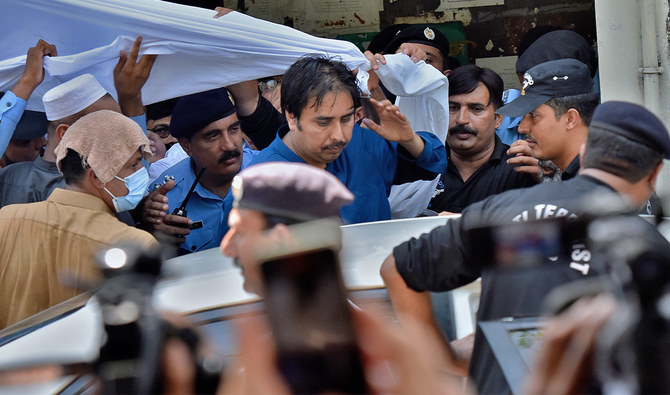
Police officers escort Shahbaz Gill, center in blue shirt, a political aide to former Pakistani prime minister Imran Khan, after a court appearance, in Islamabad, Pakistan, on August 22, 2022. (AP/File)
Short Url
Updated 24 August 2022
Follow

Pakistani court orders interior ministry to probe alleged torture of ex-PM’s aide

  • Islamabad High Court asks interior ministry to appoint an inquiry officer, preferably a retired judge
  • Dr. Shahbaz Gill was arrested on August 9 for allegedly making anti-military comments on a TV channel

ISLAMABAD: A Pakistani court on Wednesday directed the country’s interior ministry to probe allegations that former Prime Minister Imran Khan’s aide, Dr. Shahbaz Gill, was tortured in police custody.

Khan’s Pakistan Tehreek-e-Insaf (PTI) party says Gill, who is under arrest and faces sedition charges, has been tortured in police custody. Gill was arrested on August 9 for allegedly making anti-military comments on a TV channel that was subsequently suspended by the government. He was admitted to a government hospital in the capital last week after his health deteriorated in police custody.

The Pakistan government and police deny Gill was tortured.

In a 21-page order from the Islamabad High Court (IHC), Acting Chief Justice Aamir Farooq took notice of the “very serious issue” of Gill’s allegations and said the matter couldn’t “simply be ignored as it can entail serious consequences for future investigations.”

“It would be only appropriate that Ministry of Interior, Government of Pakistan should look into the matter [Gill’s alleged torture] and appoint an Inquiry Officer preferably a retired Judge of the High Court to examine the issue,” the order read.

It directed the inquiry officer to make detailed findings on the issue and also suggest ways to “curb the practice” of torture.

Justice Farooq said torture to extract evidence is prohibited in Pakistan’s constitution.

“Much judicial ink has been expended safeguarding the rights of the prisoners and accused persons and to protect them from torture,” he wrote.

A medical board at the Pakistan Institute of Management Sciences (PIMS) on August 18 suggested that Gill needed to be monitored and assessed by a cardiologist and pulmonologist. It added that Gill had a “known case of asthma since childhood” and now presented with shortness of breath, body aches including left shoulder, back, neck, right gluteal region and left sided chest pain.

While Pakistan’s constitution prohibits the use of torture “for extracting evidence,” no domestic legislation makes committing torture a criminal offense. Pakistan is a party to core international human rights treaties that prohibit the use of torture and other ill-treatment and mandate parties to the treaty to criminalize the practice.


Pakistan, Algeria discuss investment cooperation in energy, mining, digital sectors

Updated 5 sec ago
Follow

Pakistan, Algeria discuss investment cooperation in energy, mining, digital sectors

  • MoU planned between Algerian investment agency and Pakistan’s SIFC
  • Talks also cover digital governance and smart agriculture collaboration

ISLAMABAD: Pakistan and Algeria have agreed to pursue closer investment cooperation in energy, mining and digital development, Pakistan’s Special Investment Facilitation Council (SIFC) said on Friday, as Islamabad steps up efforts to attract foreign capital and expand international collaborations.

The SIFC is a hybrid civil-military body formed in 2023 to fast-track decisions related to international investment in sectors including tourism, livestock, agriculture and mines and minerals. It has been central to Pakistan’s efforts to attract foreign investment and streamline regulatory approvals amid recurring balance-of-payments pressures.

Federal Secretary SIFC Jamil Qureshi said in a social media post that he met Algeria’s Ambassador to Pakistan, Dr. Brahim Romani, and discussed signing a memorandum of understanding to strengthen institutional collaboration between the Algerian Investment Promotion Agency and the SIFC.

“Both countries share strong potential to expand cooperation in strategic sectors such as energy, mining, digital transformation, and industrial development,” he said.

“Algeria’s experience in leveraging natural resources through institutions like Sonatrach, developing large-scale mining projects, and promoting industrial localization through partnerships with global firms such as Stellantis offers valuable lessons for Pakistan as we advance priority initiatives including Reko Diq, renewable energy expansion, and EV manufacturing,” he continued.

Qureshi said the two sides also explored collaboration in digital governance and smart agriculture, similar to Algeria’s satellite-driven agricultural and climate monitoring initiatives.

Islamabad has in recent months intensified outreach to Middle Eastern, Central Asian and African partners as it seeks long-term investment rather than short-term financial support.

Pakistan’s economy has stabilized under an International Monetary Fund program, with the government actively seeking foreign investment and collaborations to boost growth, improve exports and ease pressure on foreign exchange reserves.

“We look forward to translating this shared vision into concrete projects that generate jobs, enhance exports, and strengthen Pakistan–Algeria economic partnership,” Qureshi added.

Qureshi did not provide a timeline for signing the proposed memorandum of understanding.