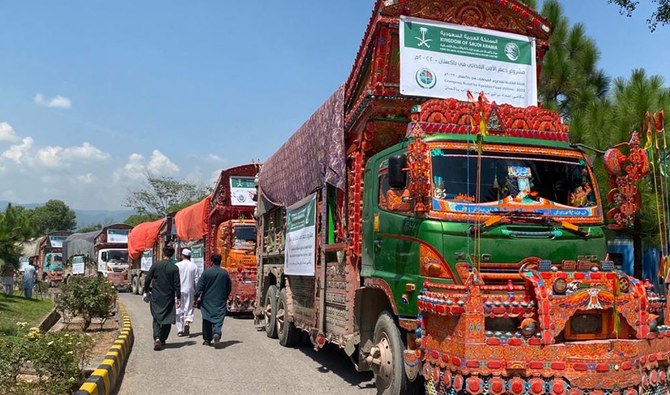
ISLAMABAD/QUETTA: The King Salman Humanitarian Aid and Relief Center on Monday dispatched a third convoy of essential food items to 17 flood-hit areas across Pakistan, the Saudi envoy to the country said.
At least 777 people have lost their lives in Pakistan since the beginning of the monsoon season in mid-June, according to the National Disaster Management Authority. The impoverished Balochistan province has been the worst hit with 255 dead, with the provincial government announcing on Sunday that all schools would remain closed for five days after nine more people were killed by heavy rains in different districts.
A joint survey by the provincial administration and UNICEF last week showed that 574 government schools, in which 79,000 children are enrolled, had been damaged due to ongoing rains and floods in 32 districts.
“The provincial health department has imposed a health emergency in Balochistan since there is imminent threat of diarrhea, cholera and malaria outbreaks in flood-hit districts,” Saleh Muhammad Nasir, the secretary health in the province, told Arab News.
“We have established a control room in the director general’s office to provide timely health facilities to the residents of flood-affected areas,” he added.
Quetta, the provincial capital of Balochistan, was also lashed by heavy rain on Sunday, causing major damage to various neighborhoods and causing prolonged power outages.
“Several houses in Quetta were partially damaged on Sunday, but the entire administration was on the ground to deal with the situation and prevent untoward incidents,” the city’s commissioner, Sohail-ur-Rehman Baloch, told Arab News.
Pakistan’s foreign minister, Bilawal Bhutto Zardari, canceled his tour of four European countries in view of the floods, his office said on Sunday.
KSrelief sent 100 emergency relief trucks carrying 10,000 food packages weighing 950 tons in total to 17 flood-ravaged districts in Pakistan.
“More than 70,000 people would benefit from this emergency relief,” Saudi Ambassador Nawaf bin Said Al-Malki told Arab News at a ceremony in Islamabad before the goods were dispatched.
Dr. Khalid Al-Othmani, director of KSrelief Pakistan, said this was the third — and the largest —consignment by the aid agency for the country’s flood victims.
“Each 95 kg food package consisted of all necessary essential food items, including 80 kg of flour, 5 liters of cooking oil, 5 kg of sugar, and 5 kg of daal chana (lentils), which is sufficient for a family for the whole month,” he told Arab News.
The Saudi international aid agency has implemented 2,069 projects globally worth almost $6 billion in 86 countries. Pakistan is one of the top five beneficiaries of the organization, with 149 projects worth $146.9 million executed since 2005.

KSrelief dispatches third relief convoy to flood-ravaged Pakistan
https://arab.news/54xtd
KSrelief dispatches third relief convoy to flood-ravaged Pakistan
- Saudi envoy in Islamabad says more than 70,000 people to benefit from emergency aid
- At least 777 people have died in Pakistan since the beginning of the monsoon season in mid-June
What is Trump’s ‘Board of Peace’?
- The Board of Peace’s charter does not appear to limit its role to the occupied Palestinian territory of Gaza
- Trump will be chairman but also “separately serve as inaugural representative of the United States of America”
BRUSSELS: US President Donald Trump’s government has asked countries to pay $1 billion for a permanent spot on his “Board of Peace” aimed at resolving conflicts, according to its charter seen by AFP.
The board was originally conceived to oversee the rebuilding of war-torn Gaza, but the charter does not appear to limit its role to the occupied Palestinian territory.
What exactly will it do? And who has been invited?
- To what end? -
The Board of Peace will be chaired by Trump, according to its founding charter.
It is “an international organization that seeks to promote stability, restore dependable and lawful governance, and secure enduring peace in areas affected or threatened by conflict,” reads the preamble of the charter sent to countries invited to participate.
It will “undertake such peace-building functions in accordance with international law,” it adds.
- Who’s boss? -
Trump will be chairman but also “separately serve as inaugural representative of the United States of America.”
“The Chairman shall have exclusive authority to create, modify, or dissolve subsidiary entities as necessary or appropriate to fulfill the Board of Peace’s mission,” the document states.
He will pick members of an Executive Board to be “leaders of global stature” to “serve two-year terms, subject to removal by the Chairman.”
He may also, “acting on behalf of the Board of Peace,” “adopt resolutions or other directives.”
The chairman can be replaced only in case of “voluntary resignation or as a result of incapacity.”
- Who can be a member? -
Member states have to be invited by the US president, and will be represented by their head of state or government.
Each member “shall serve a term of no more than three years,” the charter says.
But “the three-year membership term shall not apply to Member States that contribute more than USD $1,000,000,000 in cash funds to the Board of Peace within the first year of the Charter’s entry into force,” it adds.
The board will “convene voting meetings at least annually,” and “each member State shall have one vote.”
But while all decisions require “a majority of Member States present and voting,” they will also be “subject to the approval of the Chairman, who may also cast a vote in his capacity as Chairman in the event of a tie.”
- Who’s already in? -
The White House has said its members will include:
US President Donald Trump, chair
US Secretary of State Marco Rubio
Steve Witkoff, Trump’s special negotiator
Jared Kushner, Trump’s son-in-law
Tony Blair, former UK prime minister
Marc Rowan, billionaire US financier
Ajay Banga, World Bank president
Robert Gabriel, loyal Trump aide on the National Security Council
- Who’s been invited? -
The list of countries and leaders who say they have been invited include, but are not limited to:
Russia’s President Vladimir Putin
Canada’s Prime Minister Mark Carney
Egypt’s President Abdel Fattah El-Sisi
Argentina’s President Javier Milei
Jordan
Brazil
Paraguay
India
Pakistan
Germany
France
Italy
Hungary
Romania
Uzbekistan
Belarus
Greece
Morocco
Slovenia
Poland
- When does it start? -
The charter says it enters into force “upon expression of consent to be bound by three States.”