

Pakistan ‘categorically rejects’ Dehli’s announcement to register new voters in Indian-administered Kashmir

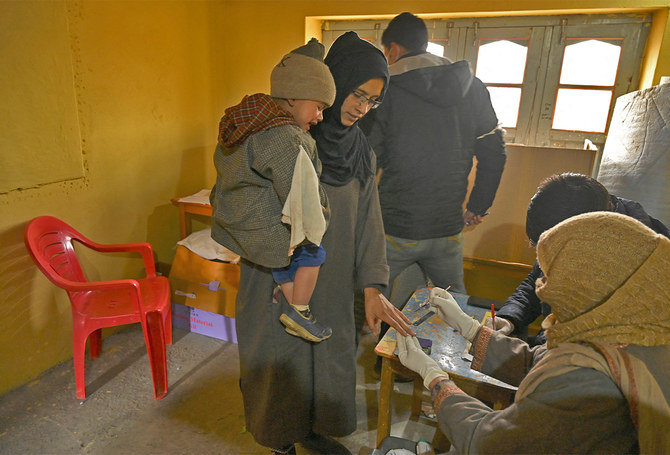
An election official marks the finger of a voter with indelible ink prior to casting ballot during the second phase of the District Development Council (DDC) and Panchayat by-elections at a polling station in Najan Sumbal area of Bandipora district on December 1, 2020. (AFP/File)
Short Url
Updated 19 August 2022
Follow

Pakistan ‘categorically rejects’ Dehli’s announcement to register new voters in Indian-administered Kashmir

  • India to register over 2 million voters in a move local politicians have called attempt to influence November elections
  • Kashmiris fear rule changes will allow BJP government led by PM Modi to alter demographics of the region

ISLAMABAD: Pakistan said on Friday it rejected what it called New Delhi's attempt at “pre-poll rigging” in Indian-administered Kashmir after announcements over two million new voters would be registered in the contested region, a move local political parties have called an attempt to influence upcoming elections.

The Muslim-majority region is claimed in full but ruled in part by nuclear arch-rivals India and Pakistan, who have fought two wars over control of the territory. New Delhi stripped semi-autonomy from its portion of the region in August 2019, changing the Indian constitution to allow non-Kashmiris to vote and own land there.

In a statement by the Pakistani foreign office, Islamabad said the announcement that even temporary residents in Kashmir, including outside workers and security personnel, would be permitted to register as ‘voters’ was an attempt “to influence the outcome of ‘so-called’ elections.”

“Despite its reprehensible measures that have followed the illegal and unilateral actions of 5 August 2019, India will not be able to break the will of the Kashmiri people or to mislead the world community,” the foreign office said, calling on New Delhi to desist from violating “international law, the UN Charter, and the 4th Geneva Convention,” which relates to the protection of civilians in times of war.

“India must also release all political prisoners detained on trumped-up charges, halt human rights violations … lift the brutal military siege, and let the Kashmiris exercise their legitimate right to self-determination as stipulated in the relevant UN Security Council resolutions,” the foreign office added.

Jammu and Kashmir Chief Electoral Officer Hirdesh Kumar told reporters on Wednesday more than 2 million new voters were expected to be enrolled in the region ahead of local polls due in November. The new registrants could increase the voter count by more than a third, adding to the existing 7.6 million voters in the region.

Kashmiris fear the rule changes will allow the Hindu-nationalist Bharatiya Janata Party (BJP) government led by Prime Minister Narendra Modi to alter the demographics of the region. The BJP says its policies in the region are for the benefit of ordinary Kashmiris.


Pakistan’s president defends ongoing strikes in Afghanistan, urges Kabul to dismantle militants

Updated 02 March 2026
Follow

Pakistan’s president defends ongoing strikes in Afghanistan, urges Kabul to dismantle militants

  • Afghanistan on Thursday launched attacks in retaliation for Pakistani airstrikes the previous Sunday
  • Pakistan’s military says it is only targeting Afghan military installations to avoid civilian casualties

ISLAMABAD: Pakistan’s president on Monday defended his country’s ongoing military strikes in neighboring Afghanistan, saying Islamabad tried all forms of diplomacy before targeting militants operating from Afghan territory, and called on the Taliban government in Kabul to disarm groups responsible for attacks in Pakistan.

Pakistan earlier said it is in “open war” with Afghanistan, alarming the international community. The border area remains a stronghold for militant organizations including Al-Qaeda and the Daesh (Islamic State) group.

“(The Afghan Taliban) must choose to dismantle the terror groups that survive on conflict and its war economy,” Asif Ali Zardari said during a speech to lawmakers, adding that “no state accepts serial attacks on its soil.”

Afghanistan on Thursday launched attacks in retaliation for Pakistani airstrikes the previous Sunday. Since then, Pakistan has carried out operations along the border, with Information Minister Attaullah Tarar claiming the killing of 435 Afghan forces and the capture of 31 Afghan positions.

Kabul has denied such claims.

In Afghanistan, the deputy government spokesman Hamdullah Fitrat said Pakistan’s military fired mortar shells at a refugee camp in eastern Kunar province, killing three children and injuring three others.

Afghanistan’s defense ministry said Afghan forces carried out strikes targeting a Pakistani military facility near Paktia province, causing “substantial losses and heavy casualties.”

Pakistan’s military did not respond to questions. It has said Pakistan is only targeting Afghan military installations to avoid civilian casualties.

Pakistan has witnessed a surge of violence in recent months and blames it on the outlawed Pakistani Taliban, known as Tehreek-e-Taliban Pakistan or TTP. It operates both inside Pakistan and from Afghan territory.
Islamabad accuses Afghanistan’s Taliban government of providing safe havens for the TTP, which Kabul denies.

The latest cross-border fighting ended a ceasefire brokered by Qatar and Turkiye in October. The two sides failed to reach a permanent agreement during talks in Istanbul.

Zardari reiterated Pakistan’s call for talks, saying, “We have never walked away from dialogue.”

The Pakistani leader again accused Afghanistan of acting as a proxy for India by sheltering militant groups.

“Stop being used by another country as a battlefield for their ambitions,” he said.

Zardari cited a recent report from the United Nations Security Council’s monitoring team that described the presence of militant groups in Afghanistan as an extra-regional threat.