

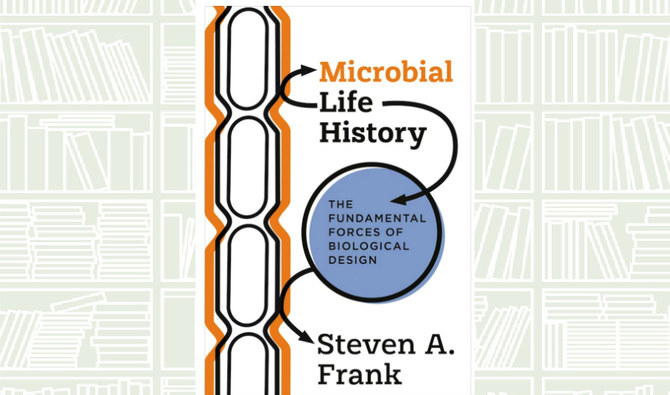
What We Are Reading Today: Microbial Life History

Short Url
Updated 18 August 2022
Follow

What We Are Reading Today: Microbial Life History

Author: Steven A. Frank

Design and diversity are the two great challenges in the study of life. Microbial Life History draws on the latest advances in microbiology to describe the fundamental forces of biological design and apply these evolutionary processes to a broad diversity of traits in microbial metabolism and biochemistry.

Emphasizing how to formulate and test hypotheses of adaptation, Steven Frank provides a new foundation for exploring the evolutionary forces of design.

He discusses the economic principles of marginal valuations, trade-offs, and payoffs in risky and random environments; the social aspects of conflict and cooperation; the demographic aspects of age and spatial heterogeneity; and the engineering control theory principles by which systems adjust to environments.

Frank then applies these evolutionary principles to the biochemistry of microbial metabolism, providing the first comprehensive link between the forces that shape biological design and cellular energetics.


What We Are Reading Today: The Political Economy of Security by Stephen G. Brooks

Updated 04 March 2026
Follow

What We Are Reading Today: The Political Economy of Security by Stephen G. Brooks

In this book, Stephen Brooks provides a systematic empirical and theoretical examination of how economic factors influence security affairs. Empirically, he analyzes how economic variables of all kinds affect interstate war, terrorism, and civil war; in total, 16 pathways are examined.

Brooks shows that the relationship between economic factors and conflict is complex and multifaceted; discrete economic factors—such as international trade, economic development, and globalized manufacturing, to name a few—are sometimes helpful for promoting peace and stability, but at other times are detrimental.

Brooks also develops a stronger theoretical foundation for guiding future research on the economics-security interaction. 

Drawing on Adam Smith, he provides a more complete range of answers to the three key conceptual questions analysts must consider: how economic goals relate to security goals; what economic factors to focus on; and how economic actors influence security policies.

Combining an innovative theoretical understanding with empirical rigor, Brooks’s account will reshape our understanding of the political economy of security.