JEDDAH: The Saudi Heritage Commission has announced that it will implement plans to survey and uncover buried heritage in the Red Sea in collaboration with the King Abdullah University of Science and Technology, the King Abdulaziz University and the University of Naples in Italy.
The commission said that plans will include surveying the Red Sea waters, from Umluj to Ras Al-Sheikh Hamid, in search for archeological findings, a project that had initially begun on July 13 and will continue to Sept. 5.
The project has thus far monitored more than 25 specific locations along the survey path including the Ras Al-Sheikh Hamid, Duba, Al-Wajh and Umluj areas using sonars. The devices will retrieve underwater and mosaic maps as well as high-quality photographs of the areas.
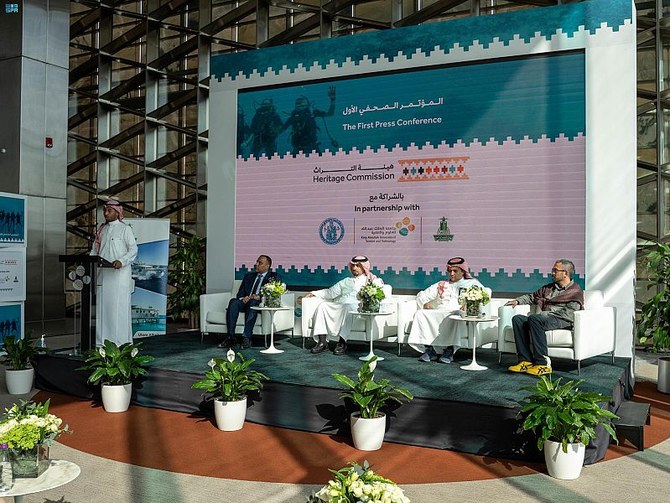
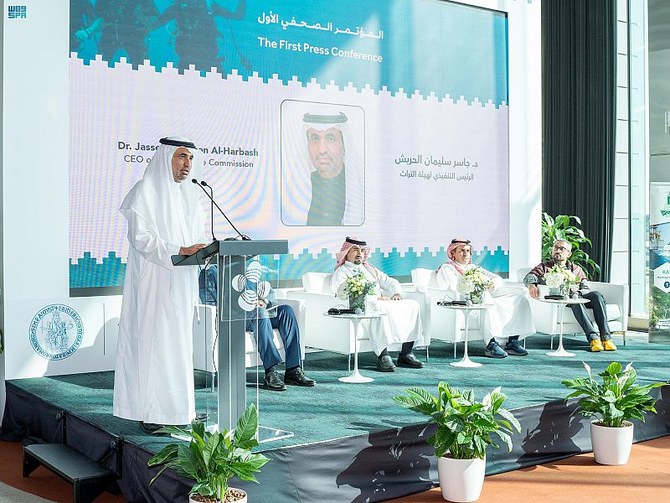
Saudi Heritage Commission CEO Dr. Jasir Al-Herbish said that the announcement is in line with the commission’s policy to notify media agencies, the general public and those interested in archeology of plans and efforts made in collaboration with scientific institutions and international organizations to discover these historical sites.
Its goal with this initiative is to develop the field of archeological diving and share the results of the historical site surveys in order to educate the public about areas in the Red Sea that are rich with cultural heritage — and just as essential as archeological findings on dry land.
Al-Herbish highlighted the efforts that are already in progress, such as a specialized center for the protection of underwater cultural heritage in the Red Sea and the Arabian Gulf.
He stressed that the waters of the Red Sea and the Arabian Gulf are still incubating many secrets about the Kingdom’s cultural heritage, and the center hopes it will contribute to discovering them.
Vice President and Senior Associate of KAUST Dr. Najah Ashry said: “We at KAUST Basic Laboratories are exploring the secrets of the Red Sea using advanced marine technologies and building advanced capabilities with our partners,” the Saudi Press Agency reported.
The Umluj shipwreck area was previously surveyed in a collaborative effort by the commission and an Italian team from the University of Naples in 2015 and 2016, which determined that the wreck dates back over 100 years.
Some of the survey findings included a mound of pottery next to the wreck, hundreds of high-quality Chinese porcelain pieces, a coconut shell and various metals.


Saudi Heritage Commission to survey Red Sea for archeological finds

https://arab.news/5phq4
Saudi Heritage Commission to survey Red Sea for archeological finds


Saudi Arabia announces new financial support to the Yemeni government
RIYADH: Saudi Ambassador to Yemen and Supervisor of the Saudi Program for the Development and Reconstruction of Yemen Mohammed Al-Jaber announced that the Kingdom, under the directives of its leadership, has provided new support to the Yemeni government's budget, aimed at paying the salaries of state employees in all sectors.
In a post on X, Al-Jaber stated that this support complements a package of development projects and initiatives, amounting to SR1.9 billion, announced on Wednesday. The package includes provision of necessary petroleum derivatives to operate power plants, which will contribute to improving the living standards of people in Yemen and alleviating daily burdens on them.
Al-Jaber’s post emphasized, in particular, that all salaries of military and security forces linked to the the higher military committee linked to the Saudi led Coalition will be paid as of Sunday.
The post is likely relate to Several Media reports which have suggested that disgraced former Southern Transitional Council (STC) chief Aidaroos Al Zubaidi — who has now fled Yemen — was taking advantage of military personnel and withholding salaries as means of pressure. Al-Zubaidi is wanted by the Yemeni government for acts of high treason and corruption.
The ambassador emphasized that these steps come within the framework of supporting the Yemeni government's efforts to implement the economic reform program, which aims to achieve financial and economic stability and enhance the state's ability to meet its basic obligations.


