

Laporta’s economic gambles far from guaranteed to pay off for Barcelona

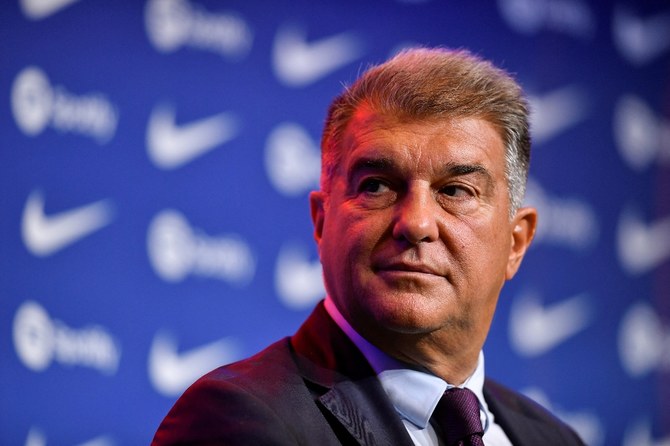
FC Barcelona President Joan Laporta gave a press conference with then-CEO ​​Ferran Reverter, in which he said the club was in “accounting bankruptcy”. (File/AFP)
Short Url
Updated 17 August 2022
Follow

Laporta’s economic gambles far from guaranteed to pay off for Barcelona

  • After a summer of pulled financial levers and big signings, a drab 0-0 draw against Vallecano showed there will be no overnight fix for the team’s on-pitch troubles

Slowly, the picture at Barcelona is getting clearer — and for coach Xavi Hernandez, better. At least we know which players are eligible to pull on the shirt officially.

It has been a long and confusing road, which finally reached an end, of sorts, with the disappointing 0-0 draw against Rayo Vallecano on Saturday night.

On Oct. 6, 2021, FC Barcelona President Joan Laporta gave a press conference with then-CEO ​​Ferran Reverter, in which he said the club was in “accounting bankruptcy” and owed $1.5 billion because of the previous board’s mismanagement.

Laporta had only returned to the presidency a few months earlier, in March 2021, and since then it has been one setback after another for the Catalan club.

First was the earth-shattering news last summer that Lionel Messi was leaving Camp Nou. Worse followed as the club, with no money, could not replace the glaring hole left by the Argentine with any big-name signings.

The president who had brought joy back to the club in 2003, who oversaw the iconic Pep Guardiola era, was now a man who only reported bad news.

That is until this summer, when Laporta worked his magic again and pulled a rabbit out of his hat — or at least pulled those financial “levers” we have heard so much about recently.

Only months after Laporta made the club’s technical bankruptcy official, Barcelona somehow became, to global astonishment, the highest-spending club this summer: Raphinha came from Leeds for $59 million, Jules Koundé from Sevilla for $55 million, and Robert Lewandowski from Bayern Munich for $46 million.

Chelsea’s Marcos Alonso and Manchester City’s Bernardo Silva could be the next to arrive if rumors are to be believed.

So how did the bankrupt club become one of the world’s biggest spenders? In a word, levers. Or, in effect, selling future income.

The first two levers allowed the club to cash in $535 million by selling 25 percent of its TV rights for the next 25 years to the US investment fund Sixth Street.

Barcelona currently earn $167 million a year from TV broadcasting rights. At these prices, Sixth Street would receive $1.05 billion over the next 25 years, double what was invested in the lever.

The club also sold 49 percent of Barça Studios, the club’s audio-visual production company, in exchange for $203 million.

In a few short weeks, fans had to become familiar with a process — all above board, everyone was assured — few had heard of before.

But legal concerns aside, is it reasonable, even ethical, for a bankrupt club to become the summer’s highest spending club? It does not sound like financial common sense.

To understand the necessity for these levers, it is first necessary to understand how the club works.

Barcelona, like Real Madrid, is fully owned by its members, and the statutes prohibit transforming the club into a “sports company” — like Chelsea. In short, it is not possible for another company to buy capital from the club.

In addition to these episodes of creative accounting, the fact remains that the club gave up part of its future TV income in an effort to create a new “virtuous circle” of victories and income that is far from guaranteed.

The idea that Barcelona’s salvation lies in mortgaging income for the next 25 years is a gap in the Laportian economic reasoning that is difficult to fill.

The president’s plan is to make the club sexy again, giving it a reboot of sorts that will ensure the new star signings will further attract resources and new fans, and create bonds and new incomes that exceed those now mortgaged.

All experts, critics and even supporters of Laporta agree this is a high-risk operation. If the team does not perform on the pitch, the house of cards could fall apart.

The 0-0 against Rayo Vallecano will hardly have placated the critics. With over $150 million spent on five signings this summer, expectations were sky-high at Camp Nou in the first game of the new La Liga season.

In front of a full house at Barça’s dilapidated stadium, Hernandez started three of their new signings, but Andreas Christensen, Raphinha and Lewandowski could not help the team achieve victory in drab performance.

Laporta has taken a massive risk, and it could well be his last card. His critics await. Should it fail, Barcelona might just have to face the possibility of becoming a sociedad anónima deportiva (sports company) owned by outside forces, something unimaginable until recently. And Laporta will go down in history as the villain who allowed it to happen under his reign.


‘20 years of engagement’ — inaugural Formula 4 championship success signals bright future for motorsport in Saudi Arabia

Updated 4 sec ago
Follow

‘20 years of engagement’ — inaugural Formula 4 championship success signals bright future for motorsport in Saudi Arabia

  • Peter Thompson, founder of the Formula 4 Saudi Arabian Championship and Meritus.GP team principal, spoke about the Kingdom’s first motorsport academy and his hopes for the future

RIYADH: Last year welcomed the inaugural season of the FIA-certified Aramco Formula 4 Saudi Arabian Championship.

The series, which aims to provide the first step on the ladder towards Formula 1, was the culmination of years of collaboration between various investors and partners, led by the Kingdom’s first motorsport academy, Meritus.GP.

The championship’s mission?

To produce local driving talent, strengthen Saudi national race engineering capabilities and advance motorsport in alignment with the objectives of Saudi Vision 2030.

Five Saudi drivers emerged, with standout victories by Omar Al-Dereyaan and Faisal Al-Kabbani, both from Riyadh. Other graduates included race winner Oscar Wurz, who has since won the 2025 Central European Formula 4 Championship.

Arab News spoke with Peter Thompson, founder of Formula 4 Saudi Arabia and Meritus.GP, about the season’s success and his hopes for the future.

How did Meritus.GP build the Formula 4 Saudi Arabian Championship?

The Formula 4 Saudi Arabian Championship was the result of more than 20 years of engagement, exploration and groundwork in Saudi Arabia, in anticipation of a potential FIA-certified junior single-seater championship in the Kingdom.

Long before the first Formula 1 Saudi Arabian Grand Prix, we were on the ground exploring circuit development opportunities, assessing infrastructure readiness and evaluating whether Saudi Arabia could host a round of one of the Asian championships operated by the team. Throughout this period, we maintained long-standing relationships within Saudi motorsport circles including former Meritus.GP driver Raad Abduljawad and his brother Mohammed Abduljawad.

A defining moment came with the introduction of Formula 1 to Saudi Arabia. The Jeddah Corniche Circuit quickly became a visible symbol of this ambition, providing confidence that Saudi Arabia could support not only Formula One, but also a structured ladder of junior single-seater racing.

When did Meritus.GP receive formal institutional approval to begin Formula 4 Saudi Arabia?

More than three years of focused groundwork preceded the first race. During this period there was no formal government mandate, no guaranteed institutional backing and no commercial certainty that the project would proceed or be viable.

Then, in December 2022, a formal No-Objection Letter was issued by the Saudi Automobile and Motorcycle Federation, under the leadership of its then-CEO Sattam Al-Hozami, which allowed the project to progress from concept to reality.

Recognizing the benefits F4 would bring to the Kingdom, Mohammed Abduljawad became an investor in June 2023, and Formula 4 Saudi Arabia moved into full delivery mode.

What were the objectives of the proposal presented to Saudi Aramco?

The proposal positioned Aramco Formula 4 Saudi Arabia as a long-term national development platform aligned with Vision 2030.

Its objectives included creating a structured FIA driver pathway from grassroots to Formula One, as well as developing Saudi engineers, mechanics and officials in motorsports.

How did the championship support Saudi drivers, and what was the impact on local talent?

A core objective of Formula 4 Saudi Arabia was to create a genuine, fair and internationally credible environment in which Saudi racers could develop.

Saudi drivers competed alongside international peers under identical technical and sporting conditions, allowing performance and development to be measured objectively.

They ended up achieving race wins, podium finishes and measurable progress across the season, demonstrating that when provided with the right structure, Saudi talent can compete at international level. 

How has Formula 4 Saudi Arabia engaged with Saudi education and skills development?

Education and skills transfer formed an important part of the championship’s wider mission.

During the season, Meritus.GP engineers and senior staff visited Saudi education and research institutions such as KAUST, Alfaisal University, University of Tabuk and the Japanese College in Jeddah to discuss career pathways in motorsport engineering, data analysis, and systems integration. These engagements were designed to connect academic study with real-world high-performance engineering environments.

What level of investment was required and how did you ensure equality of performance?

Approximately $6.5 million was invested prior to the first event.

Was there any pre-season training to help Saudi drivers prepare?

During August and September 2023 Saudi drivers participated in a structured pre-season academy program at Meritus.GP’s training facility in Sepang, Malaysia.

What role did sports psychology and driver well-being play in the championship?

Driver well-being and mental performance were treated as integral components of driver development.

Formula 4 Saudi Arabia appointed a dedicated sports psychologist to support drivers throughout the season, focusing on mental preparation, confidence building, coping strategies, performance consistency and adaptation to high-pressure racing environments.