

Five more deaths in Balochistan take Pakistan's monsoon toll to 640

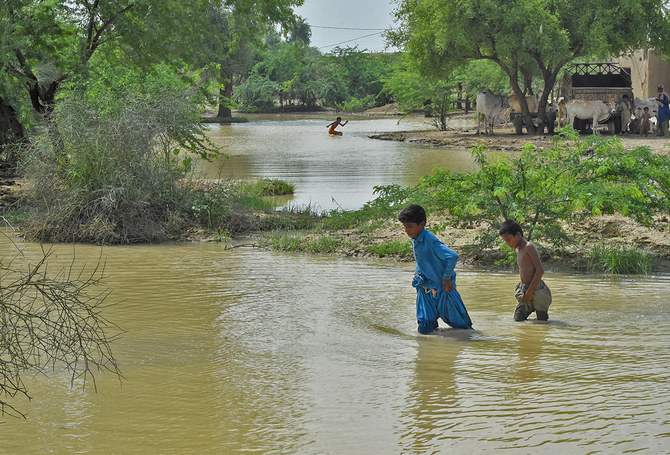
Childern wade across at a flood affected town in southwestern province of Balochistan, Pakistan on August 2, 2022. (AFP)
Short Url
Updated 17 August 2022
Follow

Five more deaths in Balochistan take Pakistan's monsoon toll to 640

  • Torrential rains, floods have claimed over 200 lives in Balochistan since mid-June
  • Railway authorities in Quetta have suspended train service to other provinces

QUETTA: A senior official in Pakistan's southwestern Balochistan province said on Wednesday three women and two children were killed after their vehicle was swept away in flood near Pishin district, taking the national death toll to 640 since the beginning of the monsoon season in mid-June.

Pakistan’s Meteorological Department warned last week that torrential rains were going to lash the country's southern region, saying they would continue until August 18.

So far, 201 residents of Balochistan have lost their lives in rains and floods since the beginning of the monsoon season in mid-June.

Speaking to Arab News, the deputy commissioner of Pishin, Zafar Ali, confirmed that a vehicle carrying women and children attempted to cross flood water while moving from Quetta to Killa Abdullah district when the accident took place.

“Locals told the driver to take another route since flood water was moving through the area, but he accelerated his vehicle which was swept away,” he said. “Three women and two children were killed in the incident.”

Ali informed that security forces had recovered the bodies from Mirani area of district Pishin, adding they had been handed over to the bereaved family.

Official statistics gathered by the provincial authorities reveal that more than 40,000 houses have been damaged in recent floods in Balochistan that have also affected 400,000 acres of agricultural land.

The situation has also made it difficult for the residents of the province to travel to other areas since train services to Sindh and Punjab have been suspended by the authorities.

“The district administration in Sibi has set an embankment to stop the flow of water toward the city,” Muhammad Kashif, a railway official, told Arab News. “Until water is drained out from the area, it will be difficult to resume train service since the tracks are completely covered with water.”

He informed the railway authorities were helping passengers travel to nearby towns by hiring buses, adding these people would then catch a train to their respective destinations.

Pakistan’s federal cabinet on Tuesday decided to form a committee, chaired by the climate change minister, which would give its recommendations on launching projects to mitigate the impact of harsh weather conditions on the lives of people.

Pakistan is among the top eight countries most affected by climate change, though its share in the world carbon emissions is nearly one percent.

The flood forecasting division of the Pakistan Meteorological Department issued an alert on Tuesday, saying India had released 171,797 cusecs water which was likely to flood rivers in Pakistan.


Pakistan vaccinates over 43 million children as last polio drive of 2025 enters 6th day

Updated 8 sec ago
Follow

Pakistan vaccinates over 43 million children as last polio drive of 2025 enters 6th day

  • Campaign running simultaneously in Pakistan and Afghanistan, last two polio-endemic countries
  • Health authorities urge parents and communities to fully cooperate with anti-polio vaccinators

ISLAMABAD: Pakistan has vaccinated more than 43.8 million children in five days of its last nationwide polio campaign of 2025, health authorities said on Saturday, as the drive entered its sixth day amid renewed efforts to curb the virus.

The campaign, running from Dec. 15 to 21, targets children under the age of five and is being conducted simultaneously in Pakistan and Afghanistan, according to Pakistan’s National Emergency Operations Center (NEOC) which oversees eradication efforts.

Pakistan and neighboring Afghanistan are the only two countries where wild poliovirus transmission has never been interrupted, keeping global eradication efforts at risk. The virus, which can cause irreversible paralysis, has no cure and can only be prevented through repeated oral vaccination.

“The last nationwide polio campaign of 2025 continues in full swing on the sixth day,” the NEOC said in a statement. “Over 43.8 million children have been vaccinated in five days so far.”

Provincial data released by the National EOC showed that around 22.7 million children had been vaccinated in Punjab province, more than 10.2 million in Sindh, approximately 6.9 million in Khyber Pakhtunkhwa and about 2.5 million in Balochistan. In Islamabad, over 450,000 children received polio drops, while more than 274,000 were vaccinated in Gilgit-Baltistan and over 714,000 in Azad Jammu and Kashmir.

“The polio campaign is being conducted simultaneously in Pakistan and Afghanistan,” the NEOC said. “More than 400,000 polio workers are going door to door across the country to administer vaccines.”

Pakistan has logged 30 polio cases so far in 2025, underscoring the fragility of progress against the virus. The country recorded 74 cases in 2024, a sharp rise from six cases in 2023, reflecting setbacks caused by vaccine hesitancy, misinformation and access challenges in high-risk areas.

Health officials say insecurity remains a major obstacle. Polio workers and their security escorts have repeatedly been targeted in militant attacks, particularly in parts of northwestern Khyber Pakhtunkhwa and southwestern Balochistan, complicating efforts to reach every child. Natural disasters, including flooding, have further disrupted vaccination campaigns in recent years.

“Parents and communities are urged to fully cooperate with polio workers,” the NEOC said, stressing that every child under the age of five must be given polio drops.

Pakistan has dramatically reduced polio prevalence since the 1990s, when annual cases exceeded 20,000. Health authorities, however, warn that without sustained access to children in underserved and conflict-affected areas, eradication will remain out of reach.