

Saudi-Uzbek trade exceeds $95m in the first half of 2022

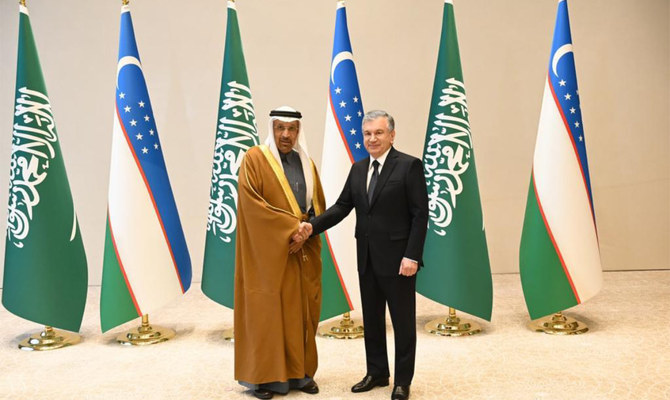
Saudi Arabia’s Investment Minister Khalid Al-Falih held a meeting with Uzbek President Shavkat Mirziyoyev during a recent visit to Uzbekistan to discuss collaboration in different sectors of the economy. (File)
Short Url
Updated 17 August 2022
Follow

Saudi-Uzbek trade exceeds $95m in the first half of 2022

  • The two countries will bolster ties further with the signing of 12 new deals this week

RIYADH: The mutual trade between Saudi Arabia and the Republic of Uzbekistan reached $95 million in the first half of 2022, a substantial increase considering that bilateral trade barely exceeded $17 million last year.

According to a joint news statement, the value is expected to grow rapidly by the end of 2022. The numbers assume significance in the aftermath of the pandemic.

In fact, the number of Uzbek companies running on Saudi funds increased from about nine to 38 in the last five years. Of the 38, 19 are sole proprietors, and the rest are joint ventures.

The two nations will bolster the ties further by signing 12 new agreements on Wednesday and Thursday when Uzbekistan President Shavkat Mirziyoyev visits the Kingdom.

According to an Uzbek state agency, high-level talks will take place in Jeddah, where the two nations will discuss opportunities to enhance multilateral cooperation further.

The discussion will focus on the green economy, technology and digitalization, innovations, small business and entrepreneurship. 
Following the meeting, new agreements are expected to be signed in the energy, telecommunications, agriculture, chemical and petrochemical industries, besides encouraging ties in culture, sports and education.

The Kingdom has become one of the largest foreign investors in energy infrastructure and one of Uzbekistan’s most significant developers of green energy projects.

ACWA Power’s Uzbek interests

Recently, the Ministry of Energy of Uzbekistan and Saudi energy company ACWA Power signed several investment agreements for about $3 billion.

ACWA Power will develop and operate a wind energy project with a production capacity of 1,500 MW in the Karakalpakstan region of Uzbekistan.

When commissioned, the plant will become the largest of its kind in Central Asia and one of the largest wind power plants in the world. 

FASTFACTS

• The number of Uzbek companies running on Saudi funds increased from about nine to 38 in the last five years.

• Recently, the Ministry of Energy of Uzbekistan and Saudi energy company ACWA Power signed several investment agreements for about $3 billion.

• The Saudi Fund for Development has contributed to the implementation of many projects in Uzbekistan, including funding the Samarkand-Gozar Road project, with a total value of $30 million.

ACWA Power also signed an agreement to establish the 100MW Nokus wind farm project, the first renewable energy project to be implemented in partnership with Uzbekistan’s public and private sectors.

The power generating company also won a $108 million wind contract after proposing a tariff of 2.56 cents per kilowatt-hour, the lowest in Uzbekistan.

Additionally, the Ministry of Energy of Uzbekistan signed a 25-year power purchase agreement with ACWA Power to establish a combined-cycle gas turbine power plant in Shirin, located in Syrdarya, Uzbekistan. The deal amounts to $1.2 billion.

According to the statement, these projects will contribute to achieving Uzbekistan’s national goal of raising the total renewable energy generation capacity to 30 percent by 2030.

Saudi Fund for Development

Moreover, the Saudi Fund for Development has contributed to the implementation of many projects in Uzbekistan, including funding the Samarkand-Gozar Road project, with a total value of $30 million.

The fund also contributed to 20 projects in the republic, including building pumping stations and other projects involving sewage, chemicals, mining, building materials, water and agriculture.

According to the Ministry of Agriculture of Uzbekistan, the Saudi and Uzbek delegations have discussed issues of cooperation in agriculture, including the prospects for enhancing mutual trade in agricultural products.

Both parties will likely sign memorandums of cooperation in agriculture, veterinary medicine and livestock development at the meeting.

They also agreed to deepen cooperation in the agricultural sector to enhance trade in farming, livestock and other products between the countries.

After signing the memoranda, action plans will be prepared, including specific measures and areas for developing cooperation and joint projects.

The Saudi side invited the Uzbekistan delegation to attend its most prominent exhibition of the agro-industrial complex, which will be held at the end of October in Riyadh.


Saudi Maaden reports 156% profit surge to $2bn on strong commodity prices, record production

Updated 05 March 2026
Follow

Saudi Maaden reports 156% profit surge to $2bn on strong commodity prices, record production

RIYADH: Saudi mining and metals company Maaden has reported a 156 percent jump in its net profit attributable to shareholders for 2025, driven by higher commodity prices, record production volumes, and a one-off bargain purchase gain.

The state-backed giant posted a net profit of SR7.35 billion ($1.95 billion) for the full year 2025, an increase from SR2.87 billion in the previous year. The firm’s revenue surged by 19 percent to SR38.58 billion, up from SR32.55 billion in 2024.

This comes as Saudi Arabia steps up efforts to expand its mining sector as a pillar of economic diversification, encouraging international participation and private investment to unlock the Kingdom’s estimated $2.5 trillion in untapped mineral resources under Vision 2030.    

In a statement on Tadawul, the company said: “Performance was led by record phosphate production, near record aluminum production, an increase in all three of Maaden’s main output commodity prices.”

The performance was also fueled by a 60 percent increase in gross profit, which reached SR14.79 billion. In its annual results announcement, Maaden attributed the top-line growth to “higher commodity market prices for phosphate, aluminum and gold business units,” as well as increased sales volumes in its phosphate and aluminum segments. This was partially offset by slightly lower sales volume in the gold unit.

Maaden’s CEO, Bob Wilt, hailed 2025 as a transformative year for the company, marked by strategic growth and operational excellence. “This was a great year for Maaden’s strategic growth. We delivered strong financial results and sustained operational excellence across the business,” he said in a statement.

“This was driven by growth in production across all businesses, including record-breaking DAP (di-ammonium phosphatevolumes), disciplined cost control across and a clear commitment to our role as a cornerstone of the Saudi economy,” Wilt added.

Profitability was further bolstered by an increased share of net profit from joint ventures and an associate. This included a one-off bargain purchase gain of SR768 million related to Maaden’s investment in Aluminium Bahrain B.S.C. The company also benefited from lower finance costs.

The fourth quarter of 2025 was strong, with Maaden swinging to a net profit of SR1.67 billion, compared to a loss of SR106 million in the same period of the prior year. Quarterly revenue rose 7 percent to SR10.64 billion.

The firm achieved record production of di-ammonium phosphate, reaching 6.72 million tonnes for the year, a 9 percent increase. Aluminum production remained near-record levels, while the company added a net 7.8 million ounces to its reportable gold mineral resources through discovery and resource development.

The phosphate division saw sales jump 17 percent to SR20.77 billion, with the earnings before interest, taxes, depreciation, and amortization margin expanding to 47 percent. The aluminum business reported a 9 percent increase in sales to SR10.99 billion, with EBITDA more than doubling in the fourth quarter.

Looking ahead, Wilt emphasized that the pace of growth will accelerate as the company advances key initiatives, including the Phosphate 3 Phase 1 and Ar Rjum projects, which remain on budget and schedule. Maaden has also secured a gas supply for its future Phosphate 4 project.

“This pace of growth will only accelerate. Not only as we advance projects and increase the scale of our exploration program, but as we continue to grow production and implement technology that will further modernize, streamline and unlock value,” Wilt added.

Earnings per share for the year rose sharply to SR1.91, up from SR0.78 in 2024. Total shareholders’ equity increased by 18.7 percent to SR61.59 billion.