

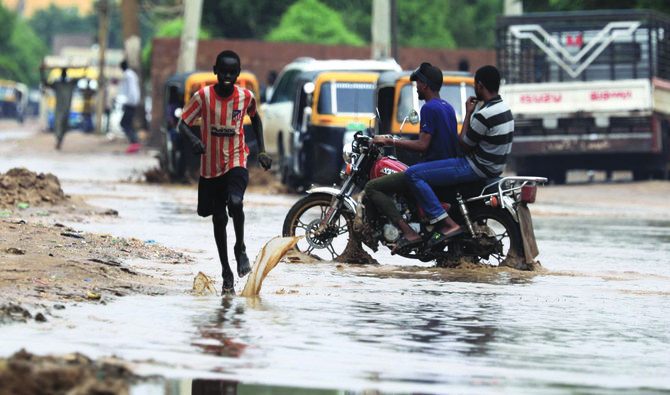
66 people killed as Sudan floods continue to tear up homes

Sudan’s rainy season usually starts in June and lasts until the end of September, with floods peaking in August and September. (AFP)
Short Url
Updated 16 August 2022
Follow

66 people killed as Sudan floods continue to tear up homes

  • Some 24,000 homes and two dozen government buildings have been badly damaged or completely destroyed

CAIRO: Flash floods triggered by heavy rains continued to tear up homes across Sudan, an official said Tuesday, with the death toll rising to 66 since the start of the rainy season.

Earlier this week, authorities had said that at least 50 people were killed since the rains started in June. Brig. Gen. Abdul-Jalil Abdul-Rahim, spokesman for Sudan’s National Council for Civil Defense, said Tuesday that at least 28 people were reported injured during the same period.

Some 24,000 homes and two dozen government buildings have been badly damaged or completely destroyed, he said.

Sudan has been without a functioning government since an October military coup derailed its short-lived democratic transition following the 2019 removal of former ruler Omar Bashir in a popular uprising.

Overall, around 136,000 people have been impacted by heavy rainfall and floods in 12 of Sudan’s 18 provinces, according to the government-run Humanitarian Aid Commission.

The UN Office for the Coordination of Humanitarian Affairs said the floods also inundated 238 health facilities. The western Darfur region and the provinces of Nile River, White Nile, West Kordofan and South Kordofan were among the hardest hit, it said.

Footage circulated online over the past weeks showing flood waters sweeping through streets and people struggling to save their belongings.

Sudan’s rainy season usually starts in June and lasts until the end of September, with floods peaking in August and September. More than 80 people were killed last year in flood-related incidents during the rainy season.

In 2020, authorities declared Sudan a natural disaster area and imposed a three-month state of emergency across the country after flooding and heavy rains killed around 100 people and inundated over 100,000 houses.


UN chief condemns Israeli law blocking electricity, water for UNRWA facilities

Updated 01 January 2026
Follow

UN chief condemns Israeli law blocking electricity, water for UNRWA facilities

  • The agency provides education, health and aid to millions of Palestinians in Gaza, the West Bank, Jordan, Lebanon and Syria

United Nations Secretary General Antonio Guterres condemned on Wednesday a move by Israel to ban electricity or water to facilities owned by the UN Palestinian refugee agency, ​a UN spokesperson said.
The spokesperson said the move would “further impede” the agency’s ability to operate and carry out activities.
“The Convention on the Privileges and Immunities of the United Nations remains applicable to UNRWA (United Nations Relief and Works Agency for Palestine Refugees in the Near East), its property and assets, and to its officials and other personnel. Property used ‌by UNRWA ‌is inviolable,” Stephane Dujarric, spokesman for the ‌secretary-general, ⁠said ​while ‌adding that UNRWA is an “integral” part of the world body.
UNRWA Commissioner General Phillipe Lazzarini also condemned the move, saying that it was part of an ongoing “ systematic campaign to discredit  UNRWA and thereby obstruct” the role it plays in providing assistance to Palestinian refugees.
In 2024, the Israeli parliament passed a law banning the agency from operating in ⁠the country and prohibiting officials from having contact with the agency.
As a ‌result, UNRWA operates in East Jerusalem, ‍which the UN considers territory occupied ‍by Israel. Israel considers all Jerusalem to be part ‍of the country.
The agency provides education, health and aid to millions of Palestinians in Gaza, the West Bank, Jordan, Lebanon and Syria. It has long had tense relations with Israel but ties have deteriorated ​sharply since the start of the war in Gaza and Israel has called repeatedly for UNRWA to ⁠be disbanded, with its responsibilities transferred to other UN agencies.
The prohibition of basic utilities to the UN agency came as Israel also suspended of dozens of international non-governmental organizations working in Gaza due to a failure to meet new rules to vet those groups.
In a joint statement, Canada, Denmark, Finland, France, Iceland, Japan, Norway, Sweden, Switzerland and the United Kingdom said on Tuesday such a move would have a severe impact on the access of essential services, including health care. They said one in ‌three health care facilities in Gaza would close if international NGO operations stopped.