BEIRUT: A man who broke into a Beirut bank and held its employees hostage was released on Tuesday by Lebanon’s prosecutor general.
Bassam Al-Sheikh Hussein broke into the Federal Bank last Thursday using a pump-action shotgun and gasoline, threatening to set himself and the place alight if he did not receive his bank deposit in US dollars.
He held employees hostage for about eight hours before the bank responded to his request and gave him $35,000 of his $209,000 deposit.
Roy Madkour, Federal Bank’s lawyer, headed to the public prosecution office Tuesday morning and dropped the bank’s rights. It was then decided to release Al-Sheikh Hussein on bail and refer his case to the investigating judge in Beirut.
Al-Sheikh Hussein headed to his house without meeting the reporters or activists who had gathered outside the Directorate General of the Internal Security Forces’ headquarters to receive him.
Georges Khattar, who waited outside the directorate’s headquarters where Al-Sheikh Hussein was detained to follow up on the situation, told Arab News: “Releasing Al-Sheikh Hussein technically means that he is not subject to prosecution anymore. That is what usually happens.”
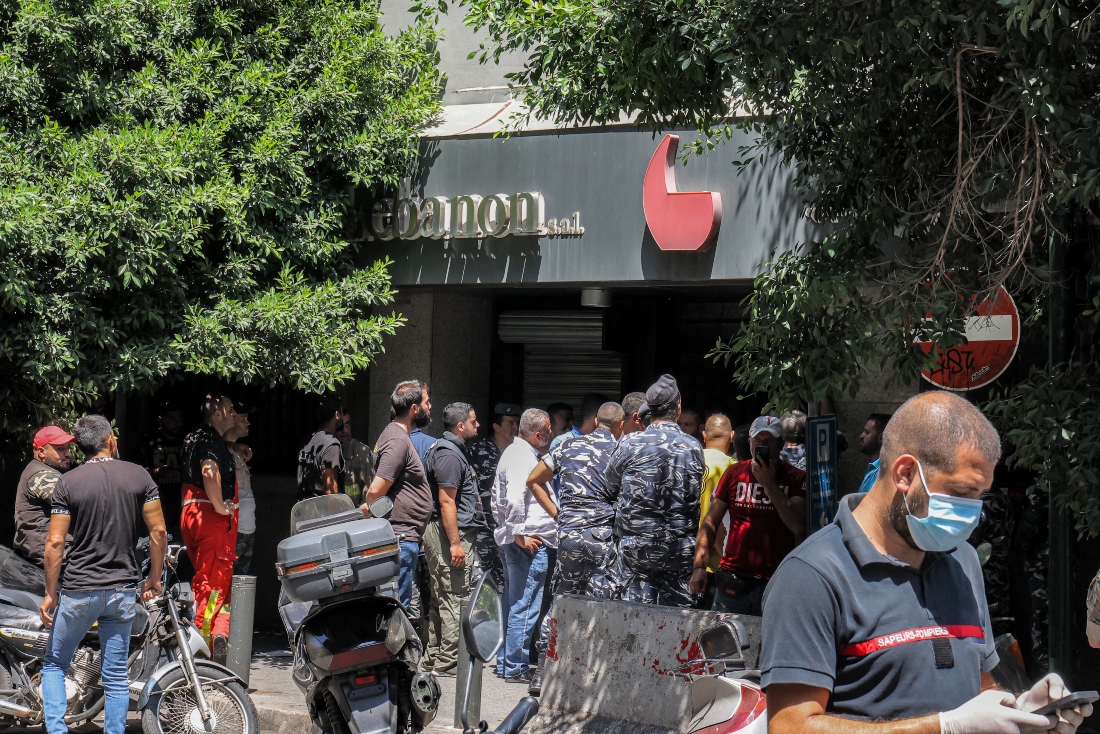
Crowds gathered outside the bank to show their support for Bassam Al-Sheikh Hussein. (File/AFP)
Activists and the detainee’s family protested Tuesday morning to demand his release.
Al-Sheikh Hussein did not appoint a lawyer during his detention period. He said he would go on hunger strike if he were not released. He also threatened to hang himself.
The Internal Security Forces had promised Al-Sheikh Hussein that he would be allowed to walk free because of the negotiations inside the bank and after his family received a part of his deposit.
After leaving the bank, however, he was transferred to the Directorate General of the Internal Security Forces. He was questioned about the source of the pump-action shotgun and the circumstances of the break-in.
Al-Sheikh Hussein’s move was praised by those whose dollar deposits have been seized by banks since 2019.
But economic expert Louis Hobeika did not regard the outcome as a “good deal.”
Hobeika told Arab News: “It’s true that the depositor received $35,000 from his bank deposit. However, the bank calculated this amount as per the Sayrafa platform rate.
“This means that the bank deducted $116,000 from Al-Sheikh Hussein’s bank deposit, estimated at $210,000, as it adopted the rate of LBP8,000 against the dollar and then proceeded to sell him the amount for $35,000 as per the rate on the Central Bank’s Sayrafa platform, which is LBP26,000 against the dollar.
“That is, the value of the amount given to the depositor by the bank equals three times the real value of the amount. Al-Sheikh Hussein lost $91,000 of his deposit and only received $35,000.”
He said although Al-Sheikh Hussein was wrong to act the way he did, he had not broken into the bank to steal.
“He wanted to retrieve his deposit and pay his father’s hospital bills. All people have seized deposits in banks. I blame the government, the banks, and the Central Bank for what’s happening. People are being treated unjustly and, for three years now, this injustice has not been addressed.
“How can people facing financial constraints similar to Al-Sheikh Hussein solve their problems if their money is seized by banks and cannot be accessed? If people had access to their deposits, their lives would have been different.”
People and depositors from the southern region of Aytaroun, where Al-Sheikh Hussein is from, protested in solidarity with the detainee. They released a statement calling on the judiciary to “be fair and just and give everyone their due.”
They emphasized the need for people to access their deposits and carried signs that said: “We reject banks and their cartels.”
They also blasted “the wrong economic policies adopted by the political ruling class” supported by successive governments and the banking sector that had caused the “theft” of depositors’ rights.