

Father and son linked to murders of Muslims, including two Pakistanis, in New Mexico

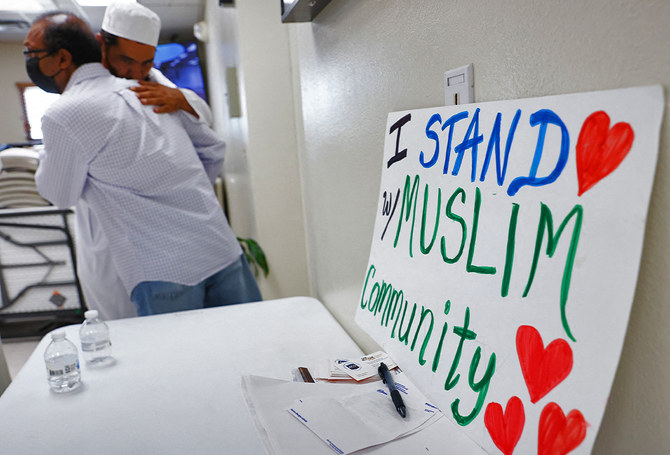
Muslims embrace following Friday prayers at the Islamic Center of New Mexico on August 12, 2022 in Albuquerque, New Mexico. (AFP)
Short Url
Updated 16 August 2022
Follow

Father and son linked to murders of Muslims, including two Pakistanis, in New Mexico

  • Police charged Afghan Muhammad Syed with two  murders, linked four killings to personal grudges
  • Son Shaheen Syed was arrested last week on federal firearms charges for providing a false address

ALBUQUERQUE, New Mexico: Police believe the son of the prime suspect in the killings of four Muslim men may have played a role in the murders, which have shaken the Muslim community in New Mexico's largest city.

Cellphone data shows Shaheen Syed, 21, was in the same "general area" of Albuquerque as his father at the time of the Aug. 5 killing of 25-year-old trucking entrepreneur Naeem Hussain, according to a filing by federal prosecutors for a Monday detention hearing during which Syed was denied bail.

Syed's attorney John Anderson said the allegations were "exceedingly thin and speculative."

Police last week charged Shaheen Syed's father, Muhammad Syed, 51, with two of the murders and linked the four killings to personal grudges, possibly fueled by intra-Muslim sectarian hatred. Shaheen Syed was arrested last week on federal firearms charges for providing a false address.

"Law enforcement officers also have recently discovered evidence that appears to tie the defendant, Shaheen Syed, to these killings," the filing said.

Agents believe Shaheen Syed observed Naeem Hussain leaving an Aug. 5 funeral service for two of the murdered Muslim men, based on FBI analysis of cell tower data. He then followed Hussain to the area of a parking lot where he was shot dead.

"Telephone calls between Muhammad Atif Syed and the defendant (Shaheen Syed) would be consistent with quick surveillance calls, both before and after the shooting," the filing said.

Prosecutors did not provide evidence on the other shootings.

Imtiaz Hussain said he believed at least two people were involved in the Aug. 1 murder of his brother Muhammad Afzaal Hussain.

A pistol and rifle were used to shoot Afzaal Hussain, a city planning director, 15 times in around 15 to 20 seconds, according to police records and Imtiaz.

“For one suspect it is difficult to use two weapons in that short an interval,“ said Imtiaz Hussain.

The victims Naeem Hussain and Afzaal Hussain were not related.

Muhammad Syed, an Afghan refugee, has been charged with killing Afzaal Hussain, who was from Pakistan, and cafe manager Aftab Hussein, 41, who had ties to Afghanistan and Pakistan. A fourth man, supermarket owner Mohammad Ahmadi, 62, was shot dead on Nov. 7, 2021.

Police have said they are working with prosecutors on potential charges for the murders of Naeem Hussain and Ahmadi.


Rubio meets Caribbean leaders as US raises pressure on Cuba

Updated 3 sec ago
Follow

Rubio meets Caribbean leaders as US raises pressure on Cuba

Basseterre: US Secretary of State Marco Rubio will seek to address Caribbean leaders' concerns about Cuba at a summit on Wednesday, as Washington ramps up pressure on the communist island fresh after removing Venezuela's president.
Rubio, a Cuban-American who has spent his political career hoping to topple Havana's government, is also looking for sustained cooperation on Venezuela and troubled Haiti as he takes part in the summit of the Caribbean Community, or CARICOM, which does not include Cuba.
After attending President Donald Trump's State of the Union address to Congress, Rubio flew overnight to join the summit in Saint Kitts and Nevis, a sun-kissed former British colony of fewer than 50,000 people.
Rubio became the highest-ranking US official ever to visit the tiny country, the birthplace of one of the United States' founding fathers, Alexander Hamilton.
Trump has reoriented foreign policy toward the Western Hemisphere through his "Donroe Doctrine" in which he has vowed unrepentant intervention to advance US interests.
After US forces snatched Venezuela's leftist leader Nicolas Maduro in a January 3 raid, the Latin American country has been forced to cut off its crucial oil shipments to Cuba.
This has plunged Cuba into a further economic morass with fuel shortages and rolling blackouts.
Speaking at the opening of the CARICOM summit on Tuesday, Jamaican Prime Minister Andrew Holness warned that a further deterioration in Cuba will impact stability across the Caribbean and trigger migration -- the top political concern for Trump.
"Humanitarian suffering serves no one," Holness said. "A prolonged crisis in Cuba will not remain confined to Cuba."
Plea for 'stability' 
Holness said that Jamaica believed in democracy and free markets -- a rebuke to the communist system in Havana -- but called for "humanitarian relief" for Cubans.
"Jamaica supports constructive dialogue between Cuba and the United States aimed at de-escalation, reform and stability," he said.
"We believe there is space, perhaps more space now than in years past, for pragmatic engagement."
The summit's host, Saint Kitts and Nevis Prime Minister Terrance Drew, also called for humanitarian backing to Cuba, saying: "A destabilized Cuba will destabilize all of us."
A medical doctor, Drew studied for seven years in Cuba and said friends there have told him of food scarcity, power outages and garbage strewn in the streets.
"I can only feel the pain of those who treated me so well when I was a student," he said.
The United States has imposed sanctions on Cuba almost continuously since Fidel Castro's 1959 revolution.
Since becoming the top US diplomat, Rubio has publicly toned down calls for regime change, and Washington has quietly held discussions with Havana.
Trump and Rubio have threatened sanctions against countries that sell oil to Cuba but stopped short of enacting some measures pushed by Cuban-American hardline critics of Havana, such as prohibiting the transfer of remittances.

'Elephant in the room' 
Kamla Persad-Bissessar, the prime minister of Trinidad and Tobago, said she empathized with the Cuban people but took issue with her Jamaican counterpart's remarks.
"We cannot advocate for others to live under communism and dictatorship," she said.
She also criticized CARICOM countries for their reticence, at least publicly, to back what she called the "elephant in the room" -- US intervention in Venezuela.
Trinidad and Tobago, whose coast is visible from Venezuela, gave access to the US military in the run-up to the operation that removed Maduro.
The deposed Venezuelan leader faces US charges of narco-trafficking, which he denies.
Persad-Bissessar thanked Trump, Rubio "and the US military... for standing firm against narco-trafficking, human and arms smuggling."
The Trump administration has been carrying out deadly strikes against alleged drug boats in the Caribbean, drawing criticism by those who say the attacks are legally and ethically dubious.
The Trinidadian prime minister praised the US approach and credited it with bringing down her country's homicide rate by helping cut the flow of firearms from Venezuela.