

Oil tanker, passenger bus crash kills 20 in central Pakistan

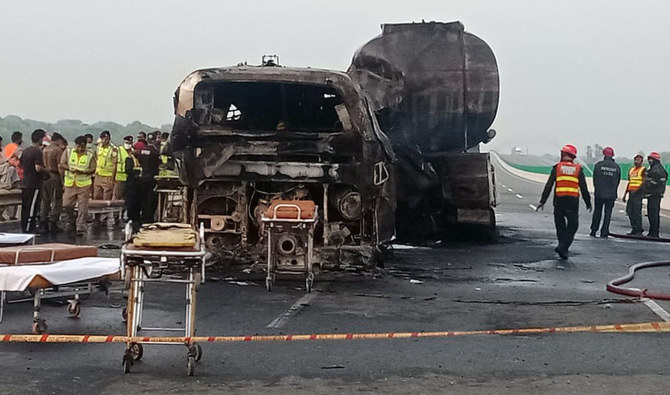
This handout photo shows the charred passenger bus and oil tanker following the collision on the Multan-Sukkur Motorway in central Pakistan on August 16, 2022. (Twitter/Commissioner Multan)
Short Url
Updated 16 August 2022
Follow

Oil tanker, passenger bus crash kills 20 in central Pakistan

  • The incident took place on a motorway near the central city of Multan
  • It was not immediately clear what caused the crash late Monday night

ISLAMABAD: A fiery crash between an oil tanker and a passenger bus killed at least 20 people in Pakistan, a police spokesperson and media said on Tuesday.

It was not immediately clear what caused the crash late Monday night or early Tuesday on a motorway near the central city of Multan.

The bus and tanker caught fire after the collision, a police spokesperson said in a statement, without providing details on the number of fatalities.

Geo and Dunya TV reported at least 20 people were killed.

Six passengers survived, an official of a state-run rescue service told Dunya TV on the spot.

“The fire was raging when we got here,” he said.


Pakistan PM calls for faster CPEC implementation, pledges security for Chinese workers

Updated 27 February 2026
Follow

Pakistan PM calls for faster CPEC implementation, pledges security for Chinese workers

  • Shehbaz Sharif pushes expanded cooperation in agriculture, IT and mining under CPEC phase two
  • Chinese envoy reaffirms Beijing’s support for Pakistan’s sovereignty and economic development

ISLAMABAD: Prime Minister Shehbaz Sharif on Friday called for speeding up projects under the China-Pakistan Economic Corridor (CPEC) and pledged stronger security guarantees for Chinese workers and investments, during a meeting with China’s ambassador in Islamabad.

Sharif made the remarks as the two countries strive to launch the second phase of CPEC, a multibillion-dollar infrastructure and energy initiative launched in 2015 as part of China’s Belt and Road Initiative (BRI).

CPEC’s first phase focused largely on power generation and transport infrastructure aimed at easing Pakistan’s chronic energy shortages and improving connectivity. The second phase seeks to expand cooperation into industrial development, with an emphasis on special economic zones and export-oriented growth.

“While highlighting the importance of accelerating ongoing CPEC projects, the Prime Minister stressed on the need to enhance cooperation in agriculture and IT and mining & minerals,” said a statement circulated by the PM Office after the meeting.

“He also underscored Pakistan’s resolve to provide a secure and conducive environment for Chinese personnel, investments, and institutions in Pakistan,” it added.

Chinese nationals and projects in Pakistan have faced security threats in the past, including attacks by militant groups targeting infrastructure sites and convoys. Islamabad has repeatedly vowed to tighten security and has deployed special protection units for Chinese workers.

China is Pakistan’s closest ally in the region and a key economic partner, with CPEC widely regarded by Islamabad as central to long-term economic growth.

During the meeting, the prime minister conveyed greetings to Chinese President Xi Jinping and Premier Li Qiang, particularly on the occasion of the Chinese New Year.

China’s Ambassador to Pakistan, Jiang Zaidong, reiterated Beijing’s support for Pakistan’s sovereignty and socioeconomic development, according to the statement. Both sides also exchanged views on regional and international issues and agreed to maintain close coordination.