

Taliban welcomes India’s diplomatic representation ‘upgrade’ in Kabul

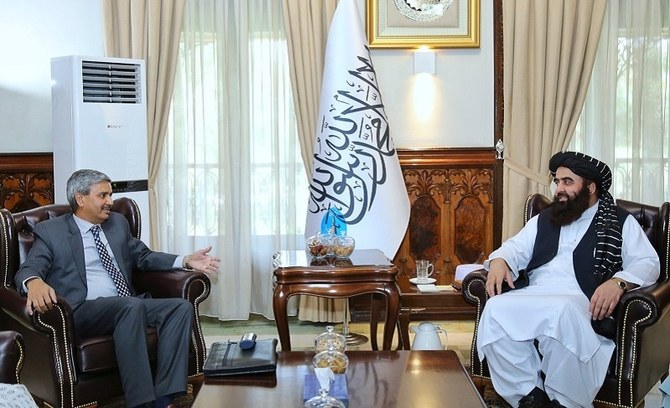
Afghanistan's Acting Foreign Minister Amir Khan Muttaqi, right, meets with Indian Ministry of External Affairs Joint Secretary J.P. Singh in Kabul on June 2, 2022. (Photo courtesy: Afghan Foreign Ministry)
Short Url
Updated 14 August 2022
Follow

Taliban welcomes India’s diplomatic representation ‘upgrade’ in Kabul

  • Indian diplomats were recently sent back to the embassy in Afghanistan
  • Indian diplomats were recently sent back to the embassy in Afghanistan

KABUL: The Afghan foreign ministry has welcomed the “upgrade” of India’s diplomatic representation in Kabul, as the Taliban administration continued to struggle for recognition by the international community a year after it took over Afghanistan.

India had closed its embassy and consulates in Afghanistan after the Taliban takeover last August, but New Delhi deployed a technical team earlier this year in June to coordinate their humanitarian efforts and assess the security situation in the country. 

Indian Foreign Minister Subrahmanyam Jaishankar confirmed on Friday that a batch of diplomats, except for the ambassador, was recently sent back to the embassy in Kabul to address a number of issues, such as humanitarian and medical assistance, as well as development projects. 

The Taliban administration has welcomed the move and promised security and immunity for Indian diplomats in Afghanistan.

“The Islamic Emirate of Afghanistan welcomes India’s step to upgrade its diplomatic representation in Kabul,” Abdul Qahar Balkhi, Afghan foreign ministry spokesperson, said in a statement issued on Saturday. 

“The Afghan government hopes that upgrading diplomatic representation and dispatching diplomats would strengthen Afghan-India relations leading to the completion of unfinished projects by India and the commencement of new vital projects.” 

Though India was one of the few countries which opposed the reconciliation process with the Taliban in the past, experts said on Sunday that New Delhi is now looking to reshape its relations with Afghanistan. 

“India is keen to engage with the Taliban as New Delhi believes that the Taliban government is going to stay for 5+ years this time or maybe longer,” Farid Mamundzay, Afghan ambassador to India appointed by the previous government, told Arab News. 

“So it’s important for India’s geopolitical interest to forget the past and form new working relations with Kabul.”

An Afghan foreign ministry official, who requested anonymity because he was not authorized to speak to the media, told Arab News that India didn’t want to be left behind its geopolitical rivals.

“India wants to have their own direct lines of communication to the Afghan government, as well as to counter Pakistani and Chinese influence in Afghanistan,” the official said.

India recently opposed plans by China and Pakistan to involve third countries in their ongoing multibillion-dollar infrastructure project, after Beijing and Islamabad agreed to extend the program to Afghanistan. New Delhi said last month that the proposed participation of third countries on those projects “directly infringe on India’s sovereignty and territorial integrity.”

India’s efforts to improve relations with the Taliban government are aimed at protecting its own interests, Torek Farhadi, analyst and advisor to the former Afghan government, told Arab News. 

“When it comes to the Taliban, India will instrumentalize them against Pakistan when it is convenient for New Delhi,” he said. 

“What we need to understand about India is that they are a pragmatic player, driving towards their own interests.” 


Indonesia reaffirms Yemen’s territorial integrity, backs stability efforts amid tensions

Updated 01 January 2026
Follow

Indonesia reaffirms Yemen’s territorial integrity, backs stability efforts amid tensions

  • Statement comes after Saudi Arabia bombed a UAE weapons shipment at Yemeni port city
  • Jakarta last week said it ‘appreciates’ Riyadh ‘working together’ with Yemen to restore stability

JAKARTA: Indonesia has called for respect for Yemen’s territorial integrity and commended efforts to maintain stability in the region, a day after Saudi Arabia bombed a weapons shipment from the UAE at a Yemeni port city that Riyadh said was intended for separatist forces. 

Saudi Arabia carried out a “limited airstrike” at Yemen’s port city of Al-Mukalla in the southern province of Hadramout on Tuesday, following the arrival of an Emirati shipment that came amid heightened tensions linked to advances by the UAE-backed Southern Transitional Council in the war-torn country. 

In a statement issued late on Wednesday, the Indonesian Ministry of Foreign Affairs said it “appreciates further efforts by concerned parties to maintain stability and security,” particularly in the provinces of Hadramout and Al-Mahara. 

“Indonesia reaffirms the importance of peaceful settlement through an inclusive and comprehensive political dialogue under the coordination of the United Nations and respecting Yemen’s legitimate government and territorial integrity,” Indonesia’s foreign affairs ministry said. 

The latest statement comes after Jakarta said last week that it “appreciates the efforts of the Kingdom of Saudi Arabia, as well as other relevant countries, working together with Yemeni stakeholders to de-escalate tensions and restore stability.” 

Saudi Arabia leads the Coalition to Restore Legitimacy in Yemen, which includes the UAE and was established in 2015 to combat the Houthi rebels, who control most of northern Yemen. 

Riyadh has been calling on the STC, which initially supported Yemen’s internationally recognized government against the Houthi rebels, to withdraw after it launched an offensive against the Saudi-backed government troops last month, seeking an independent state in the south.  

Indonesia has also urged for “all parties to exercise restraint and avoid unilateral action that could impact security conditions,” and has previously said that the rising tensions in Yemen could “further deteriorate the security situation and exacerbate the suffering” of the Yemeni people. 

Indonesia, the world’s biggest Muslim-majority country, maintains close ties with both Saudi Arabia and the UAE, which are its main trade and investment partners in the Middle East.