

Finance division says Pakistan’s economy made headway despite challenges since independence

A labourer pulls a trolley loaded with medicine at a market in Peshawar on September 1, 2021. (AFP)
Short Url
Updated 13 August 2022
Follow

Finance division says Pakistan’s economy made headway despite challenges since independence

  • The country is currently facing the daunting challenge of dealing with a mounting current account deficit, dwindling forex reserves
  • The finance division says its aspiration is to put Pakistan’s economy on higher growth trajectory through investment, efficiency, productivity

KARACHI: Pakistan’s finance division on Saturday brought out a comprehensive report on 75 years of the country’s economic journey, showing the economy had improved its growth potential over a period of time despite tough challenges.

Pakistan is poised to celebrate its 75th independence anniversary on Sunday.

The South Asian nation of over 220 million people is currently facing a daunting challenge of managing a stuttering economy, as it faces a huge current account deficit projected at nearly four percent of the Gross Domestic Product (GDP).

The country’s foreign exchange reserves have also been consistently depleting in recent months, though officials say Pakistan will soon be in a position to stabilize its external sector with the assistance of friendly countries and the International Monetary Fund (IMF).

“Pakistan’s GDP rose from $3bn to $383bn from 1950-2022,” the report said. “In 1950, GDP was 1.8 percent and in 2022 it is 5.97 percent.”

The report noted the per capita income in Pakistan also rose from $86 to $1,798 within the same period.

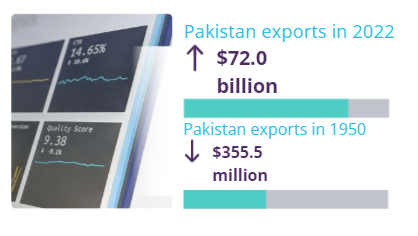
“Exports rose from $355.5 million to $72.0 billion from 1950-2022,” it added, “while Tax Revenues rose from Rs. 0.31 billion to Rs. 6,126.1 billion from 1950-2022.”
The finance division said Pakistan only inherited 34 industrial units at the time of its independence out of the 921 currently operating in the country.

“FDI [Foreign Direct Investment] increased from $1.2 million in FY1950 to $1,867.8 million in FY2022,” it noted, “while the remittances increased from $0.14 billion in FY1973 to $31.2 billion in FY2022.”

“Pakistan has made significant headway in spite of the many challenges that it has faced,” the report maintained. “The nation was able to transform itself into a semi-industrial economy and hub for business activities.”

The finance division added its aspiration was to put the economy on a higher growth trajectory through greater investment, efficiency and productivity.


Pakistan and Kazakhstan sign 37 MoUs to deepen cooperation, set $1 billion trade target

Updated 6 sec ago
Follow

Pakistan and Kazakhstan sign 37 MoUs to deepen cooperation, set $1 billion trade target

  • Both sides agree to form strategic partnership and discuss enhanced physical connectivity
  • PM Sharif says the two sides should turn these MoUs into implementable agreements

ISLAMABAD: Pakistan and Kazakhstan on Wednesday agreed to establish a strategic partnership, signed 37 memoranda of understanding (MoUs) and set a target of raising bilateral trade to $1 billion within a year, as the two sides agreed to strengthen bilateral cooperation and physical connectivity amid a push for greater regional integration.

The MoUs were signed in the presence of Prime Minister Shehbaz Sharif and President Kassym-Jomart Tokayev, who arrived in Islamabad a day earlier on an official visit.

Landlocked Kazakhstan is seeking access to global maritime trade through Pakistan’s ports on the Arabian Sea, while Islamabad has been positioning itself as a regional transit hub linking Central Asia with South Asia, the Middle East and beyond.

“We had very useful and productive meetings since morning, and just now we have had this signing ceremony of 37 MOUs,” Sharif said while addressing the gathering at the PM House, expressing hope that the understandings would soon be converted into binding agreements and implemented.

The two countries agreed to expand cooperation across transport and logistics, including rail, road and multimodal corridors, with Sharif offering Kazakhstan access to Pakistan’s transit infrastructure and seaports as part of broader efforts to enhance regional connectivity through Central Asia and Afghanistan.

Sharif acknowledged that current bilateral trade levels remained well below potential.

“Unfortunately, our trade volume is just meager $250 million during the last year,” he said. “This does not reflect not only the strength of our friendship, but also the potential of the two countries ... Let us make a commitment that we will take up our trade volume to $1 billion in the next one year.”

Speaking at the ceremony, Tokayev described Pakistan as a key partner for Kazakhstan.

“Pakistan is a reliable and important partner of Kazakhstan in South Asia and beyond,” he said. “Our peoples are united by centuries-old ties rooted in the legacy of the Great Silk Road, as well as by deep cultural and spiritual affinity.”

Beyond connectivity, the MOUs cover cooperation in energy, agriculture, mining and minerals, pharmaceuticals, defense production, digital technologies and artificial intelligence.

The two sides also agreed to promote joint ventures, particularly in food processing, agriculture value chains and industrial production.

Investment cooperation featured prominently, including the launch of a joint investment platform involving Kazakhstan’s sovereign wealth entities and Pakistani partners to identify bankable projects in mining, energy and infrastructure.

The talks also addressed collaboration in education, science and culture, with both sides agreeing to expand academic exchanges, institutional linkages between universities and people-to-people contacts through cultural and sporting initiatives.

This is the first visit of a Kazakhstan president to Pakistan in 23 years.

The two countries are also scheduled to hold the joint business forum in which more than 250 companies from both sides will come together and are expected to sign commercial agreements.