

Pakistani minister threatens to boycott polio campaign amid rising militant activities in tribal districts

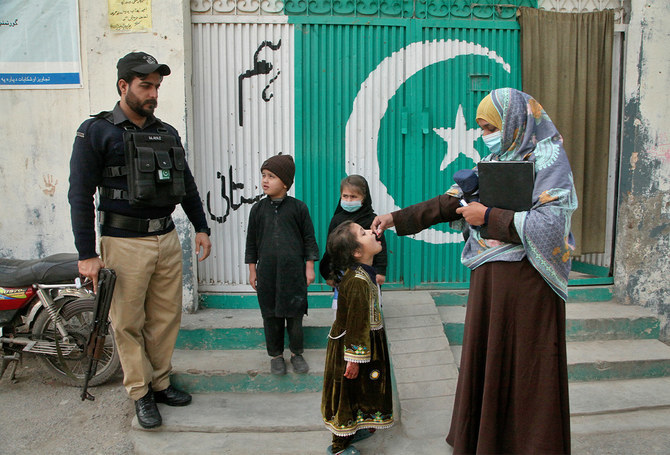
A police officer stands guard while a health worker administers a polio vaccine to a child, in Peshawar, Pakistan, on February 28, 2022. (AP/File)
Short Url
Updated 13 August 2022
Follow

Pakistani minister threatens to boycott polio campaign amid rising militant activities in tribal districts

  • The religious affairs minister’s warning was issued after a local leader of his political faction was recently gunned down
  • The country has recorded 13 polio cases this year despite routinely carrying out vaccination drives to immunize children

ISLAMABAD: Pakistan’s religious affairs minister Maulana Abdul Shakoor threatened to boycott polio vaccination campaign in the country’s tribal districts in a recent video clip if the provincial administration of Khyber Pakhtunkhwa and security institutions failed to protect people amid rising militant activity in the region.

The minister’s warning came just a few weeks after a local leader of his political faction, Jamiat-e-Ulema-e-Islam (JUI-F), was gunned down in North Waziristan tribal district.

His statement mentioned the anti-polio campaign in the country where 13 cases of the virus have so far been recorded since the beginning of the year.

Among these cases, 12 were reported from North Waziristan district.

“We want to make it clear that if the government and security institutions fail to provide us peace, the people of [former] Federally Administered Tribal Areas will not accept the government’s activities and boycott polio [vaccination],” the minister said in the video clip.

It is not clear when the statement was recorded.

The federal government has also not reacted to the development, though it threatens to undermine the anti-polio drives which are routinely carried out across the country to immunize millions of children.

Militants have targeted dozens of health workers administering polio drops in Pakistan where many parents routinely refuse to get their children inoculated against the crippling disease.

The recent polio cases have dealt a blow to the South Asian nation’s efforts to eradicate the disease which can cause severe paralysis in children.

Pakistan and Afghanistan are the only two countries in the world where polio remains endemic. In 2021, Pakistan reported only one case, raising hopes it was close to eradicating the disease.


Pakistan to begin first phase of Hajj 2026 trainings from today

Updated 31 December 2025
Follow

Pakistan to begin first phase of Hajj 2026 trainings from today

  • Training programs to be held in phases across Pakistan till February, says religion ministry
  • Saudi Arabia allocated Pakistan a total quota of 179,210 pilgrims for Hajj 2026

ISLAMABAD: Pakistan’s religious affairs ministry has said that it will begin the first phase of mandatory Hajj 2026 training for pilgrims intending to perform the pilgrimage from today, Thursday.

The one-day Hajj training programs will be held in phases across the country at the tehsil level until February. The ministry directed intending pilgrims to bring their original identity cards and the computerized receipt of their Hajj application to attend the training sessions.

“Pilgrims should attend the one-day training program according to their scheduled date,” Pakistan’s Ministry of Religious Affairs (MoRA) said in a statement.

The ministry said training schedules are being shared through the government’s Pak Hajj 2026 mobile application as well as via SMS. It added that details of the schedule are also available on its website.

According to the ministry, training programs will be held in Abbottabad on Jan. 2; Ghotki, Thatta and Kotli on Jan. 3; and Tando Muhammad Khan and Khairpur on Jan. 4.

Hajj training sessions will be held in Rawalakot, Badin and Naushahro Feroze on Jan. 5, while pilgrims in Fateh Jang, Dadu and Tharparkar will receive the training on Jan. 6.

The ministry said training programs will be conducted in Umerkot and Larkana on Jan. 7, followed by sessions in Mirpurkhas, Shahdadkot and Mansehra on Jan. 8.

Pakistan’s religious affairs ministry has previously said these trainings will be conducted by experienced trainers and scholars using multimedia.

It said the training has been made mandatory to ensure that intending pilgrims are fully aware of Hajj rituals and administrative procedures.

Saudi Arabia has allocated Pakistan a quota of 179,210 pilgrims for Hajj 2026, of which around 118,000 seats have been reserved under the government scheme, while the remainder will be allocated to private tour operators.

Under Pakistan’s Hajj scheme, the estimated cost of the government package ranges from Rs1,150,000 to Rs1,250,000 ($4,049.93 to $4,236), subject to final agreements with service providers.
