

Spain evacuates 294 more Afghan workers and families through Pakistan 

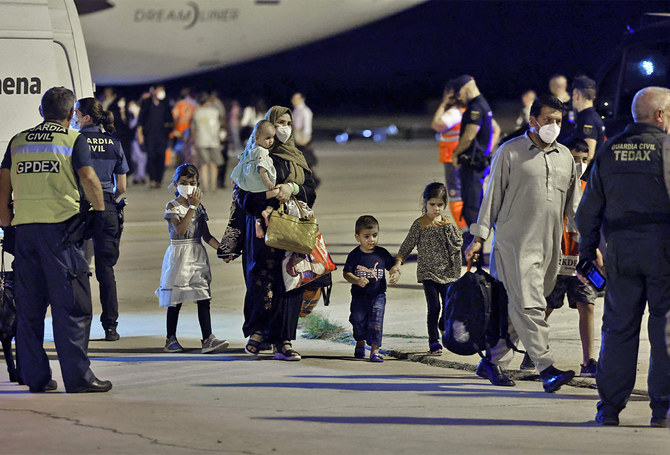
Family members of Afghans who collaborated in Afghanistan with the Spanish authorities arrive from Islamabad in an airplane chartered by Spain, at the Torrejón de Ardoz military air base, Spain, on August 10, 2022. (AFP)
Short Url
Updated 11 August 2022
Follow

Spain evacuates 294 more Afghan workers and families through Pakistan 

  • Group included who had worked for or helped Spanish government officials and Spanish troops 
  • Government will continue to bring former Afghan workers and their families, says Spanish foreign minister

MADRID: A plane provided by the Spanish government has brought 294 Afghan refugees via Pakistan to Spain, authorities said Thursday, bringing to 3,900 the number of people evacuated by Madrid since the Taliban takeover of Afghanistan last year.

A government statement said the latest group of Afghan workers and their families flew into an air base near Madrid late Wednesday and were met by government officials, including Spanish Foreign Affairs Minister José Albares.

“This flight is further evidence that we are keeping our commitment to not leave anyone behind,” Albares said in the statement.

The group included people who had worked for or helped Spanish government officials and Spanish troops stationed in Afghanistan before the Taliban takeover.

The statement said Spain has carried out five evacuation operations over the past year.

Albares told Spanish National Television on Thursday that the government will continue to bring former Afghan workers and their families to Spain, but for security reasons he couldn't say how many.

Spain launched the flights to bring workers who hadn’t been able to leave Afghanistan during the airlift operation in August 2021, when it pulled out about 2,200 Spaniards and Afghans via Kabul’s airport. 


Pakistan reviews austerity measures amid Middle East crisis, urges strict nationwide implementation

Updated 11 March 2026
Follow

Pakistan reviews austerity measures amid Middle East crisis, urges strict nationwide implementation

  • Deputy Prime Minister Ishaq Dar chairs review meeting of austerity steps
  • Officials briefed on salary cuts, school closures, four‑day week, petrol conservation

ISLAMABAD: Pakistan’s government on Wednesday assessed progress on a sweeping set of austerity measures introduced to mitigate the country’s economic strain from sharply rising global oil prices and supply disruptions linked to the ongoing war in the Middle East.

Prime Minister Shehbaz Sharif this week announced a series of austerity steps, including a four‑day work week for government offices, requiring 50  percent of staff to work from home, cutting fuel allowances for official vehicles by half, grounding up to 60  percent of the government fleet and closing all schools for two weeks to conserve fuel amid the global oil crisis.

The measures were unveiled in response to global oil market volatility triggered by the conflict involving the United States, Israel and Iran, which has disrupted supply routes such as the Strait of Hormuz and pushed crude prices sharply higher, straining Pakistan’s heavily import‑dependent energy sector.

“The meeting stressed the importance of strict and transparent adherence to the austerity measures, promoting fiscal responsibility and prudent use of public resources,” Deputy Prime Minister and Foreign Minister Senator Mohammad Ishaq Dar said in a statement.

He was chairing a meeting of the Committee for Monitoring and Implementation of Conservation and Additional Austerity Measures, constituted under the directions of the PM, bringing together federal and provincial officials to review execution of the broad cost‑cutting plan. 

Dar emphasized the government’s commitment to enforcing the PM’s austerity steps nationwide. The committee’s review also covered reductions in departmental expenditure, deductions from salaries of senior officials earning over Rs. 300,000 ($1,120), and coordination with provincial administrations to ensure uniform implementation of the plan.

Participants at the meeting reiterated that all ministries and divisions must continue strict monitoring and reporting, with transparent oversight mechanisms, as Pakistan navigates the economic pressures from the prolonged Middle East crisis and its fallout on global energy and trade markets.