

US uncovers Iran ‘plot’ to kill ex-White House official John Bolton

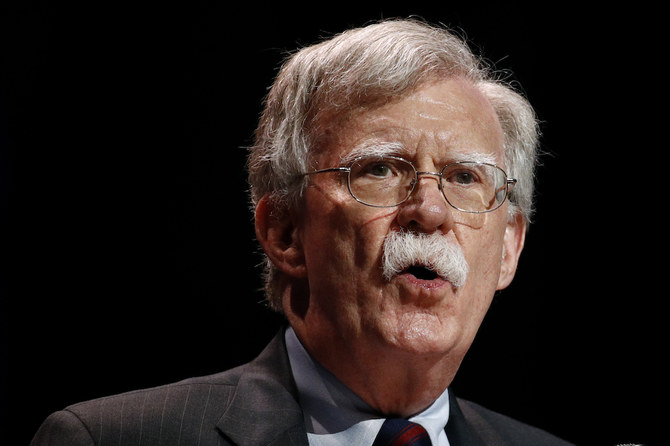
Justice Department says an Iranian operative has been charged in a plot to murder former Trump administration national security John Bolton. (File/AP)
Short Url
Updated 10 August 2022
Follow

US uncovers Iran ‘plot’ to kill ex-White House official John Bolton

  • Justice Department says it uncovered an Iranian plot to kill the former White House national security adviser
  • It announced charges against a member of the Islamic Revolutionary Guard Corps

WASHINGTON: The US Justice Department said Wednesday it had uncovered an Iranian plot to kill former White House National Security Adviser John Bolton, and announced charges against a member of the Islamic Revolutionary Guard Corps.
The Justice Department said 45-year-old Shahram Poursafi, also known as Mehdi Rezayi, had offered to pay an individual in the US $300,000 to kill Bolton, the former US ambassador to the UN.
The Justice Department said that plan was likely set in retaliation for the US killing of top Guard commander Qassem Soleimani in Iraq in January 2020.
Prosecutors say the scheme unfolded more than a year after Soleimani, the head of the Revolutionary Guard’s elite Quds Force and an architect of Tehran’s proxy wars in the Middle East, was killed in a targeted airstrike at Baghdad’s international airport in January 2020. After the strike, Bolton, who by then had left his White House post, tweeted, “Hope this is the first step to regime change in Tehran.”

The allegation came as Iran weighs a proposed agreement in Vienna talks to revive the 2015 agreement that aims to prevent Tehran from developing nuclear weapons.
For months Tehran has held up the deal, demanding that the US remove its official designation of the Islamic Revolutionary Guard Corps as a sponsor of terrorism.
“This is not the first time we have uncovered Iranian plots to exact revenge against individuals on US soil and we will work tirelessly to expose and disrupt every one of these efforts,” said US Assistant Attorney General Matthew Olsen.
According to the charges, Poursafi tried to arrange Bolton’s murder beginning in October 2021, when he contacted online an unidentified person in the US, first saying he wanted to commission photographs of Bolton.
Poursafi provided the person with Bolton’s office address, including the name and contact information for someone who worked in the office, and took screenshots of surveillance photographs of Bolton’s office, the affidavit says.
He offered $250,000, which was then negotiated up to $300,000.
“Poursafi added that he had an additional ‘job,’ for which he would pay $1 million,” the Justice Department said.

But that second person, court documents say, was a confidential source for the US Federal Bureau of Investigation.
The ostensible assassin stalled, waiting for an initial payment, but only in late April did Poursafi send money, paying a total of $100 in cryptocurrency.
Poursafi was charged with the use of interstate commerce facilities in the commission of murder-for-hire, which brings up to 10 years in prison, and with providing and attempting to provide material support to a transnational murder plot, which carries a 15-year sentence.
In his own statement, Bolton thanked the FBI and Justice Department for their work in developing the case and the Secret Service for providing protection.
“While much cannot be said publicly right now, one point is indisputable: Iran’s rulers are liars, terrorists, and enemies of the United States,” he said.
He urged President Joe Biden to not restore the nuclear agreement.
Bolton, one of the leading “hawks” of the US foreign policy establishment and a strong critic of Iran, was national security adviser in the White House of president Donald Trump from April 2018 to September 2019.

In the administration of president George Bush, he was ambassador to the UN from 2005-2006.
He was strongly opposed to the 2015 agreement between Tehran and major powers to limit its nuclear program, and supported the Trump administration’s unilateral pullout from the pact in May 2018.
The court documents indicated Bolton was aware of the plot and cooperated with investigators, allowing photographs of himself outside his Washington office to be sent to Poursafi.
Over the months Poursafi discussed the plot with his US contact, he disclosed that it related to Tehran’s desire for revenge for the US killing of Soleimani.
Since that strike on Soleimani Tehran has vowed to extract revenge, and US officials have said that the country had been looking to kill one or more US officials.
Another official believed on Tehran’s target list was Mike Pompeo, who was secretary of state at the time of the assassination of Soleimani, and before that director of the Central Intelligence Agency.
At the time Pompeo said Soleimani had been plotting large scale attacks on US targets like embassies.
(With AFP and AP)


Afghanistan says it thwarted Pakistani airstrike on Bagram Air Base as fighting enters fourth day

Updated 51 min 53 sec ago
Follow

Afghanistan says it thwarted Pakistani airstrike on Bagram Air Base as fighting enters fourth day

  • The fighting has been the most severe between the neighbors for years
  • Pakistan accuses Taliban government of harboring militant groups that stage attacks against it

KABUL: Afghanistan thwarted attempted airstrikes on Bagram Air Base, the former US military base north of Kabul, authorities said Sunday, while cross-border fighting between Pakistan and Afghanistan stretched into a fourth day.
The fighting has been the most severe between the neighbors for years, with Pakistan declaring that it’s in “open war” with Afghanistan.
The conflict has alarmed the international community, particularly as the area is one where other militant organizations, including Al-Qaeda and the Daesh group, still have a presence and have been trying to resurface.
Pakistan accuses Afghanistan’s Taliban government of harboring militant groups that stage attacks against it and also of allying with its archrival India.
Border clashes in October killed dozens of soldiers, civilians and suspected militants until a Qatari-mediated ceasefire ended the intense fighting. But several rounds of peace talks in Turkiye in November failed to produce a lasting agreement, and the two sides have occasionally traded fire since then.
On Sunday, the police headquarters of Parwan province, where Bagram is located, said in a statement that several Pakistani military jets had entered Afghan airspace “and attempted to bomb Bagram Air Base” at around 5 a.m.
The statement said Afghan forces responded with “anti-aircraft and missile defense systems” and had managed to thwart the attack.
There was no immediate response from Pakistan’s military or government regarding Kabul’s claim of attempted airstrikes on Bagram or the ongoing fighting.
Bagram was the United States’ largest military base in Afghanistan. It was taken over by the Taliban as they swept across the country and took control in the wake of the chaotic US withdrawal from the country in 2021. Last year, US President Donald Trump suggested he wanted to reestablish a US presence at the base.
The current fighting began when Afghanistan launched a broad cross-border attack on Thursday night, saying it was in retaliation for Pakistani airstrikes the previous Sunday.
Pakistan had said its airstrike had targeted the outlawed Pakistani Taliban, also known as Tehreek-e-Taliban Pakistan, or TTP. Afghanistan had said only civilians were killed.
The TTP militant group, which is separate but closely allied with Afghanistan’s ruling Taliban, operates inside Pakistan, where it has been blamed for hundreds of deaths in bombings and other attacks over the years.
Pakistan accuses Afghanistan’s Taliban government of providing a safe haven within Afghanistan for the TTP, an accusation that Afghanistan denies.
After Thursday’s Afghan attack, Pakistani Defense Minister Khawaja Mohammad Asif declared that “our patience has now run out. Now it is open war between us.”
In the ongoing fighting, each side claims to have killed hundreds of the other side’s forces — and both governments put their own casualties at drastically lower numbers.
Two Pakistani security officials said that Pakistani ground forces were still in control on Sunday of a key Afghan post and a 32-square-kilometer area in the southern Zhob sector near Kandahar province, after having seized it during fighting Friday. The captured post and surrounding area remain under Pakistani control, they added. The officials spoke on condition of anonymity, because they weren’t authorized to speak publicly.
In Kabul, the Afghan government rejected Pakistan’s claims. Deputy government spokesman Hamdullah Fitrat called the reports “baseless.”
Afghan officials said that fighting had continued overnight and into Sunday in the border areas.
The police command spokesman for Nangarhar province, Said Tayyeb Hammad, said that anti-aircraft missiles were used from the provincial capital, Jalalabad, and surrounding areas on Pakistani fighter jets flying overhead Sunday morning.
Defense Ministry spokesman Enayatulah Khowarazmi said that Afghan forces had launched counterattacks with snipers across the border from Nangarhar, Paktia, Khost and Kandahar provinces overnight. He said that two Pakistani drones had been shot down and dozens of Pakistani soldiers had been killed.
Fitrat said that Pakistani drone attacks hit civilian homes in Nangarhar province late Saturday, killing a woman and a child, while mortar fire killed another civilian when it hit a home in Paktia province.
There was no immediate response to the claims from Pakistani officials.
