In high-level military shuffle, Lt Gen Faiz Hameed moved from Peshawar to Bahawalpur Corps

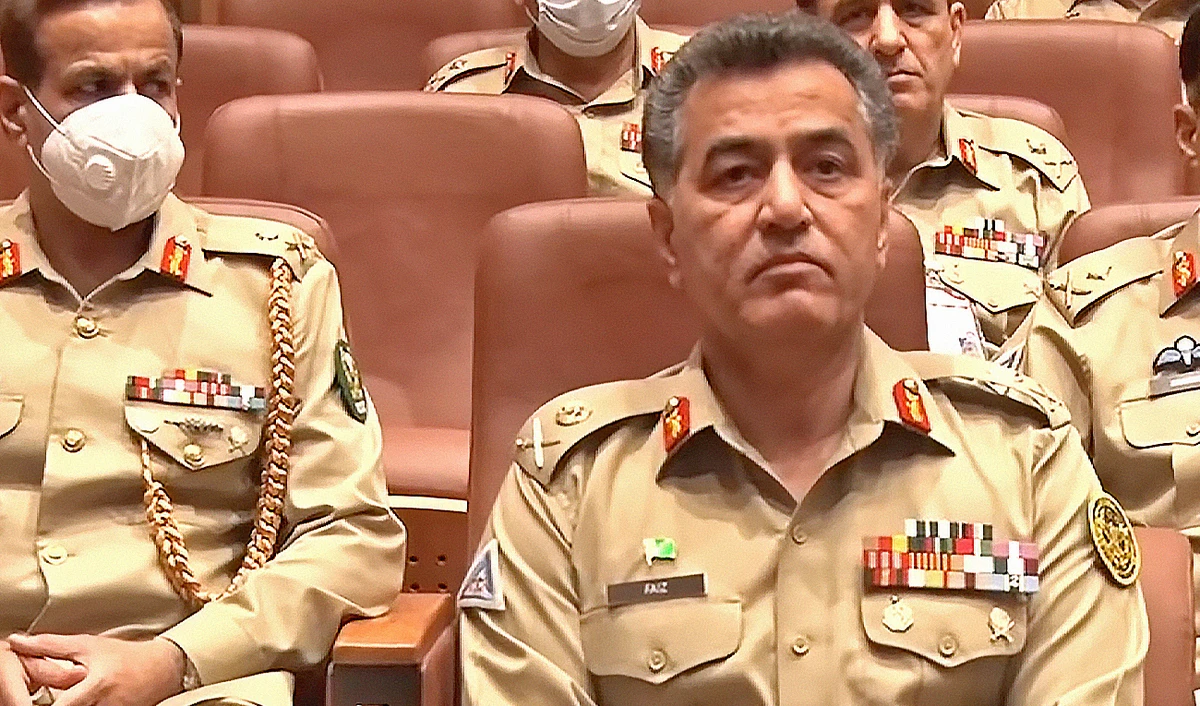
Lt. Gen. Faiz Hameed (right) attends 78th Formation Commanders’ Conference held at the General Head Quarters in Rawalpindi, Pakistan, on June 15, 2021. (Photo courtesy: ISPR/File)
Short Url
Updated 08 August 2022
Follow

In high-level military shuffle, Lt Gen Faiz Hameed moved from Peshawar to Bahawalpur Corps

  • Gen Hameed was posted last year as corps commander in Pakistan's northwest
  • Before that, Gen Hameed served as head of ISI, Pakistan’s premier intelligence agency

ISLAMABAD: The Pakistan army said on Monday it was posting Lt Gen Faiz Hameed, the current Corps Commander Peshawar, to head the Corps in Bahawalpur.

Gen Hameed is widely considered close to ex-premier Imran Khan prime minister and was the head of the ISI, Pakistan’s premier intelligence agency, before he was moved to Peshawar last year.

“Lieutenant General Sardar Hassan Azhar Hayat posted as Commander Peshawar Corps,” the army’s media wing said. “Lieutenant General Faiz hamid posted as Commander Bahawalpur Corps.”

The Peshawar, or XI, Corps, is the only corps assigned in the northwestern Khyber Pakhtunkhwa province and is currently stationed in the provincial capital of Peshawar. The Corps was established and quickly raised in 1975 to support administrative military operational units in the country's northwest bordering Afghanistan. The corps is widely known for its involvement in the Soviet–Afghan War.

After the September 11 attacks in the United States in 2001 and the subsequent US invasion of Afghanistan, the XI Corps became the main Pakistani formation involved in fighting in the country's tribal regions in the country's northwest. It also commands substantial forces of the paramilitary Frontier Corps.

Gen Hameed's posting from Peshawar comes less than a week after the US carried out a drone strike in neighbouring Afghanistan, killing al Qaeda leader Ayman al-Zawahiri with a drone missile while he stood on a balcony at his home in Kabul. The strike has raised questions about whether Pakistan’s airspace was used and if the government or military were involved.

Last week, former director-general of the ISPR Lt Gen Asif Ghafoor was appointed corps Commander Quetta after the serving commander died in a helicopter crash.

The army is arguably the most influential institution in Pakistan, with the military having ruled the country for about half of its 75-year history since independence from Britain and enjoying extensive powers even under civilian administrations.

Pakistan Airports Authority reports ‘historic’ twin-engine aircraft landing in Lahore

Updated 13 December 2025
Follow

Pakistan Airports Authority reports ‘historic’ twin-engine aircraft landing in Lahore

  • Twin-engine aircraft are usually larger, heavier and require better airport infrastructure, navigation systems to land
  • Pakistan Airports Authority says landing reflects its commitment to enhance aviation sector, strengthen infrastructure

ISLAMABAD: The Pakistan Airports Authority (PAA) announced on Saturday that the New General Aviation Aerodrome achieved a significant milestone when it handled the landing of a twin-engine aircraft. 

A twin-engine aircraft has two engines that provide it redundancy and increased performance compared to single-engine counterparts. These aircraft range from small twin-engine propeller planes to large commercial jetliners. The presence of multiple engines enhances safety by allowing the aircraft to continue flying in the event of an engine failure.

However, twin-engine aircraft are usually larger, heavier and more complex than single-engine planes. They require advanced airport infrastructure such as better runways, navigation systems and air traffic coordination. 

“The New General Aviation Aerodrome, Lahore achieved another significant operational milestone today with the successful landing of a twin-engine aircraft, following the recent arrival of a single-engine aircraft,” the PAA said in a statement. 

It said the flight was also boarded by Air Vice Marshal Zeeshan Saeed, the director general of the PAA. The move reflected “strong institutional confidence” in the aerodrome’s safety standards, operational capability, and overall readiness, it added. 

“The landing was conducted with exceptional precision and professionalism, demonstrating the aerodrome’s robust operational framework, technical preparedness, and effective airside coordination in accordance with contemporary aviation requirements,” the PAA said. 

It said the landing represented a “major advancement” in Pakistan’s general aviation sector and underscores the PAA’s commitment to enhancing regional aviation capacity, strengthening infrastructure and promoting excellence in aviation development.