

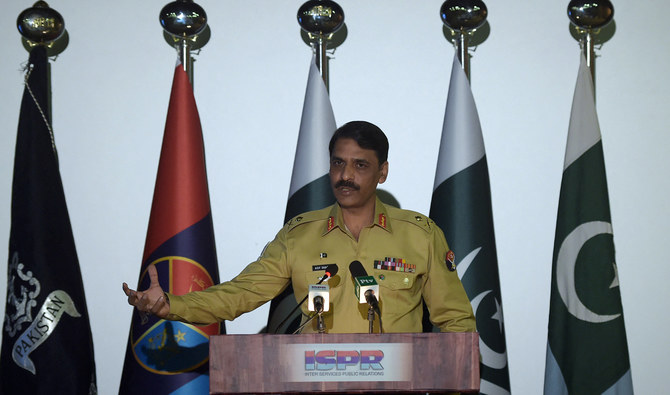
Lt Gen Asif Ghafoor, former head of army media wing, appointed commander of 12 Corps

Pakistan's former army spokesman Major General Asif Ghafoor speaks with media representatives during a press conference in Rawalpindi, Pakistan on April 17, 2017. (AFP/File)
Short Url
Updated 04 August 2022
Follow

Lt Gen Asif Ghafoor, former head of army media wing, appointed commander of 12 Corps

  • Ghafoor replaces Gen Sarfaraz Ali who died in helicopter crash during flood relief operation this week
  • In his last role ad DG ISPR, Ghafoor was a widely believed to have tightened the military’s grip on media

ISLAMABAD: Lt. Gen. Asif Ghafoor has been appointed Commander 12 Corps, Quetta, the Pakistan military said in a statement late on Wednesday night, replacing the last top commander in the southwestern Balochistan province who died in a helicopter crash earlier this week.

A Pakistani military helicopter carrying General Sarfaraz Ali and five others crashed on a mountain during a flood relief operation and all on board were killed, the military and police said on Tuesday.

The army aviation helicopter, which was helping with flood relief work in Balochistan province, lost contact with air traffic control on Monday.

“He [Ghafoor] is replacing Lt. Gen. Sarfraz Ali ... who embraced shahadat (martyrdom) in a helicopter crash due to bad weather during flood relief operations in Lasbela, Balochistan, on 1 August 2022,” the Pakistan army said in a statement.

Lt Gen Ghafoor has previously served as the head of the army’s media wing, ISPR, a role in which he is widely believed to have tightened the military’s grip over Pakistan’s media landscape and imposed de facto censorship rules. The military denies it suppresses the press.

The XII Corps, also known as Quetta Corps, is stationed in Quetta, the capital of Balochistan province. The strategically key formation has been on the frontlines of the war against militants and separatists, and was originally raised after the Soviet invasion of Afghanistan in 1979, spending the first few years of its history guarding against Soviet expansionism.

Ethnic Baloch militants have for decades waged an insurgency against the Pakistani government and army in Balochistan, complaining that its rich gas and mineral resource are unfairly exploited to the benefit of other parts of the country. The state denies this. The Pakistan army has launched several operations against separatist insurgents in its 75-year-long history. But the insurgency in Balochistan, a sparsely populated, mountainous, desert region bordering Afghanistan and Iran, has sometimes waned and sometimes intensified over the years.

The province is also home to deep-water Gawadar port, which neighboring China has been developing as part of a multi-billion dollar China-Pakistan Economic Corridor to link road and sea routes with Beijing’s Belt and Road Initiative. Separatists oppose the projects and try to attack them.


Pakistan to hold mandatory training for Hajj pilgrims on Thursday

Updated 7 sec ago
Follow

Pakistan to hold mandatory training for Hajj pilgrims on Thursday

  • Day-long training being held to ensure intending pilgrims are aware of Hajj rituals, administrative matters, says state media
  • Religion ministry says experienced “master trainers” and scholars from the ministry and Hajj camps will provide training

ISLAMABAD: Pakistan’s religion ministry has announced that a mandatory training program for Hajj 2026 pilgrims will begin from Thursday, state media reported this week as Islamabad gears up for the annual Islamic pilgrimage. 

The announcement was made by Dr. Syed Atta ur Rehman, the federal secretary of religious affairs, while he chaired a meeting of the Curriculum Committee for Hajj Training in Islamabad on Monday, state broadcaster Radio Pakistan reported. 

“The day-long training will be mandatory for all intending pilgrims as per their schedule, which will be communicated to them through Pak Hajj mobile app, website and SMS,” Radio Pakistan said. 

The state media said the ministry has made the training mandatory to make intending pilgrims aware of Hajj rituals and administrative matters. 

“Experienced master trainers and scholars from the ministry and Hajj camps will provide training through multimedia,” it said. 

Saudi Arabia allocated Pakistan a quota of 179,210 pilgrims earlier this year for Hajj 2026. Of these, around 118,000 seats have been allocated to the government scheme and the rest to private tour operators.

Under Pakistan’s Hajj scheme, the estimated cost of the government package ranges from Rs1,150,000 to Rs1,250,000 [$4,049.93 to $4,236], subject to final agreements with service providers.