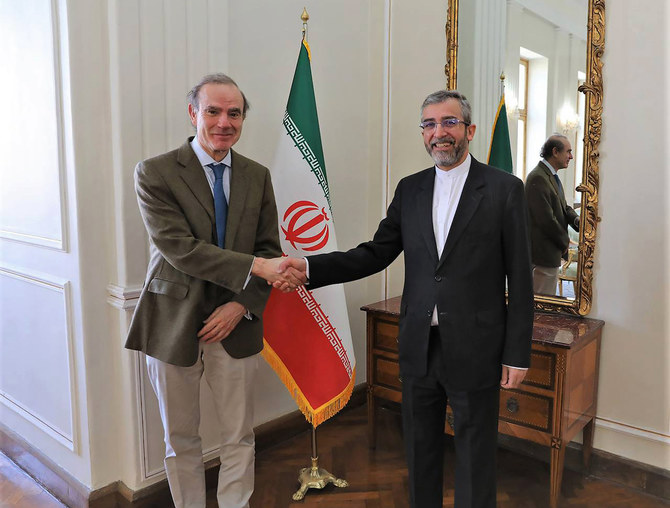
TEHRAN: Iran, the United States and the European Union said Wednesday they would send representatives to Vienna amid what appears to be a last-ditch effort at reviving talks over Tehran’s tattered 2015 nuclear deal with world powers.
It wasn’t immediately clear if other parties to the landmark accord would attend the surprise summit, nor if there had any progress after a monthslong stalemate and fruitless round of indirect talks between Iran and the US in Doha.
The European Union official who chairs the talks, Enrique Mora, wrote on Twitter that the negotiations would focus on the most recent draft on restoring the agreement, while Tehran said it was dispatching nuclear negotiator Ali Bagheri Kani to the Austrian capital.
US Special Representative for Iran Rob Malley was expected to go to Vienna for the talks on Thursday, two American officials said. They spoke on condition of anonymity to discuss the plans before they were announced.
The prospects for the deal’s restoration have darkened in the past few months with major sticking points remaining, including Tehran’s demand that Washington provide guarantees that it won’t again quit the pact and that it lift terrorism sanctions on Iran’s paramilitary Revolutionary Guard.
The abruptly called meeting in Vienna comes after EU foreign affairs chief Josep Borrell has repeatedly pushed to break the deadlock and salvage the deal in past weeks. He recently wrote in The Financial Times that “the space for additional significant compromises has been exhausted.”
Former President Donald Trump withdrew the US from the 2015 deal, which lifted most international sanctions on Tehran in exchange for tight restrictions on Iran’s nuclear program. Since then, Iran has massively expanded its nuclear work and now has enough highly enriched uranium to fuel one nuclear weapon, according to nonproliferation experts.
However, Iran still would need to design a bomb and a delivery system for it, likely a monthslong project. Iran insists its program is for peaceful purposes, though UN experts and Western intelligence agencies say Iran had an organized military nuclear program through 2003.


![]()

Iran, US, EU to send envoys to Vienna for nuclear talks
Short Url
https://arab.news/4xh33
Iran, US, EU to send envoys to Vienna for nuclear talks
- It wasn’t immediately clear if other parties to the landmark accord would attend the surprise summit
- US Special Representative for Iran Rob Malley was expected to go to Vienna for the talks on Thursday


Latest updates



Recommended


© 2026 SAUDI RESEARCH & PUBLISHING COMPANY, All Rights Reserved And subject to Terms of Use Agreement.