


KARACHI: Tayaba Organisation, a Pakistani non-governmental organization (NGO), has become the first global entity to raise charity funds to address water scarcity issues by implementing the innovative blockchain-based Non-Fungible Token (NFT) technology, the founder of the organization said on Saturday.

In this undated photo, women fill their water cans in the Thar desert region in Pakistan, where water shortage is a major issue. (Photo courtesy: Tayaba Organisation)
The charity organization is engaged in Pakistan’s remote desert and mountainous regions, hit by acute water shortages, through its innovative solution ‘H2O wheel,’ or Help 2 Others, which is a specially designed water-carrying can tailored as a simple and effective product that helps transport safe water and is aimed at removing burden off the shoulders. The organization has impacted lives of over 100,000 people in underserved areas housing marginalized communities.
“Tayaba [Organisation] has become the first Pakistani NGO and one of the first globally to implement the innovative blockchain-based NFT technology for fundraising purposes in the charity sector,” Bilal bin Saqib, the founder and chief executive officer (CEO) of the charity, told Arab News in an exclusive interview on Saturday.
“NFTs are the next fundraising frontier because they offer something beyond just a direct monetary donation, unlike cryptocurrencies. They offer the chance to be part of a community of like-minded people. When you buy an NFT for social good, you're not just giving your money to a cause, but becoming emotionally invested in the project itself.”
NFTs are financials asset consisting of digital data stored in a blockchain that can’t be replicated. The ownership of an NFT, recorded in the blockchain, can be transferred by the owner that allows NFTs to be sold and traded.
“If you think about it, most things in the real world are 'non-fungible,' like your dog, house or parents. Even you are non-fungible because you’re unique and there is only one of you. In more technical terms, NFTs are files that live on the blockchain,” Saqib explained.
“This means that NFTs cannot be altered or deleted from some central system and the transaction history is readily viewable on the blockchain by anyone. NFTs allow you to own digital media assets like you own digital currencies, e.g. Bitcoin. Art is a very common form of NFTs.”
The organization has currently got two live collections on Opensea, one of the biggest NFT hosting platforms. The first consists of 12 assets, including trading cards, animated images and gifs. The second collection includes three tiers of loyalty cards that give their holders special benefits.
“We’ve got H2O green, silver and gold cards that carry their own unique advantages, including access to all the information on how your water wheel contributions are being distributed,” the Tayaba Organisation CEO said.
Saqib, who previously featured on the Forbes 30 Under 30 list in recognition of social entrepreneurship through his organization, said he was overjoyed by fundraising through first NFT collections.
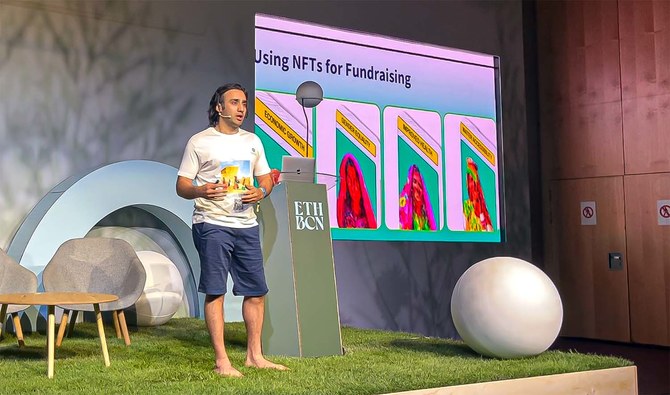
“Tayaba's first collection of NFTs was also geared towards the art of storytelling. We told the world about Fantastic Fatima, Happy Habiba, empowerment, economic growth and gender equality,” he said.
"We wanted the world to see the faces we helped and the lives we tried to change. And we succeeded beyond our wildest dreams by raising Rs2 million ($8,364) from our first collection."

In this undated photo, Bilal Bin Saqib, the founder and chief executive officer (CEO) of Tayaba Organisation, takes a selfie with Vilatik Buterin, co-founder of Ethereum cryptocurrency, in London, United Kingdom. (Photo courtesy: Tayaba Organisation)
Passionate for Pakistan’s digital journey, the Tayaba Organisation chief said he plans to organize a conference in Pakistan, for which he has already invited Vitalik Buterin, the co-founder of Ethereum, who has accepted the invite.
“I don’t want Pakistan to be left behind in the next big leap of technology and the internet which is why I plan to one day hold a Web3 Pakistan Conference. That is my big vision and so, when I ran into Vitalik Buterin at EthCC (Ethereum Community Conference), I had to go up to him and invite him to it,” Saqib, who graduated in social innovation and entrepreneurship from the London School of Economics, told Arab News.
“Who would be a better keynote speaker at Eth Pakistan than the co-founder of Ethereum himself. He was very amiable about the whole thing and expressed a desire to come visit Pakistan at some point in the future. I would be honored and excited to host him when he does come.”
Pakistan, which has yet to decide about the future of crypto currency trade within its territorial boundaries, ranked third on the Crypto Adoption Index 2021, while its citizens hold $20 billion in cryptocurrencies, according to Chainanalysis, an American blockchain analysis firm headquartered in New York.
“Blockchain knows no boundaries and I believe social good should be the same. The decentralised nature makes it so that anyone can participate regardless of geography and having any crypto wallet can give you access to the cause,” Saqib said.
“As far as Pakistan’s policy on crypto goes, there is no outright ban but just a discouragement from the State Bank of Pakistan, as per their many circulars which encourage people to 'refrain' due to 'risks'.”
To a question about the future of crypto trade in Pakistan, the Tayaba Organisation chief said the country remains a lucrative market despite the government’s “unsure” policy.
“The government has had an unsure policy regarding crypto, which has sadly inhibited many Pakistanis who are enthusiastic about Web3 technologies. Despite that, it's also important to note that Pakistan has a pretty lucrative and vastly undocumented crypto ecosystem,” he said.
“There is a lot of potential for cryptocurrency and other Web3 technologies in Pakistan. Think of the kind of earnings the government could make by formalising and legalising this economy. There would be foreign exchange earnings, a globally competitive market of internet businesses, and direct and indirect tax revenue.”
Web3 is an idea for a new iteration of the world wide web that incorporates concepts such as decentralization, blockchain technologies and token-based economy.
Blockchain technology can be used to resolve land disputes, agricultural problems and even end corruption, according to Saqib. Through transparency and immutability, the blockchain can be a decentralized guarantor that can’t be bribed, edited or biased.
Asked about any problems he faced in fundraising through NFTs, Saqib said the "confused" government policies had been a challenge for the charity.
“Lack of awareness among people about NFTs, setting up crypto wallets, and the generally confused policies of our government have posed some challenges to us,” he said.
"We guide our donors on how to set up their crypto wallets and educate them about NFTs. With time we have seen inhibition around NFTs reduce, which is a good sign."
Saqib said he would keep creating awareness about Web3, which hosts decentralized apps that run on blockchain technology, in Pakistan.
“I will continue to advocate for and raise awareness regarding Web3 in Pakistan. Tayaba is just one platform to do that. We used NFTs primarily as an awareness-raising tool about Tayaba and the benefits of Web3 technology,” he said.
“I am also working on another platform, Web3 Pakistan, which will provide free courses to Pakistanis becoming blockchain experts and developers. Web3 is going to be big and I don’t want Pakistan to be left behind yet again.”


