

Focus to be on partnerships during Saudi crown prince’s visit to France

The most significant element of the visit is the timing, amid a turbulent international and regional climate and shortly after US President Joe Biden’s trip to the Gulf. (File/AFP)
Short Url
Updated 28 July 2022
Follow

Focus to be on partnerships during Saudi crown prince’s visit to France

  • Trip to Europe comes as Saudi Arabia diversifies cooperation across wider range of countries
  • France will present itself as a major partner in the context of US disengagement from Middle East

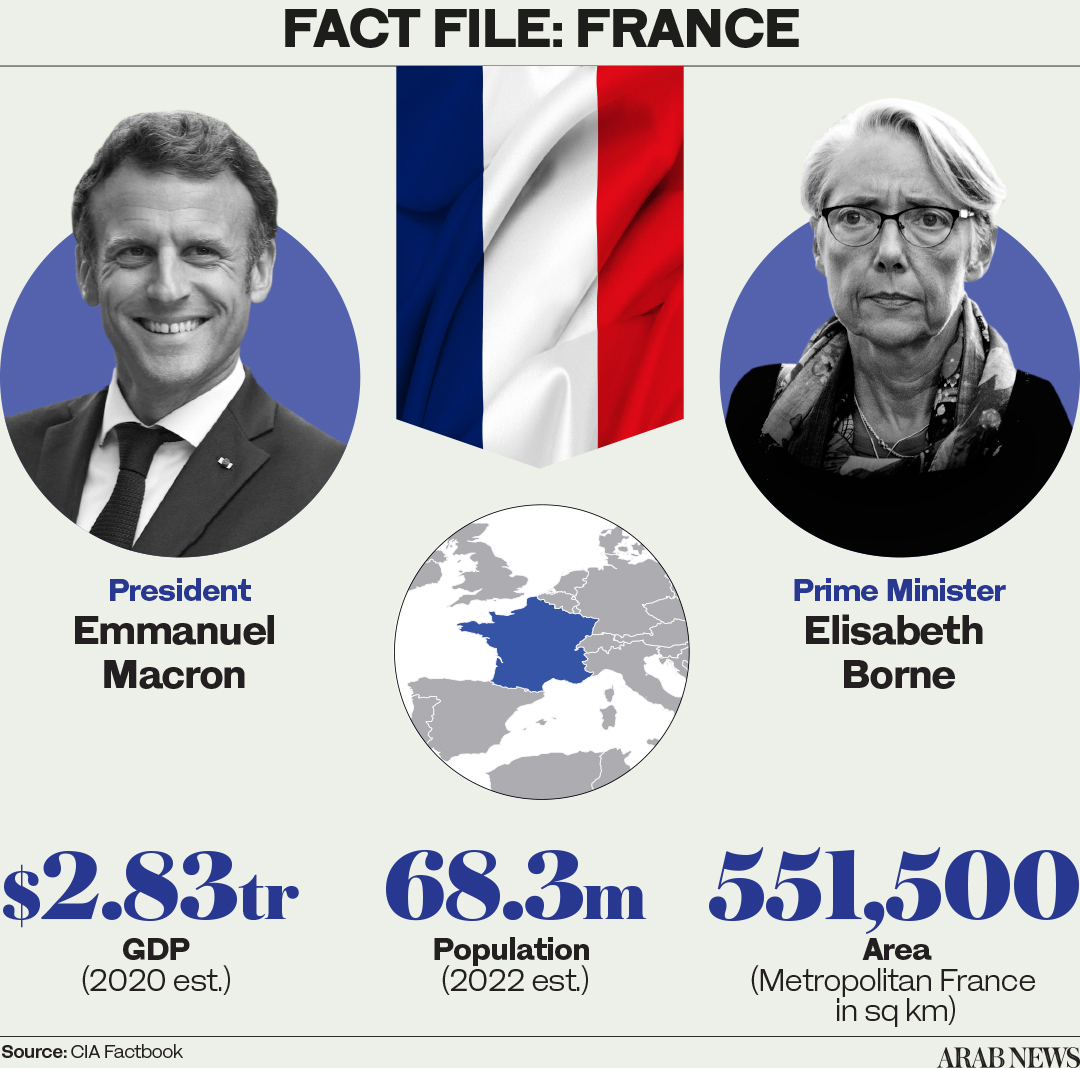
PARIS: The visit of Crown Prince Mohammed bin Salman to Paris, and his anticipated meeting with French President Emmanuel Macron, is a sign of the strength of Saudi Arabia’s relationship with France and of the depth of the bonds of their friendship.

The most significant element of the visit is the timing, amid a turbulent international and regional climate and only a few days after US President Joe Biden’s trip to the Gulf.

The crown prince’s visit illustrates the desire expressed by a number of nations, including Saudi Arabia, to diversify cooperation with the rest of the world, even in areas traditionally reserved for America.

In this context, France holds a special place, given the regular and sustained relations between Macron and the crown prince, as evidenced by the trip made by the French leader to the Kingdom as part of his January tour of the Gulf.

In Paris, while addressing various aspects of bilateral relations, the two leaders will review the economic partnership and ways to strengthen it in sectors of mutual interest.

During their meeting in January, they agreed to strengthen the participation of the private sector in economic exchanges, as well as the sharing of expertise and the development of skills.
Vision 2030, initiated by the Saudi crown prince, and the France 2030 economic plan, are vectors of opportunities and convergence.

The respective commitments in the field of environmental and biodiversity protection will also be on the agenda.

Macron and Crown Prince Mohammed bin Salman will once again emphasize the importance of commitment to the fight against climate change on the basis of the Paris Agreement. And the Kingdom’s own ambitious twin Saudi Green and Middle East Green initiatives are firmly supported by France.

The visit will also provide an opportunity to discuss cultural relations between the two countries, an area in which Paris and Riyadh have succeeded in establishing a fruitful cooperation for the development of the AlUla region. The two leaders aim to grow the collaboration, particularly in the development of museums, the preservation of heritage, and film production.

On a more strategic level, energy security, in the context of the Russian invasion of Ukraine, will be high on the agenda. A source suggested the Saudi crown prince would give assurances to Macron over the Kingdom’s efforts to mitigate the crisis.

France will be looking to present itself as a major partner in view of the American disengagement from the Middle East, and the Saudi desire to diversify partners both on a military and economic level.

Talks on the Palestinian issue are a certainty and the same goes for Lebanon, a country mired in an endemic political crisis and inertia that has prevented even its closest partners from coming to its aid.

The other focus of discussions will be on the Iranian nuclear issue and its regional repercussions. Macron has maintained that the solution to the impasse involves a return as soon as possible to the Joint Comprehensive Plan of Action nuclear deal signed with Tehran in 2015.

In this context, the meeting with the crown prince will give Macron the chance to reaffirm to Saudi Arabia, and other countries in the region, that France is ready to participate in the development of the outline of a new partnership.

For Macron, who has just started his second presidential term, this is undoubtedly a way of initiating a new dynamic of foreign policy with regard to the Middle East region.

National program identifies 165 native plants for afforestation efforts in Asir

Updated 29 December 2025
Follow

National program identifies 165 native plants for afforestation efforts in Asir

  • The survey is part of broader plans focused on restoring degraded land, using native vegetation 

JEDDAH: Saudi Arabia’s National Afforestation Program has identified more than 165 species of native plants suitable for afforestation in the Asir region, highlighting the ecological diversity of one of the Kingdom’s most environmentally varied areas, the Saudi Press Agency reported.

The findings form part of broader national efforts to expand vegetation cover, address land degradation, and support sustainability goals linked to the Saudi Green Initiative and Vision 2030.

According to the program, the identified species are distributed across a wide range of natural environments in Asir, including mountainous terrain, highlands, slopes, valleys, plains, rocky landscapes, and coastal areas stretching from the Red Sea to Tihama.

The species belong to numerous plant families, including Fabaceae, Anacardiaceae, Burseraceae, Capparaceae, Ebenaceae, Euphorbiaceae, Malvaceae, Myrtaceae, Oleaceae, and Primulaceae, among others.

Plants suitable for afforestation range from large and small trees to perennial and annual shrubs, herbs, succulents, bulbs, and climbing plants. 

Among the most notable species identified are the grey mangrove, mastic tree, mooring or ben tree, juniper, sycamore fig, wild olive, henna, wild jasmine, hawthorn, and arak.

The Saudi Arabian Botanical Society described the announcement as an important step in protecting plant diversity and strengthening the ecosystem conservation in the Kingdom. 

Munirah bin Hamad Al-Hazani, founder and president of the society, said that prioritizing native species is central to sustainable afforestation.

“Focusing on the cultivation of native plants adapted to diverse environments forms the cornerstone of sustainable afforestation projects, as it plays a pivotal role in enhancing vegetation cover, combating land degradation, and conserving natural and financial resources,” she told Arab News.

Al-Hazani added that long-term success depends on cooperation between government bodies and the nonprofit sector, alongside community involvement and environmental awareness programs.

The National Afforestation Program has increasingly emphasized community participation, working with government agencies, private companies, and nonprofit organizations to support planting initiatives and environmental education. Its approach includes promoting volunteerism and discouraging harmful environmental practices, while focusing on the use of native plants adapted to local conditions.

Parallel efforts are underway in other regions of the Kingdom to support vegetation restoration through research and infrastructure development. In Jouf, often referred to as the Kingdom’s food basket, the King Salman bin Abdulaziz Royal Reserve Development Authority has established a Central Nursery and a Wild Seeds Research and Production Station to address the growing demand for reliable sources of native seeds and seedlings.

The project was launched in 2023 under the directive of Prince Abdulaziz bin Saud bin Naif, the minister of interior and chairman of the authority’s board of directors. 

Since then, the facilities has become a key component of vegetation restoration efforts within the reserve.

The authority has focused on building operational capacity by recruiting and training specialists to manage cultivation and research activities. The research and production station includes 14 mother-seed production fields containing over 400,000 trees and shrubs. 

Planting began in late 2024, with more than 30 native plant species represented, selected for their role in the reserve’s natural ecosystem. 

The facility also includes two seed storage units with a combined capacity of 3,000 kilograms. Seeds are collected annually from multiple sites within the reserve and used for seedling production habitat rehabilitation.

The Central Nursery spans 6,000 square meters and includes 30 greenhouses spanning 1,500 square meters, as well as two shade houses used during summer months. A plant hardening facility, designed to prepare seedlings for natural environmental conditions, covers 10,000 square meters and is divided into seven sections. The nursery’s annual production capacity reaches 1.5 million seedlings, representing more than 15 native plant species. 

Together, these initiatives underscore the growing role of native plant research and propagation in Saudi Arabia’s afforestation strategy, particularly as the Kingdom works to balance environmental restoration with long-term sustainability goals.