

China In-Focus — Central Bank’s daily cash injection falls; Industrial profits rebound; Q2 smartphone sales fall 

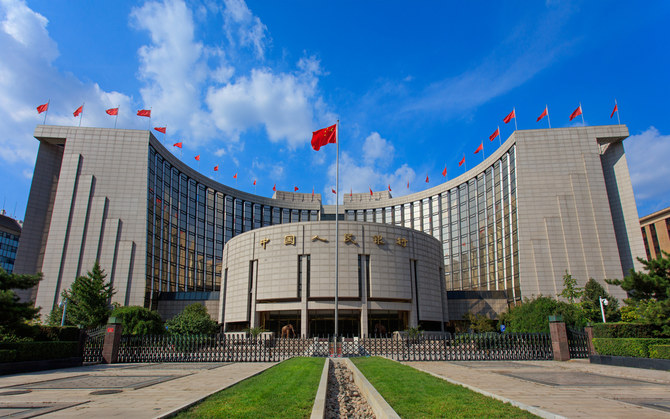
The People’s Bank of China ploughed 2 billion yuan ($295.76 million) through seven-day reverse repos on Wednesday. (Shutterstock)
Short Url
Updated 27 July 2022
Follow

China In-Focus — Central Bank’s daily cash injection falls; Industrial profits rebound; Q2 smartphone sales fall 

RIYADH: China’s central bank continued injecting liquidity in small doses into the banking system in the run-up to the month-end.

The People’s Bank of China ploughed 2 billion yuan ($295.76 million) through seven-day reverse repos on Wednesday, the tiniest daily cash injection since January 2021.

With 3 billion yuan worth of such a liquidity tool maturing on Wednesday, the PBOC drained 1 billion yuan on a net basis on the day.

China’s industrial profits rebound in June 

China’s industrial profits in June grew 0.8 percent from a year earlier, rebounding from a 6.5 percent decline in May, according to data released by the National Bureau of Statistics on Wednesday.

Buoyed by easing pandemic curbs and government stimulus, June’s data shows industrial firms are gradually coming back from painful supply chain disruptions in the second quarter.

As the pandemic was effectively controlled and the industrial chain further recovered, industrial firms’ efficiency improved markedly, NBS Senior Statistician Zhu Hong said in a statement.

China’s economy braked sharply in the April-June quarter, highlighting the colossal toll on activity from widespread lockdowns that hit domestic consumption and business confidence.

Industrial firms saw their combined profits rise 1 percent to 4.27 trillion yuan from January to June from the same period a year earlier. That matched the 1.0 percent growth pace in the first five months, the data showed.

Liabilities at industrial firms jumped 10.5 percent at the end-June, also remaining the same as the 10.5 percent growth as of end-May.

In June, China’s industrial output grew 3.9 percent from a year earlier, while factory-gate inflation hit a 15-month low as the country continues to buck the global trend of accelerating prices. 

China Q2 smartphone sales fall

Chinese smartphone sales in April-June fell 14.2 percent on year and volumes hit a decade low, Counterpoint Research said on Wednesday, as China struggles to recover from the impact of COVID-19 lockdowns and the industry braces for more uncertainty.

Quarterly sales volumes were 12.6 percent lower than those seen in the first quarter of 2020, when the pandemic hit China and sales were the worst since the fourth quarter of 2012, when the iPhone 5 was introduced, according to Counterpoint.

The research firm does not give unit sales estimates.

(With input from Reuters) 


Saudi Arabia’s NDMC raises $13bn for infrastructure projects 

Updated 6 sec ago
Follow

Saudi Arabia’s NDMC raises $13bn for infrastructure projects 

RIYADH: Saudi Arabia raised $13 billion through a seven-year syndicated loan as the Kingdom steps up funding for infrastructure projects spanning power, water and public utilities.  

The financing was arranged by the National Debt Management Center as part of the government’s medium-term borrowing strategy, which aims to diversify funding sources and secure financing at competitive costs, the agency said in a statement. 

The transaction supports Saudi Arabia’s broader push to upgrade infrastructure under its Vision 2030 economic transformation program, as the government accelerates investment in utilities and development projects alongside private-sector participation. 

“This transaction aims to leverage market opportunities to execute alternative government financing activities that contribute to economic growth, including the financing of development and infrastructure projects aligned with Saudi Vision 2030,” said NDMC.  

NDMC was established in 2015 within the Ministry of Finance as the Debt Management Office before being restructured into its current form, with a mandate to manage public debt and meet the government’s financing needs across short-, medium- and long-term horizons. 

The syndicated loan follows a series of recent debt market transactions. In December, the center raised SR7.01 billion ($1.87 billion) through a domestic sukuk issuance split across five tranches, with the first one valued at SR1.23 billion set to mature in 2027.  
The second tranche amounted to SR335 million, maturing in 2029. 

The third tranche was valued at SR1.180 billion maturing in 2032, and the fourth tranche was SR1.692 billion set to expire in 2036.  

The fifth tranche was worth SR2.573 billion, maturing in 2039. 

In September, NDMC completed the issuance of a $5.5 billion (SR20.63 billion) international sukuk under the Kingdom’s Global Trust Certificate Issuance Program. 

The offering — the country’s first international sukuk based on an Ijarah structure — was issued in two tranches. A five-year sukuk maturing in 2030 raised $2.25 billion (SR8.44 billion), while a 10-year tranche maturing in 2035 secured $3.25 billion (SR12.19 billion, NDMC said at the time. 

The center added that the issuance aligns with its strategy to diversify the investor base and meet Saudi Arabia’s financing requirements through international debt capital markets in an efficient and effective manner.