


RIYADH: Alexis Konstantopoulos, Greece’s ambassador to Saudi Arabia, has highlighted the enduring quality of relations between the two countries, and underlined the “ground-breaking” potential for future partnership.
“This is a long-term relationship,” Konstantopoulos, who is also his country’s ambassador to Oman and Yemen, told Arab News during an exclusive interview.
“We want to do more together to be able to bring more of Greek knowhow and Greek excellence to Saudi Arabia, and of course Saudi knowhow and excellence also to Greece and to the wider region in Europe,” he said.
The Kingdom has maintained a strong partnership with Greece that has been enriched over the years by political, economic, defense and cultural initiatives.
Konstantopoulos hopes that the next step in strengthening bilateral relations would be the widening of cooperation in culture and tourism.
“What I hope to accomplish, first of all, is bringing our two countries, our two governments, our two leaders, and our two peoples closer together. I think it’s very important that we get to understand each other better and further promote our cooperation,” he said.
“I think our relations are ground-breaking. Both our countries have principle-based international rules. We want to abide by international rules. We adhere to the UN Charter, to UN (Security) Council resolutions, and to the Law of the Sea, to respect for the integrity and sovereignty of other countries,” he added.
“We consider mutual respect and the principle of friendly neighborly relations (as) extremely important. We see eye to eye on many things, on international issues.”
Konstantopoulos expressed the potential for innovative cultural exchanges and partnerships. A major component of his job is to find new ways to connect the two countries through various sectors under Vision 2030, a modernization program launched by Saudi Crown Prince Mohammed bin Salman in 2016.
“Both our countries are ancient civilizations with very profound and old cultures, and there’s lots to do together on that,” Konstantopoulos said.
Outside of its mountainous and island landscapes, Greece is known for its theater, architecture, museums, and cultural landmarks that welcome tourists from around the world.
Tourism is an important sector for both countries, and the ambassador believes that there is great potential for collaboration in that sector.
“We have deep-rooted and ancient civilizations and tourism, because people-to-people relations are extremely important and Greece is a very touristic country,” Konstantopoulos said.
“On culture, hopefully, we’ll be able to do ground-breaking things together. We can explore the possibilities to do archaeological excavations and the setting up of museums together.”
Konstantopoulos said shipping is another area where both countries can benefit from cooperation.
He recalled that in the 1990s, there were more than 10,000 Greeks living and working in Saudi Arabia.
“I think our bilateral relations are really deeply rooted, because Greece has been present in the Kingdom since the 1960s,” he said.
“Greek companies were among the first … to come here to the Kingdom to contribute to the construction of this country.
“We have great companies that are willing to work within Saudi Arabia and to contribute to Vision 2030, and to the way this vision is transforming the country.”
The next step in strengthening diplomatic ties comes on Tuesday, with the crown prince’s visit to Greece and his meeting with Prime Minister Kyriakos Mitsotakis.
King Salman met with Mitsotakis at the Royal Court in Riyadh in 2020, and the crown prince welcomed the Greek leader in the Saudi capital in 2021 to discuss ways to enhance coordination in various fields.
“We’d like this visit to enhance our bilateral relations even more (to make it) really forward looking. I think we’ve made a lot of progress,” Konstantopoulos said.
“There’s much more we can do together to live up to the level of our mutual ambition. And that’s what we’re currently working on, to be able to do more together, not only on the political and defense side but also on investment, people-to-people and cultural side.”
Konstantopoulos has lived in Saudi Arabia since 2016, when he served as EU deputy ambassador to the Kingdom before becoming the Greek ambassador.
In his six years in Saudi Arabia, he has witnessed first-hand the growth and diversification of the once oil-reliant economy and investment through Vision 2030.
“My experience here in Saudi Arabia (has been) amazing. It’s great. It’s been so interesting. At the same time, it’s so intellectually enticing just to be able to live in Saudi Arabia during this time of changes and when society is evolving very rapidly.
Things are moving fast. It has a young and vibrant population who are taking over. It’s thrilling,” he said.
“I think I’m very lucky to be able to serve here during this period because it’s a historic one. Saudi Arabia is a fast-growing country with lots of perspectives and lots of different things happening here.”
FASTFACT
A brief history of modern Greece
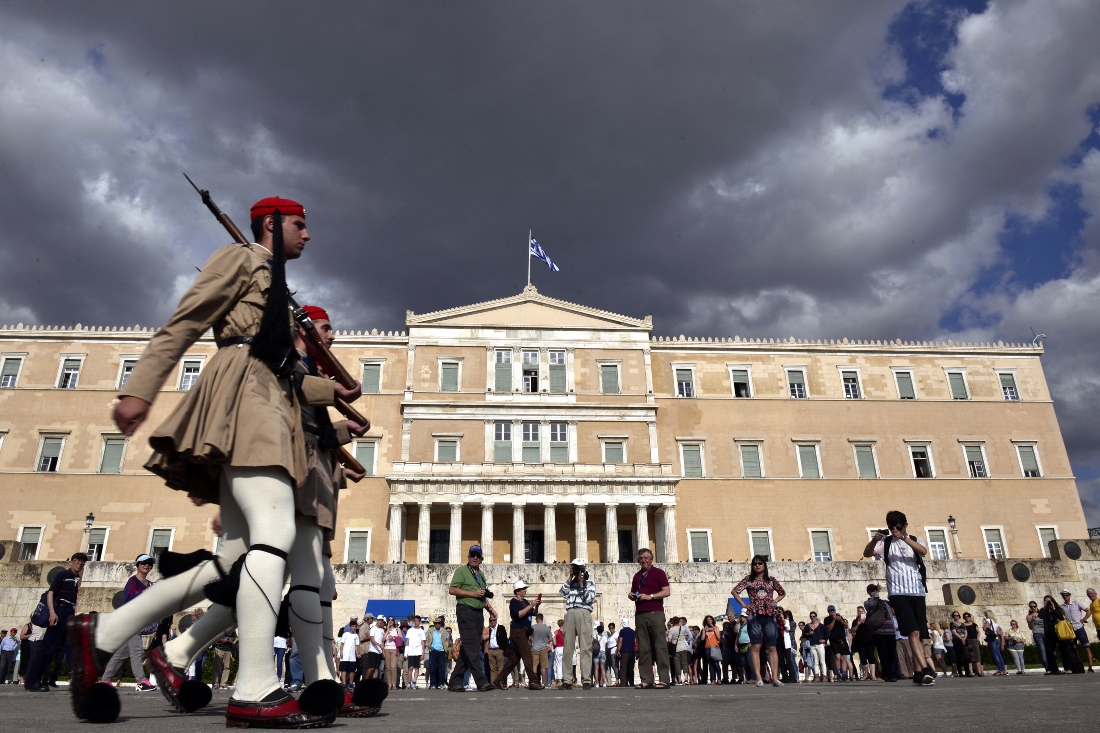
Evzoni presidential guards walking in front of the parliament of Greece in Athens. (AFP)
The Greek War of Independence, which began in 1821, led to the creation of the modern Greek state, which was recognized by the Ottomans in 1829 and by the international community in 1830.
Greece’s territory grew between 1864 and 1947, and in 1981 it became a full member of the European Community, enhancing the stability of the country’s democracy and establishing it as a critical state in the Balkans and eastern Mediterranean.
Barely two centuries after the war of independence, Greece is viewed as a pillar of stability and prosperity for the wider region of southern Europe and the eastern Mediterranean, and an EU member state. In recent years, Greece has instituted key infrastructural upgrades, including the digital state and new labor framework, transforming itself into a very competitive investment destination. Nonetheless, Greece has faced its share of internal and external crises.
For most of its modern history it has been deeply polarized, financially dependent and indebted to foreign creditors, and facing external threats. The debt crisis of 2009 onward brought the nation to the very brink of crashing out of the eurozone.
Greece was in the process of a slow return to growth after years of austerity when the COVID-19 pandemic hit in early 2020. This coincided with another turbulent period in Greek-Turkish relations.
The two states have a long and troubled history. Indeed, modern Turkey was established on the back of a victory against Greek forces in the aftermath of the First World War. The participation of both states in NATO since 1952 has not eased relations since they each have outstanding issues concerning the Aegean Sea and Cyprus. The two disagree on the boundaries of their territorial waters and, in turn, disagree on the extent of their exclusive economic zones.

keywords


