About 2,500 Boeing workers reject deal, vote to go on strike

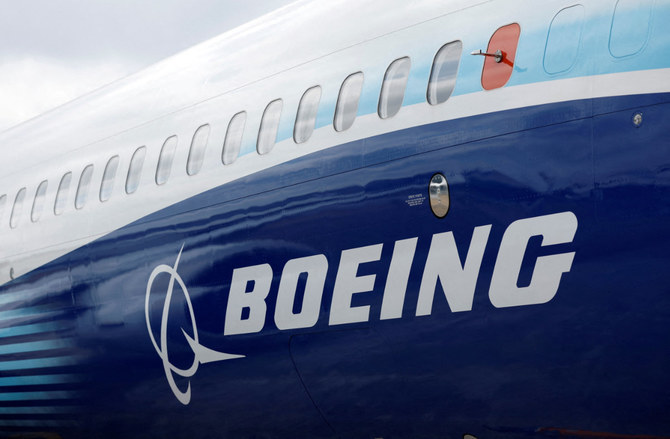
Boeing workers have accused the company of offering a deal that was not fair and equitable. (Reuters photo)
Short Url
Updated 25 July 2022
Follow

About 2,500 Boeing workers reject deal, vote to go on strike

  • Boeing saus the  ompany’s contract offer included competitive raises and a generous retirement plan 

ST. CHARLES, Missouri: Roughly 2,500 Boeing workers are expected to go on strike next month at three plants in the St. Louis area after they voted Sunday to reject a contract offer from the plane maker.
The strike is planned to begin Aug. 1 at Boeing manufacturing facilities in St. Charles County, St. Louis County and Mascoutah, Illinois, after the International Association of Machinists and Aerospace Workers District 837 union voted down the contract, according to the St. Louis Post-Dispatch.
“We cannot accept a contract that is not fair and equitable, as this company continues to make billions of dollars each year off the backs of our hardworking members,” the union said.
Boing said in a statement that the Arlington, Virginia-based company is disappointed in the vote, but it will now use its “contingency plan to support continuity of operations in the event of a strike.”
A Boeing spokesman said the company’s contract offer included competitive raises and a generous retirement plan that included Boeing matching employee contributions to their retirement plan up to 10 percent of their pay.
Boeing is expected to give an update on its finances this week when it releases its next quarterly earnings report on Wednesday. Earlier this year, Boeing reported a $1.2 billion loss in the first quarter, but just last week the company announced that Delta Air Lines had ordered 100 of its 737 airplanes.


Egypt defies African FDI trend with inflows of $11bn in 2025: UNCTAD 

Updated 4 sec ago
Follow

Egypt defies African FDI trend with inflows of $11bn in 2025: UNCTAD 

RIYADH: Egypt emerged as Africa’s top destination for foreign direct investment in 2025, attracting an estimated $11 billion in inflows in a year marked by declining investment across the continent. 

According to UNCTAD’s latest Global Investment Trends Monitor, the North African country ranked ahead of other major African economies despite a sharp regional slowdown. 

The performance underscores Egypt’s relative resilience at a time when foreign investment into Africa has normalized following an unusually strong 2024, which UNCTAD said was inflated by a single large project. As a result, the 2025 data reflects a return to more typical investment levels across the continent. 

“Among African economies, inflows to Angola reached an estimated $3 billion, marking a return to positive values after nine consecutive years of net divestments,” the report stated. 

It added: “Egypt, with inflows of $11 billion, remained the largest FDI host country in Africa.”  

While Egypt solidified its position as Africa’s leading FDI host, other notable movements on the continent included Mozambique, where inflows surged 80 percent to $6 billion, driven by renewed activity in major liquified natural gas projects.  

Angola also saw a positive shift, recording an estimated $3 billion in FDI after nine consecutive years of net divestments. 

UNCTAD noted that Egypt’s strength extended beyond headline inflows, with the country also contributing to an increase in greenfield investment activity across Africa. While the number of greenfield projects fell globally and across most lower-income economies, Africa recorded a 5 percent increase in project numbers in 2025, supported in part by growth in Egypt and Côte d’Ivoire. 

Globally, FDI flows rose by 14 percent in 2025 to approximately $1.6 trillion, though growth was heavily concentrated in developed economies, which saw a 43 percent increase.  

In contrast, flows to developing economies declined by 2 percent, with the least developed countries particularly affected; three-quarters experienced stagnant or falling investment. 

The report highlighted that new project announcements remained weak globally amid elevated policy uncertainty, with international project finance declining for the fourth consecutive year.  

Looking ahead, UNCTAD warned that geopolitical tensions, regional conflicts, and economic fragmentation could continue to suppress real investment activity in 2026, even as financing conditions are expected to ease.  

For Africa, sustaining FDI inflows will require navigating persistent challenges such as financing constraints, risk perceptions, and structural vulnerabilities.