Al Qaeda affiliate claims attack on Mali’s main military base

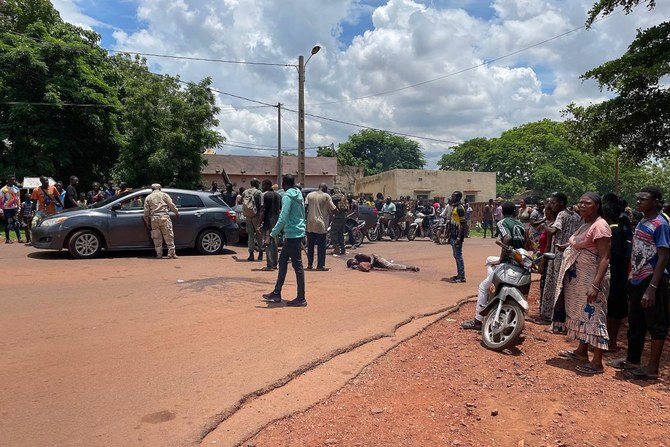
The Malian army said it thwarted a “terrorist” attack on the outskirts of the capital where a key base used by the ruling military is located. (AFP)
Short Url
Updated 23 July 2022
Follow

Al Qaeda affiliate claims attack on Mali’s main military base

  • Raid on Kati base represented the first time in Mali’s decade-long insurgency that Islamists hit a military camp close to Bamako
  • The attack killed at least one soldier and wounded six

DAKAR: Al Qaeda’s affiliate in Mali claimed responsibility on Saturday for an attack on the country’s main military base, which it said was a response to governmental collaboration with Russian mercenaries.
Friday’s raid on the Kati base 15 km (10 miles) outside the capital Bamako killed at least one soldier and represented the first time in Mali’s decade-long insurgency that Islamist militants have hit a military camp so close to Bamako.
The raid, carried out using two car bombs, also wounded six people, while seven assailants were killed and eight arrested, Mali’s military said.
The media unit for Al-Qaeda’s local affiliate, Jama’at Nusrat Al-Islam wal Muslimeen (JNIM), said in a statement its Katiba Macina branch had carried out the attack, according to a translation by the SITE Intelligence Group, which monitors jihadist statements.
The Malian military had blamed Katiba Macina for the attack in a statement on Friday.
The JNIM statement said a Malian fighter had detonated a car bomb at the base’s gate and a fighter from Burkina Faso detonated another inside the base, allowing additional fighters to enter the camp.
It justified the attack by citing the presence in Mali of mercenaries from Russia’s Wagner Group, which began supplying hundreds of fighters last year to support the Malian military and has since been accused by human rights groups and local residents of participating in massacres of civilians.
“We say to the Bamako government: if you have the right to hire mercenaries to kill the defenseless innocent people, then we have the right to destroy you and target you,” it said.
The Russian government has acknowledged Wagner personnel are in Mali but the Malian government has described them as instructors from the Russian military rather then private security contractors. Wagner has no public representation and has not commented on the accusations of human rights violations.
In a separate statement on Saturday, JNIM also claimed responsibility for attacks in five central and southern Mali towns on Thursday, which the Malian military said had killed one soldier and wounded 15.


Kosovo voters cast ballots in a second attempt this year to elect a government and avoid more crisis

Updated 58 min 32 sec ago
Follow

Kosovo voters cast ballots in a second attempt this year to elect a government and avoid more crisis

  • The prime minister’s party is again the favorite in the race, but it is unclear whether it will manage to muster a majority this time in the 120-member parliament

PRISTINA: Voters in Kosovo cast ballots on Sunday in an early parliamentary election in hopes of breaking a political deadlock that has gripped the small Balkan nation for much of this year.
The snap vote was scheduled after Prime Minister Albin Kurti’s governing Vetevendosje, or Self-Determination, party failed to form a government despite winning the most votes in a Feb. 9 election.
The deadlock marked the first time Kosovo could not form a government since it declared independence from Serbia in 2008 following a 1998-99 war that ended in a NATO intervention.
The prime minister’s party is again the favorite in the race, but it is unclear whether it will manage to muster a majority this time in the 120-member parliament, after other mainstream parties refused an alliance.
According to Kosovo’s election laws, 20 parliamentary seats are automatically assigned to ethnic Serb representatives and other minority parties.
Another inconclusive vote would further deepen the crisis. Kosovo has already not approved a budget for next year, sparking fears of possible negative effects on the already poor economy in the country of 2 million people.
Lawmakers are set to elect a new president in March as current President Vjosa Osmani’s mandate expires in early April. If this fails too, another snap election must be held.
The main opposition parties are the Democratic League of Kosovo and the Democratic Party of Kosovo. They have accused Kurti of authoritarianism and of alienating Kosovo’s US and European Union allies since he came to power in 2021.
A former political prisoner during Serbia’s rule in Kosovo, the 50-year-old Kurti has taken a tough stand in talks mediated by the European Union on normalizing relations with Belgrade. In response, the EU and the United States imposed punitive measures.
Kurti has promised to buy military equipment to boost security.
No reliable pre-election polls have been published. Kurti’s party at the previous election won around 42 percent of the votes while the two main rival parties had together around 40 percent.
Analysts say that even the slightest changes in numbers on Sunday could prove decisive for the future distribution of power but that nothing is certain.
Tensions with restive ethnic Serbs in the north exploded in clashes in 2023 when scores of NATO-led peacekeepers were injured. In a positive step, ethnic Serb mayors this month took power peacefully there after a municipal vote.
Kurti has also agreed to accept third-country migrants deported from the United States as part of tough anti-immigration measures by the administration of President Donald Trump. One migrant has arrived so far, authorities have told The Associated Press.
Kosovo is one of the six Western Balkan countries striving to eventually join the EU, but both Kosovo and Serbia have been told they must first normalize relations.