

Smoldering Beirut port silo at risk of collapse as grain ignites

1 / 4
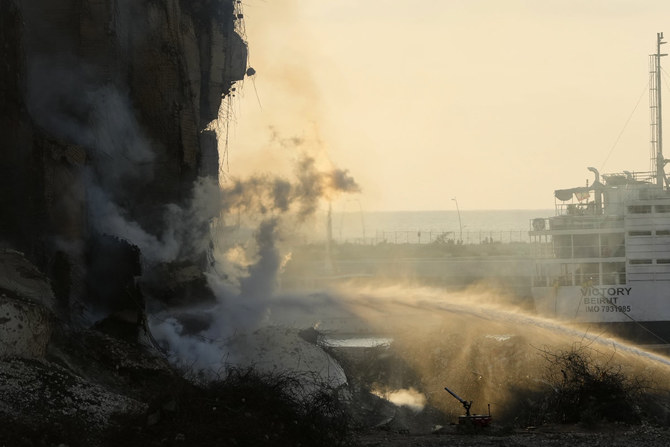
Firefighters extinguish a fire at the silos in the north block of the Beirut Port in Beirut on July 21, 2022. (AP)
2 / 4
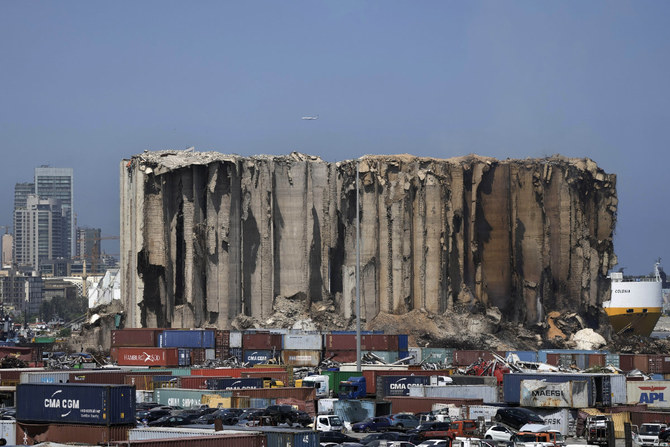
General view of fire-hit grain silos at Beirut port, Lebanon, on July 22, 2022. (AP Photo/Hassan Ammar)
3 / 4
General view of fire-hit grain silos at Beirut port, Lebanon, on July 22, 2022. (AP Photo/Hassan Ammar)
4 / 4
A view of the silos in the north block of the Beirut Port blackened by a dayslong fire on July 22, 2022. (AP)
Short Url
Updated 22 July 2022
Follow

Smoldering Beirut port silo at risk of collapse as grain ignites

  • Fire rages as Lebanon suffers from worsening wheat and bread shortages
  • Silos survived deadly port blast and ‘stand as a witness to a crime that affected everyone’

BEIRUT: A massive silo holding thousands of tons of grain at Beirut port is at risk of collapse because of a fire that has been smoldering for weeks amid Lebanon’s summer heat.

Flames and thick black smoke could be seen rising from the silo after the blaze flared up on Friday.

The fire prompted a warning by Lebanon’s Prime Minister Najib Mikati to “workers and members of the civil defense and the fire brigade not to approach the location for their safety and to avoid endangering their lives.”

Recent high temperatures are believed to have caused wheat in the silo — one of two massive structures that withstood the deadly blast at Beirut’s port two years ago — to ferment, igniting thousands of tons of grain.

Reports by the ministries of interior, economy, public works and environment have warned that “parts of the left side of the silo might be at risk of collapse.”

The threat to the silo is causing growing alarm among port workers and management of the facility.

Smoke and flames at the site also revive the painful memory of the deadly explosion that shook the port on Aug. 4, 2020.

Caretaker Interior Minister Bassam Mawlawi has asked the fire brigade and civil defense to immediately start “cooling down” the wheat silos.

While the Lebanese look on helplessly as the last of the wheat stored in the silo burns, mills and bakeries around the country are struggling with an acute shortage of subsidized flour used to make Lebanese pita bread.

Caretaker Economy Minister Amin Salam said that 50,000 tons of wheat will arrive in Lebanon in the coming 10 days, ensuring a six-week supply.

Seven mills out of 11 have closed because they ran out of subsidized wheat, according to a bakery owners’ syndicate.

The presence of more than 500,000 tourists in Lebanon is adding to the strain on bread supplies, it added.

Meanwhile, the silo fire has revived simmering tensions between families of the port blast victims and government bodies.

Last April, government agencies recommended the silos be demolished due to the risks the structures pose to the surrounding area.

However, families and activists reject the demolition, saying that it will destroy “one of the main landmarks of the biggest explosion witnessed by Lebanon,” according to the Order of Engineers.

The silos “stand as a witness to a crime that affected everyone,” it said.

The Order of Engineers has called for work to “consolidate the affected silos.”

Experts say that the fire will die down eventually, but have warned against using water to fight the blaze, saying this might accelerate the fermentation process.

Political, security, judicial and military officials continue to blame each other for the port explosion.

Judicial investigations into the crime were suspended last November, due to political interventions and lawsuits filed against judge Tarek Bitar, who is heading the inquiry.

Defendants, including former MPs and ministers, are calling for Bitar to be removed from the case.

In a briefing submitted to the Security Council on Thursday, the UN special coordinator for Lebanon, Joanna Wronecka, highlighted “the absence of progress in the judicial measures related to the Beirut port explosion case, which further saddens the families of the dead and wounded.”

Wronecka demanded that “hindrances obstructing the judicial course be removed, and a comprehensive and transparent investigation into the case be carried out.”


Israel’s settler movement takes victory lap as a sparse outpost becomes a settlement within a month

Updated 59 min 18 sec ago
Follow

Israel’s settler movement takes victory lap as a sparse outpost becomes a settlement within a month

  • Smotrich, who has been in charge of Israeli settlement policy for the past three years, has overseen an aggressive construction and expansion binge aimed at dismantling any remaining hopes of establishing a Palestinian state in the occupied West Bank

YATZIV SETTLEMENT, West Bank: Celebratory music blasting from loudspeakers mixed with the sounds of construction, almost drowning out calls to prayer from a mosque in the Palestinian town across this West Bank valley.
Orthodox Jewish women in colorful head coverings, with babies on their hips, shared platters of fresh vegetables as soldiers encircled the hilltop, keeping guard.
The scene Monday reflected the culmination of Israeli settlers’ long campaign to turn this site, overlooking the Palestinian town of Beit Sahour, into a settlement. Over the years, they fended off plans to build a hospital for Palestinian children on the land, always holding tight to the hope the land would one day become theirs.
That moment is now, they say.
Smotrich goes on settlement spree
After two decades of efforts, it took just a month for their new settlement, called “Yatziv,” to go from an unauthorized outpost of a few mobile homes to a fully recognized settlement. Fittingly, the new settlement’s name means “stable” in Hebrew.
“We are standing stable here in Israel,” Finance Minister and settler leader Bezalel Smotrich told The Associated Press at Monday’s inauguration ceremony. “We’re going to be here forever. We will never establish a Palestinian state here.”
With leaders like Smotrich holding key positions in Israel’s government and establishing close ties with the Trump administration, settlers are feeling the wind at their backs.
Smotrich, who has been in charge of Israeli settlement policy for the past three years, has overseen an aggressive construction and expansion binge aimed at dismantling any remaining hopes of establishing a Palestinian state in the occupied West Bank.
While most of the world considers the settlements illegal, their impact on the ground is clear, with Palestinians saying the ever-expanding construction hems them in and makes it nearly impossible to establish a viable independent state. The Palestinians seek the West Bank, captured by Israel in 1967, as part of a future state.
With Netanyahu and Trump, settlers feel emboldened
Settlers had long set their sights on the hilltop, thanks to its position in a line of settlements surrounding Jerusalem and because they said it was significant to Jewish history. But they put up the boxy prefab homes in November because days earlier, Palestinian attackers had stabbed an Israeli to death at a nearby junction.
The attack created an impetus to justify the settlement, the local settlement council chair, Yaron Rosenthal, told AP. With the election of Israel’s far-right government in late 2022, Trump’s return to office last year and the November attack, conditions were ripe for settlers to make their move, Rosenthal said.
“We understood that there was an opportunity,” he said. “But we didn’t know it would happen so quickly.”
“Now there is the right political constellation for this to happen.”
Smotrich announced approval of the outpost, along with 18 others, on Dec. 21. That capped 20 years of effort, said Nadia Matar, a settler activist.
“Shdema was nearly lost to us,” said Matar, using the name of an Israeli military base at the site. “What prevented that outcome was perseverance.”
Back in 2006, settlers were infuriated upon hearing that Israel’s government was in talks with the US to build a Palestinian children’s hospital on the land, said Hagit Ofran, a director at Peace Now, an anti-settlement watchdog group, especially as the US Agency for International Development was funding a “peace park” at the base of the hill.
The mayor of Beit Sahour urged the US Consulate to pressure Israel to begin hospital construction, while settlers began weekly demonstrations at the site calling on Israel to quash the project, according to consulate files obtained through WikiLeaks.
It was “interesting” that settlers had “no religious, legal, or ... security claim to that land,” wrote consulate staffer Matt Fuller at the time, in an email he shared with the AP. “They just don’t want the Palestinians to have it — and for a hospital no less — a hospital that would mean fewer permits for entry to Jerusalem for treatment.”
The hospital was never built. The site was converted into a military base after the Netanyahu government came to power in 2009. From there, settlers quickly established a foothold by creating makeshift cultural center at the site, putting on lectures, readings and exhibits
Speaking to the AP, Ehud Olmert, the Israeli prime minister at the time the hospital was under discussion, said that was the tipping point.
“Once it is military installation, it is easier than to change its status into a new outpost, a new settlement and so on,” he said.
Olmert said Netanyahu — who has served as prime minister nearly uninterrupted since then — was “committed to entirely different political directions from the ones that I had,” he said. “They didn’t think about cooperation with the Palestinians.”
Palestinians say the land is theirs
The continued legalization of settlements and spiking settler violence — which rose by 27 percent in 2025, according to Israel’s military — have cemented a fearful status quo for West Bank Palestinians.
The land now home to Yatziv was originally owned by Palestinians from Beit Sahour, said the town’s mayor, Elias Isseid.
“These lands have been owned by families from Beit Sahour since ancient times,” he said.
Isseid worries more land loss is to come. Yatziv is the latest in a line of Israeli settlements to pop up around Beit Sahour, all of which are connected by a main highway that runs to Jerusalem without entering Palestinian villages. The new settlement “poses a great danger to our children, our families,” he said.
A bypass road, complete with a new yellow gate, climbs up to Yatziv. The peace park stands empty.