Israeli leader warns Hezbollah during visit to border

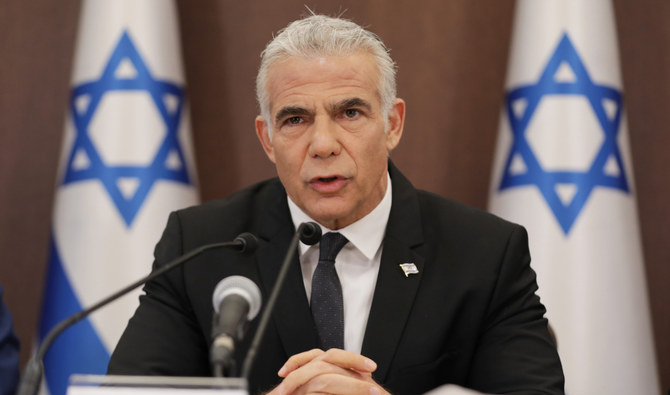
Israeli Prime Minister Yair Lapid speaks during a cabinet meeting at the prime minster's office in Jerusalem, Sunday, July 17, 2022. (AP/File)
Short Url
Updated 20 July 2022
Follow

Israeli leader warns Hezbollah during visit to border

  • The visit came at a time of heightened tensions with Hezbollah, a heavily armed group that fought Israel during a monthlong war in 2006

JERUSALEM: Israel’s new prime minister paid an unannounced visit to the border with Lebanon on Tuesday, threatening to unleash a harsh military response to what he described as “unacceptable” aggression by the Lebanese militant Hezbollah group.

The visit came at a time of heightened tensions with Hezbollah, a heavily armed group that fought Israel during a monthlong war in 2006.

On Monday, Israel said it intercepted a drone that crossed from Lebanese territory, and last week, Hezbollah’s leader threatened Israel with military escalation if a dispute over a maritime border is not resolved in Lebanon’s favor.

“Israel is prepared to act against any threat,” said Yair Lapid, who took over Israel’s caretaker prime minister on July 1.

“We have no interest in escalation but Hezbollah’s aggression is unacceptable and is liable to lead the entire region into an unnecessary escalation.”

He was joined by Israeli Defense Minister Benny Gantz and top military officials as he toured the area.

Israel considers Hezbollah its most serious immediate threat, estimating the Iranian-backed group has some 150,000 rockets and missiles aimed at Israel.

Earlier this month, the Israeli military said it shot down three unmanned aircraft launched by Hezbollah heading toward an area where an Israeli gas platform was recently installed in the Mediterranean Sea.

Hezbollah confirmed it had launched three unarmed drones toward the disputed maritime area.

The launch of the drones appeared to be an attempt by Hezbollah to influence US-brokered negotiations between Israel and Lebanon over their maritime border, an area that is rich in natural gas.

Last week, Hezbollah’s leader, said Lebanon should be able to extract oil and gas in Lebanese waters and warned that sending the drones was “a modest beginning to where the situation could be heading.”


Syrian and Lebanese presidents discuss border security after Hezbollah strikes hit west Damascus

Updated 5 sec ago
Follow

Syrian and Lebanese presidents discuss border security after Hezbollah strikes hit west Damascus

  • Ahmad Al-Sharaa expresses Syria’s absolute support for Lebanese government’s efforts to disarm the Iran-backed militant group

LONDON: The Syrian president, Ahmad Al-Sharaa, and his Lebanese counterpart, Joseph Aoun, discussed border security on Tuesday.

It came as Syria accused the Iran-backed militant group Hezbollah of massing reinforcements close to the border, targeting army positions in Syria, and launching artillery shells from Lebanese territory that landed near the town of Serghaya, west of the capital Damascus.

During his conversation with Aoun, Al-Sharaa expressed his absolute support for the Lebanese government’s efforts to disarm Hezbollah, the Syrian Arab News Agency reported. Depriving the group of its weapons was a crucial step in efforts to strengthen the sovereignty of Lebanon and protect the region from the consequences of ongoing armed conflicts, he added.

The two leaders also emphasized the need for joint action to ensure the safety of the Syrian people.

Thousands of Syrians who fled to Lebanon to escape the 13-year civil war in their country have returned home since the US and Israel launched strikes against Iran on Feb. 28, and the spread of the conflict to other parts of the Middle East.

Israel has launched strikes against Israel and several Arab countries in the region, while Hezbollah, an ally of Tehran which the UK and other nations consider a terrorist organization, has also fired into Israel.

Israeli forces have hit back against Hezbollah with strikes on southern Lebanon and southern Beirut, and its forces have occupied key areas south of the Litani River.